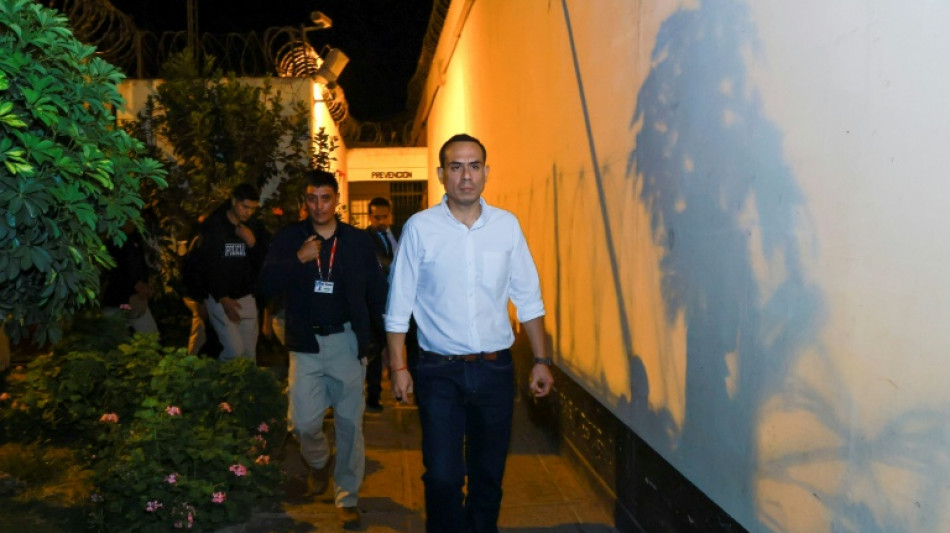
Peru's interim president embraces the spotlight in 'war' on crime / Photo: JAIRO DIAZ - Peruvian Presidency/AFP/File

 Albanian PM rallies support as Trump-linked resort row festers

 Boulter stuns Rybakina to reach Queen's Club semi-finals

 When Hockney told AFP about his lockdown 'blessing' in France

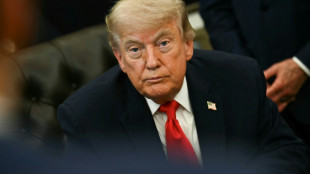
 Trump calls US World Cup team before first match

 'We're over it': Wemby says Spurs focused on game five after historic loss

 Cuba opens more sectors to private business

 Ghana World Cup player Partey, facing rape trial in UK, denied Canada visa: FIFA
 Judge rejects bid to halt removal of Trump name from Kennedy Center

 World's first gig economy treaty adopted at the ILO

 World Cup struggles to ignite US excitement
 Premier League changes hair-pulling punishment for new season

 McLaren's Norris pips Russell in second Barcelona F1 practice

 Florence's Giotto frescoes restored to glory after renovation

 Whole England squad must feel 'loved' at World Cup: Bellingham

 Iran says deal with US closer than ever as Trump lashes out

 Contemporary art giant David Hockney dies aged 88

 Van Gils claims Auvergne Tour stage as Tuckwell moves into overall lead
 Ebola spreading into new areas in northeast DR Congo: WHO
 Kennedy Center board, Justice Dept appeal order to remove Trump's name

 Wall Street wobbles as SpaceX shares launch, oil slides on Mideast deal hopes

 US deportation flight carrying Iranians en route to C.African Republic
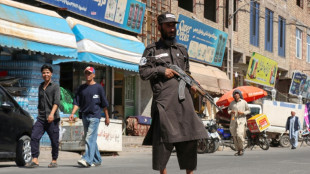
 'I don't want to limit myself': Chinese star Xin Zhilei on new experiences

 Ronaldo 'very positive' as Portugal head for World Cup

 Mercedes' Russell quickest in opening Barcelona F1 practice
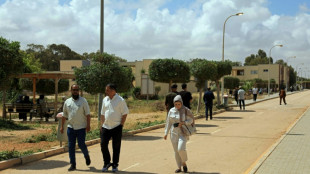
 O'Callaghan and Short star at Australian swim trials
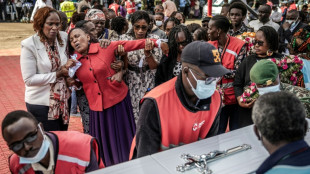
Like a veritable action hero, Peru's interim president rolls up his sleeves to take part in nighttime raids on prisons and in the street, always making sure his bravado is captured on camera.
Jose Jeri -- barred from seeking election next year due to a constitutional one-term limit -- has made crime the focus of what will be a short presidency ending in July.
As the 39-year-old seeks to stabilize a government rocked by anti-crime protests and political turmoil that led to the ouster last month of his predecessor, Dina Boluarte, Jeri has opted for a tough approach to what many perceive to be the country's biggest challenge: crime.
"We are in the streets, on the ground," the former speaker of Congress boasted during a recent operation, insisting that finally a government was "addressing the problem directly."
Many Peruvians blamed Boluarte for a surge in graft and criminality, particularly extortion, giving rise to protests led by Gen Z demonstrators that left dozens injured and at least one dead.
The unrest triggered Boluarte's impeachment, and Jeri was sworn in on October 10 as Peru's seventh president since 2017.
For some, his strategy seems to be working.
"Something has changed compared to the previous government, whose presence was barely noticeable and didn't engage in dialogue with anyone," Carmen Zuniga, the 50-year-old manager of a community kitchen in Lima, told AFP.
Jeri has drawn comparisons to El Salvador's gang-busting President Nayib Bukele -- who is criticized by rights groups for rounding up innocents in his war on crime even as he is praised by many at home for making life safer.
Throwing rights concerns out of the window, Peru's new president restricted family visits for inmates considered dangerous, and imposed a mobile blackout to prevent gangsters from using phones from prison to run their extortion schemes.
He does not like the comparison to Bukele. "I am Jose Jeri. Everyone has their own personality and style," he said recently.
- 'We must declare war' -
According to a Datum poll from February, 55 percent of Peruvians approve of Bukele's iron-fisted approach.
More recently, an Ipsos poll found that 45 percent of respondents were in favor of Jeri's actions, only slightly more than the 42 percent who were not.
Often dressed in jeans and a white collared shirt with rolled-up sleeves, Jeri has sought to cultivate an image as a man of action, posing for cameras along with law enforcement officials.
He set the tone from his very first speech, saying: "The main enemy is out there, in the streets. It's the criminal gangs... and we must declare war on them."
Just over a week after he was sworn in, Jeri declared a 30-day state of emergency in Lima and the neighboring port of Callao, authorizing the army to patrol the streets and carry out arrests without warrants.
Boluarte had taken a similar measure, with limited effect.
The results of Jeri's approach are unclear: he has yet to disclose any statistics.
"What I've seen are only populist measures... They are not effective as extortions and murders continue," 20-year-old engineering student Jose Rodriguez told AFP in the capital.
Peru is gripped by a wave of extortion that has claimed dozens of lives, particularly of bus drivers -- some shot at the wheel if their companies refuse to pay protection money.
Experts say the practice has taken off amid high levels of post-pandemic poverty and unemployment, political instability following the 2022 ouster of president Pedro Castillo, and the domestic rise of gangs such as Venezuela's Tren de Aragua.
Since the beginning of the year, 56 bus drivers have been killed, according to the public prosecutor's office -- several of them since Jeri took office.
"Jeri's imitation of Bukele may be effective in the short term," said Ricardo Valdes, director of Capital Humano y Social Alternativo, a human rights NGO.
"It's a clever communication strategy... but it creates expectations and could collapse due to its inefficiency," he added.
A.AbuSaada--SF-PST