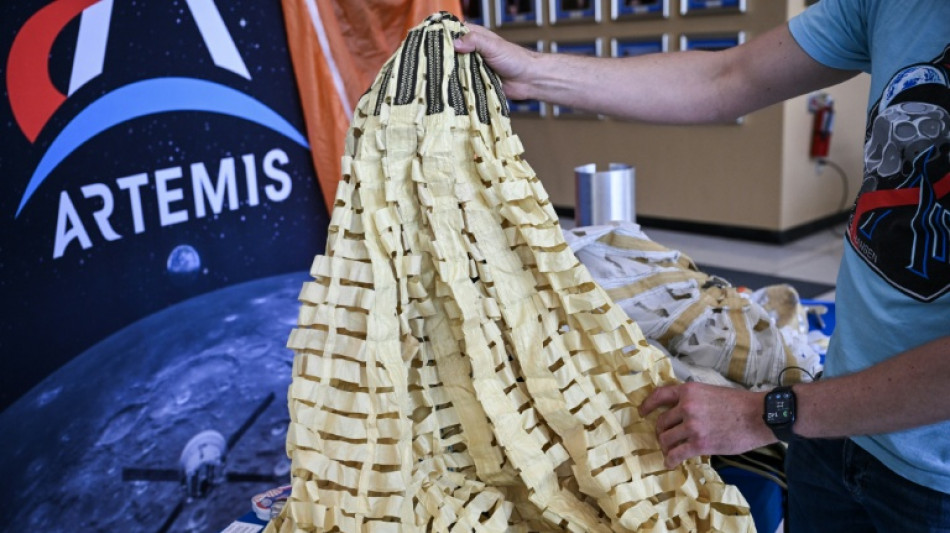
Parachutes: A vital part of Artemis II's trip home / Photo: RONALDO SCHEMIDT - AFP

 'Severe drought' declared in parts of UK
 IUX Announces New Web Client Portal Built for Enhanced Browser-Based Trading

 School roof collapse kills teacher, 32 children in NW Pakistan

 Inter skipper Martinez facing month out with thigh injury

 Spanish prosecutors back abuse probe into Julio Iglesias

 Tech sell-off deepens as US inflation sparks AI jitters

 Southgate does not forsee a return to management

 Two dead as Istanbul endures heaviest rainfall in 80 years

 After latest Nepal flood, survivors fear for future

 EU leaders clash over budget as spectre of French elections looms
 'No place to breathe': life in Indonesia's fire epicentre

 'Can't sleep': Spain's housing crunch upends lives

 Musk calls on Ukraine's Zelensky to 'go' after satellite slowdown row
 Still smiling at 117, Albanian may be world's oldest woman

 Pope has 'good night' in hospital: Vatican

 China's economy seen missing target as global shocks bite: AFP poll

 Costa Rica opens jail inspired by El Salvador mega-prison

 Same-sex couple takes fight for equality to Slovakian court

 'High hopes' as Indonesian women get a football league, again

 'Expectations high' for Bordeaux-Begles' Champions Cup hat-trick bid, says Depoortere

 Rennie urges All Blacks to stay focused against 'hurting' Wallabies

 Palmeiras beat Fluminense 2-1 in Libertadores semi-final first leg

 Brewers blasts leave Dodgers on brink

 Tech stock lead rout after US inflation fuels rate hike bets
 Al-Fayed survivors say UK police missing 'bigger picture'

As the Orion spacecraft hurtles home, friction caused by re-entry into Earth's atmosphere will drastically decrease its speed from a potential 25,000 miles per hour (40,000 kilometers per hour).
But for a gentle, 17-mile-per-hour (27-kph) impact in the Pacific Ocean, Orion and the humans onboard need parachutes.
Artemis II is scheduled to splash down off the southern California coast at 5:07 pm local time (0007 GMT) after the most dangerous part of its mission -- re-entry.
Jared Daum, the parachute system manager for Artemis II, explains how it will work in comments to AFP that have been lightly edited for clarity.
Q: What is the role of parachutes during re-entry?
A: The heat shield gets us down to 350 miles per hour (560 kph), but that's all the heat shield can do due to the mass of the vehicle. So at that point we need something more.
So at 24,000 feet (7,300 meters), we start the deployment sequence to get us down to the water. The parachute system, in my opinion, is one of the most important systems on the spacecraft.
It decelerates the vehicle from about 350 miles per hour to about 17 miles per hour for a nice soft landing for the crew in the Pacific Ocean.
Q: How does it work?
A: [It's] a series of four types of parachutes, 11 total, starting with what we call the forward bay cover parachute. It's all Kevlar, about seven feet (two meters) in diameter, and its job is to lift off the cover to expose the rest of our hardware.
[Next] we have two mortar-deployed drogue parachutes, each about 23 feet (7 meters) in diameter. Their job is to stabilize and decelerate the vehicle from that 350 down to about 150 miles per hour (240 kph).
The [three] pilot parachutes [deployed next] are about nine feet (2.7 meters) in diameter, and their only job is to lift up our three main parachutes. Each main parachute is about 300 pounds (136 kg) and 11,000 square feet (1,022 square meters).
As we get into our larger parachutes, like the drogues and the mains, we have a lighter-weight nylon ... not unlike what you might build a tent out of, or an old-school windbreaker. It's very light but strong enough to produce the drag that we need to decelerate.
As the capsule splashes down, the parachutes will instantaneously deflate when the risers are severed ... and we'll see the parachutes fall into the ocean.
The flight software deploys the first parachutes all the way down through the main parachutes. Of course the crew has the ability to manually command the chutes ... if for some reason we have low confidence in the flight software.
Q: Is there a plan B?
A: Redundancy is key with spaceflight. It's not like you can drive your car down the road, get a flat tire, pull over, fix it and keep going. With these parachutes you have one shot and it's got to work then.
So we have redundancy built into each of the four types of parachutes. We can lose one forward bay cover parachute, one drogue, one pilot and one main parachute, and the astronauts will still have a safe landing.
Without the parachutes, the crew would have no safe way to get back. This vehicle is designed to use parachutes, as are all of our crewed spacecraft from now all through previous history.
K.AbuDahab--SF-PST