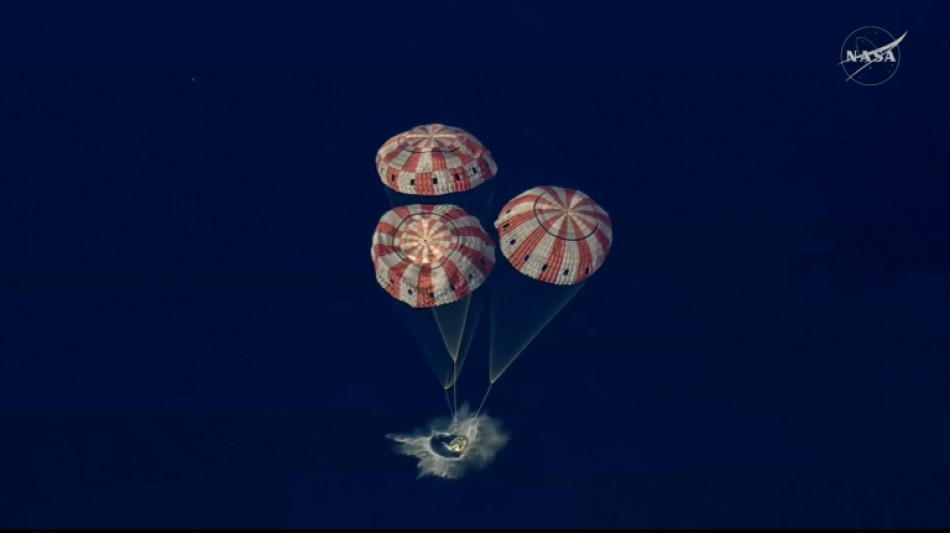
'A perfect mission': Artemis II astronauts return to Earth / Photo: - - NASA/AFP

 Two dead as Istanbul endures heaviest rainfall in 80 years

 After latest Nepal flood, survivors fear for future

 EU leaders clash over budget as spectre of French elections looms

 'No place to breathe': life in Indonesia's fire epicentre

 'Can't sleep': Spain's housing crunch upends lives

 Musk calls on Ukraine's Zelensky to 'go' after satellite slowdown row

 Still smiling at 117, Albanian may be world's oldest woman

 Pope has 'good night' in hospital: Vatican

 China's economy seen missing target as global shocks bite: AFP poll

 Costa Rica opens jail inspired by El Salvador mega-prison

 Same-sex couple takes fight for equality to Slovakian court

 'High hopes' as Indonesian women get a football league, again

 'Expectations high' for Bordeaux-Begles' Champions Cup hat-trick bid, says Depoortere

 Rennie urges All Blacks to stay focused against 'hurting' Wallabies

 Palmeiras beat Fluminense 2-1 in Libertadores semi-final first leg

 Brewers blasts leave Dodgers on brink

 Tech stock lead rout after US inflation fuels rate hike bets

 Al-Fayed survivors say UK police missing 'bigger picture'

 Online 'witch hunt' sweeps up Asians misidentified as US rape accused

 Prospect of Bolsonaro win looms large over Brazil's Indigenous

 Freed from Belarus, founder of Lady Gaga's biggest fan site tells his story

 Behind AI's carbon footprint, a potential climate tool

 Trump's new press secretary faces scrutiny over credentials

 PSG 'got lucky' to win Man City thriller, says Luis Enrique

 Real Madrid comeback stuns Roma as Mourinho enjoys happy reunion

The NASA spacecraft carrying four astronauts splashed down as planned Friday off the California coast, capping the US space agency's successful crewed test mission around the Moon, the first such flyby in more than 50 years.
Mission commander Reid Wiseman reported that the crewmembers -- himself along with Christina Koch, Victor Glover and Jeremy Hansen -- were "stable" and "green."
"They're in great condition, that's what that means," said Rob Navias, the NASA public affairs official who narrated their return on the agency's livestream.
Following a brief but nerve-wracking communications blackout during their high-stakes re-entry, Wiseman's voice triggered relief that the astronauts were well on their way back home.
"We have you loud and clear," he said following a voice check from mission control in Houston.
NASA and the US military will now help them leave the bobbing capsule, after which they will be flown to a recovery ship off the Pacific coast near San Diego.
As the astronauts returned to Earth their spacecraft reached maximum speeds more than 30 times the speed of sound, and faced searing temperatures around half as hot as the surface of the Sun. It was a key test of their heat shield, which in an earlier trial mission had faced complications.
But the Artemis II re-entry went off without a hitch.
"This was a textbook entry and a textbook touchdown," said Navias.
NASA administrator Jared Isaacman called the voyage "a perfect mission."
"We're back in the business of sending astronauts to the Moon," he said, and "this is just the beginning."
"We are going to get back into doing this with frequency, sending missions to the Moon until we land on it in 2028 and start building our base."
- Historic journey -
From liftoff to splashdown, the trip clocked in at nine days, one hour, 31 minutes and 35 seconds -- though NASA rounds up and calls it a 10-day mission.
It began with a dramatic launch from Florida on April 1, and was studded with firsts, records and extraordinary moments.
It was the inaugural crewed mission of NASA's program aiming to install a sustained presence on the Moon, including, as administrator Isaacman emphasized, the eventual construction of a base.
The second phase of the Artemis program was a test mission to verify the reliability of the Orion capsule, which before now had not carried humans.
The voyage also broke a record: the four astronauts become the humans to travel furthest away from the Earth, at 252,756 miles (406,771 kilometers).
While hurtling through deep space and zipping around the Moon the astronauts took thousands of photographs, amassing a stunning portfolio of images that captivated people on Earth.
They also witnessed a solar eclipse along with extraordinary meteorite strikes on the lunar surface, which left NASA scientists awe-struck.
Several achievements added to the voyage's historic nature: Glover was the first person of color to fly around the Moon, Koch was the first woman, and Canadian Hansen the first non-American.
- Vital heat shield -
The Orion capsule passed a key test: the re-entry stakes were particularly high given concerns that arose during Artemis I, when an uncrewed 2022 test flight to the Moon and back saw a crucial heat shield erode in unexpected ways.
To minimize risks this time around, NASA shifted the re-entry path they had used in the test mission, after determining it had played a role in the complications.
The astronauts returned at a steeper and thus shorter trajectory, which NASA officials in discussion with the astronauts concluded would reduce risk to an acceptable degree.
Still, the heat shield situation prompted uneasy comparisons to the Challenger and Columbia space shuttle disasters of 1986 and 2003 respectively, when astronauts died after warning signs were set aside.
The Orion capsule will now be painstakingly examined to assess how it fared.
But to the relief of NASA, the astronauts and their families along with the public at large, Artemis II completed a successful trip home, returning four still-healthy astronauts.
Loved ones were watching the descent from mission control in Houston, where the astronauts are due to reunite with their families, likely this weekend.
Q.Jaber--SF-PST