-
 US woman who survived botched execution is awake and speaking
-
Russia's plague scare: What we know

-
 From 1800s to modern pharma: a Nobel-winning chemistry quest
-
French luxury giant to fund redevelopment of two Paris streets: city hall

-
 Southampton boss Eckert given suspended ban over 'Spygate'
-
Trump wants to turn Florida golf course into presidential retreat

-
 Russia warns of 'false' information as second plague case reported
-
Mayor of Turkish opposition stronghold defects to Erdogan party

-
 IEA ready to release more oil reserves if necessary
-
Children among heavy casualties in Ukraine after Russian strikes

-
 HSBC 'consults' over UK unit job cuts amid AI adoption
-
Court orders German ex-spy chief kept in jail after spying, treason arrest
-
 UK court quashes five ex-traders' Libor rate rigging convictions
-
Guinea caps bottled water prices after sachets banned

-
 XM Receives “Global Customer Experience Leader Award 2026” at the TrustFinance Performance Awards
-
Spared, married, hanged: the last weeks of Iranian protester Alireza Sepahi
-
 Stocks slide as oil climbs on Mideast flareup
-
Nobel physics winner's pride at pioneering AI role

-
 Heavy casualties in Ukraine after Russian strikes
-
IMF preparing El Nino assistance, concerned about AI bubble burst: chief to AFP
-
 French wine harvest set to hit historic low
-
West must embrace 'national power' or face decline: Rubio

-
 Kyiv 'cannot agree' to EU membership limiting food exports: minister
-
Shell refining margins reach record highs as wars hit supply

-
 Arteta targets more Arsenal glory after signing new deal until 2030
-
Former Spain, Barca winger Pedro retires from football

-
 Russell hit with Singapore grid penalty for taking new power unit
-
Arteta signs new Arsenal deal until 2030

-
 Spotify expands audiobooks to more than 180 markets
-
Stocks decline as oil climbs on Mideast flareup

-
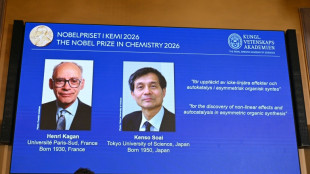 French-Japanese duo wins chemistry Nobel for solving molecular 'mystery'
-
Gauff says online abuse was 'draining' after China Open exit

-
 England's Nations League surge helps heal World Cup wounds
-
As sector struggles, Porsche puts luxury ahead of volume

-
 Mayor of opposition stronghold Izmir defects to Erdogan party
-
'It's personal': Fiji minister pushes better climate finance at pre-COP
-
 Mertens beats Gauff to set up Swiatek clash at China Open
-
Russia glosses over dark Soviet past in reinvented museum

-
 Benin full of pride at role in Messi's last dance
-
UK tax body opened probe into Man City in 2018: FT

-
 France suspends stun grenade use at student protests ahead of PM speech
-
Yemen's Houthis claim new attacks on Saudi airports as conflict deepens

-
 Indonesian court hears 'negligence' complaint against state over fires, haze
-
Germany factory production at highest level for 18 months

-
 Rubio in Greece to urge against Western civilisation 'decline'
-
Thailand floods death toll rises to 60 since mid-September

-
 Micron workers at Taiwan plant vote in favour of strike
-
US pushes Russia for information on plague reports

-
 In 'The Social Reckoning,' Jeremy Allen White takes on Facebook's 'frightening' ambition
-
Myanmar leader lands in Malaysia for migrant return talks

'Howl at the Moon': NASA's bid to boost space enthusiasm
When NASA flight director Zebulon Scoville was working a shift during the uncrewed Artemis I test flight, he realized the US space agency wasn't consistently livestreaming the spacecraft's journey to Earth.
"They said, well, we don't have bandwidth, we've got to get all this vehicle and engineering data down," Scoville recalled. "I was like -- wrong."
"This program will be over if people don't buy it and they don't come with us."
NASA eventually got a low-bandwidth live stream up for that 2022 uncrewed mission.
And once it was over, senior officials named the NASA veteran "imagery czar" to boost engagement.
He told AFP he spent two years working across the agency to figure out how better to take the public on NASA's new Moon missions.
That included adding an optical communications system onto the Orion spacecraft, a laser that transmitted to a ground station on Earth, sending streaming video in higher resolution.
Throughout the more than nine-day Artemis II crewed test flight -- which ended Friday with an emotional splashdown off the California coast -- NASA has maintained live programming on its own streaming platform and across social media.
That, combined with third-party streamers and broadcast news, has earned millions of views.
And as NASA official Lori Glaze said Friday: "To all of our new followers out there, please stay tuned."
- NASA on Twitch -
From social media posts clipped from livestreamed events with the astronauts to an extraordinary portfolio of celestial photographs, viewers caught an eyeful of Artemis II.
Insitutions including museums held Artemis splashdown parties, and some teachers integrated the launch into their lessons.
Alex Roethler, a Wisconsin physics teacher, said watching the mission helped his students get "more engaged," and made lessons "feel more real."
"I love having the livestream available, and I also think it's cool that they use Twitch," Roethler said, referring to a video streamer site favored by gamers. "That is a platform more of our students use."
The crew themselves have been integral to the storytelling.
During the nearly seven-hour lunar flyby, astronauts Christina Koch, Victor Glover, Jeremy Hansen and Reid Weisman gave near-literary descriptions of lunar surface features and left scientists in Houston awe-struck.
With Artemis II, there have been "just smiles and actually showing emotion through NASA, where we have sometimes had a history of being a little bit dry," Scoville said.
"It's okay to jump up and down and howl at the moon," he added.
- Apollo-Artemis parallels -
Before Artemis II, the United States hadn't sent astronauts around the Moon since 1972 for the Apollo 17 mission -- the last of that famed space program that saw humans walk on the lunar surface.
In the lead-up to the 10-day test flight, NASA faced both a blase populace and a fractured media environment.
The space agency had to battle for attention across traditional and social media in a way the three-TV-channel era of Apollo never experienced. The Apollo 11 Moon landing in 1969 saw approximately one-fifth of the global population tune in.
Yet for all the mythical qualities of Apollo, Jack Kiraly, director of government relations at the Planetary Society, said "nostalgia" perhaps "glosses over some of the issues that the program at the time faced."
"Everything that led up to that was actually broadly unpopular with the American electorate, with the public writ large," Kiraly told AFP.
Still, even with that in account, the analyst said "I don't think this moment is living up to the hype" of most Apollo missions, and added he hopes NASA's communications strategies continue to improve.
- 'Longing for something good' -
Ahead of Artemis II, Scoville had conversations with mission commander Reid Wiseman in which they reflected on parallels between the Apollo 8 lunar mission and this most recent Moon flyby.
The United States in 1968 was politically fractured and at war.
Nearly 60 years later, not so much has changed.
"We're watching the news today, with wars, with division, and, like, how much everyone is just so longing for something good to happen," Scoville said.
In a recent space-to-Earth press conference, Wiseman said their only news source during the mission was their families, who said Artemis has captivated people worldwide, though he admitted they are "biased."
Wiseman said he hoped the trip could "have the world pause" to take in the beauty of our planet and universe.
"I think for the folks that decided to tune in -- and it sounds like it was quite a few -- this has happened," he said.
Throughout their journey, all four astronauts emphasized how unified Earth looks from afar -- a takeaway they hoped would permeate public consciousness.
"People are wanting to reach out to their inner rocket nerds," Scoville said. "This is just a glimpse of what's to come."
T.Ibrahim--SF-PST