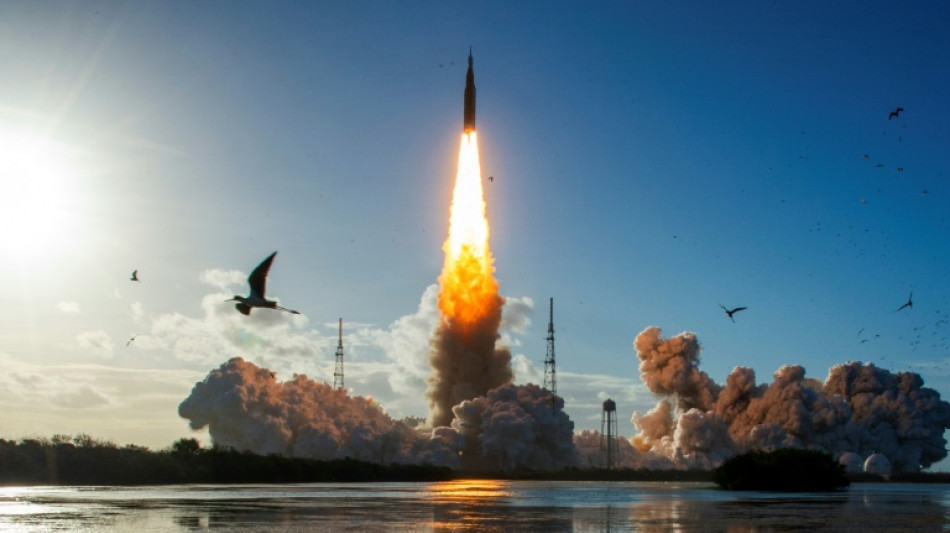
Top takeaways from the Artemis II mission / Photo: Jim WATSON - AFP

 Two dead as Istanbul endures heaviest rainfall in 80 years

 After latest Nepal flood, survivors fear for future

 EU leaders clash over budget as spectre of French elections looms

 'No place to breathe': life in Indonesia's fire epicentre

 'Can't sleep': Spain's housing crunch upends lives

 Musk calls on Ukraine's Zelensky to 'go' after satellite slowdown row

 Still smiling at 117, Albanian may be world's oldest woman

 Pope has 'good night' in hospital: Vatican

 China's economy seen missing target as global shocks bite: AFP poll

 Costa Rica opens jail inspired by El Salvador mega-prison

 Same-sex couple takes fight for equality to Slovakian court

 'High hopes' as Indonesian women get a football league, again

 'Expectations high' for Bordeaux-Begles' Champions Cup hat-trick bid, says Depoortere

 Rennie urges All Blacks to stay focused against 'hurting' Wallabies

 Palmeiras beat Fluminense 2-1 in Libertadores semi-final first leg

 Brewers blasts leave Dodgers on brink

 Tech stock lead rout after US inflation fuels rate hike bets

 Al-Fayed survivors say UK police missing 'bigger picture'

 Online 'witch hunt' sweeps up Asians misidentified as US rape accused

 Prospect of Bolsonaro win looms large over Brazil's Indigenous

 Freed from Belarus, founder of Lady Gaga's biggest fan site tells his story

 Behind AI's carbon footprint, a potential climate tool

 Trump's new press secretary faces scrutiny over credentials

 PSG 'got lucky' to win Man City thriller, says Luis Enrique

 Real Madrid comeback stuns Roma as Mourinho enjoys happy reunion

NASA's Artemis II mission sent four astronauts -- three Americans and one Canadian -- on the first lunar flyby in more than 50 years.
The journey of Christina Koch, Victor Glover, Jeremy Hansen and Reid Weisman around the Moon was rich in firsts, records and extraordinary moments.
Here's a rundown of the trip's top takeaways:
- Unprecedented diversity -
The first woman (Koch), the first person of color (Glover) and the first non-American (Hansen) were members of the crew on the historic voyage around the Moon.
Until now, only white American men had been selected for these missions, which occurred during NASA's Apollo program of the 1960s and 70s.
More than half-a-century later, the astronaut corps is far more diverse -- but the question of representation remains thorny, especially as the Trump administration has dismantled diversity and inclusion policies for federal agencies.
Since the Republican's return to power and subsequent executive orders targeting diversity, equity and inclusion terminology, NASA has scrubbed from its website a public commitment to send the first woman and first person of color to the lunar surface in future missions.
- Distance record -
The Artemis II journey was the first crewed mission of NASA's program aiming to install a sustained presence on the Moon, including the eventual construction of a base.
It also broke a record: the four astronauts become the humans to travel furthest away from the Earth, at 252,756 miles (406,771 kilometers).
The team broke the record set by the 1970 Apollo 13 mission, which they surpassed by more than 4,000 miles (more than 6,400 kilometers).
Reflecting on the achievement, astronaut Hansen said the moment should "challenge this generation and the next, to make sure this record is not long-lived."
- 'Earthset' -
The four astronauts took thousands of photographs throughout their journey, amassing a stunning portfolio of images from deep space.
One has already become famous, a remarkable shot being called "Earthset."
The photo paired the delicate, watery planet Earth with the harsh, huge curve of the Moon, separated by black space -- and recalled 1968's iconic "Earthrise" image.
- Solar eclipse and meteorite strikes -
Witnessing a solar eclipse from space was a spectacle worthy of science fiction, as pilot Glover put it.
"Humans probably have not evolved to see what we're seeing," he said. "It is truly hard to describe. It is amazing."
The Moon appeared to them as a black orb surrounded by a halo of light, all set against the backdrop of the vast darkness of space.
During this celestial event the crew also saw flashes of light -- meteorite strikes on the lunar surface.
Reports of the sightings had scientists on Earth awestruck.
They also noted the need to better understand this phenomenon to mitigate risks to future astronauts who might be exposed on the lunar surface.
- Far side of the Moon -
The astronauts flew behind the Moon's far side at an unprecedented altitude of some 4,000 miles, allowing for humans to see with their own eyes lunar regions that previously only robots had captured.
Their Apollo predecessors had flown less than 100 miles over the celestial body, which gave a far different vantage point.
- Space Race 2.0 -
The Artemis II mission opened a new chapter in space exploration.
As the first crewed flight for the SLS rocket and Orion spacecraft, it paved the way for a US return to the lunar surface -- this time with the ambition of establishing a sustained human presence there and laying the groundwork for future missions to Mars.
NASA is making these efforts as China works to send humans to the Moon by 2030.
Thus far Washington has relied on international partners in its lunar efforts -- including from Europe, Canada and Japan -- though US President Donald Trump's return to the White House has cast doubt on the program's collaborations in the future.
U.Shaheen--SF-PST