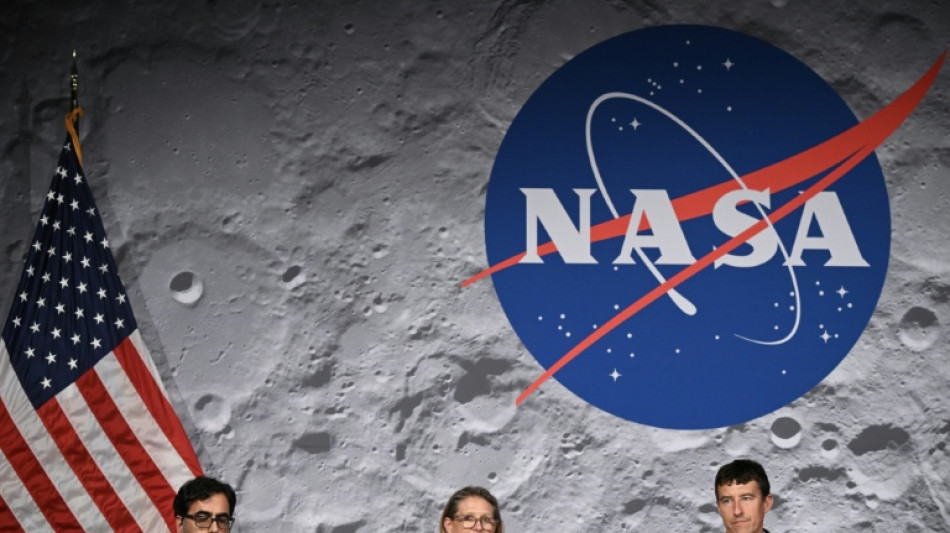
After Artemis II, NASA looks to SpaceX, Blue Origin for Moon landings / Photo: RONALDO SCHEMIDT - AFP

 Two dead as Istanbul endures heaviest rainfall in 80 years

 After latest Nepal flood, survivors fear for future

 EU leaders clash over budget as spectre of French elections looms

 'No place to breathe': life in Indonesia's fire epicentre

 'Can't sleep': Spain's housing crunch upends lives

 Musk calls on Ukraine's Zelensky to 'go' after satellite slowdown row

 Still smiling at 117, Albanian may be world's oldest woman

 Pope has 'good night' in hospital: Vatican

 China's economy seen missing target as global shocks bite: AFP poll

 Costa Rica opens jail inspired by El Salvador mega-prison

 Same-sex couple takes fight for equality to Slovakian court

 'High hopes' as Indonesian women get a football league, again

 'Expectations high' for Bordeaux-Begles' Champions Cup hat-trick bid, says Depoortere

 Rennie urges All Blacks to stay focused against 'hurting' Wallabies

 Palmeiras beat Fluminense 2-1 in Libertadores semi-final first leg

 Brewers blasts leave Dodgers on brink

 Tech stock lead rout after US inflation fuels rate hike bets

 Al-Fayed survivors say UK police missing 'bigger picture'

 Online 'witch hunt' sweeps up Asians misidentified as US rape accused

 Prospect of Bolsonaro win looms large over Brazil's Indigenous

 Freed from Belarus, founder of Lady Gaga's biggest fan site tells his story

 Behind AI's carbon footprint, a potential climate tool

 Trump's new press secretary faces scrutiny over credentials

 PSG 'got lucky' to win Man City thriller, says Luis Enrique

 Real Madrid comeback stuns Roma as Mourinho enjoys happy reunion

With Artemis II successfully completing its historic lunar mission on Friday, NASA is banking on billionaires Jeff Bezos and Elon Musk for the next step: landing astronauts on the Moon.
The Apollo program -- which sent the first and only humans to the Moon's surface between 1969 and 1972 -- was designed so that only two astronauts could land on the lunar surface for a maximum of a few days.
More than 50 years later, American ambitions and expertise have grown, with NASA hoping to send four people on a mission lasting several weeks and eventually building a lunar base.
For the second phase of its mission, the space agency is looking to commercial landers designed by Musk's SpaceX and Bezos's Blue Origin to get its astronauts on the Moon.
After Artemis II splashed down in the Pacific Ocean on Friday after its record-breaking journey, NASA officials urged all hands on deck for a crewed landing in 2028.
"We need all of industry to work and come along with us, and they need to accept that challenge and come with us and really start the production lines that are going to be required in order to achieve that goal," Lori Glaze, the acting associate NASA administrator, told a press conference.
The Apollo program relied on a single rocket, the Saturn V, which carried both the lunar lander and the capsule carrying the astronauts.
NASA has opted for two separate systems for Artemis: the first to launch the Orion spacecraft carrying the crew from Earth, and another to launch the lunar lander, which will be privately contracted.
- 'Camping trip' -
The decision was driven by the technical limitations of the Apollo program, Kent Chojnacki, a senior NASA official in charge of lunar lander development, told AFP.
"It was very not expandable to long-term exploration and long-term stays," he explained.
Although spectacular, the Apollo missions were like "camping trips," said Jack Kiraly, director of government relations at the Planetary Society, which encourages space exploration.
The systems NASA is looking at now are "huge compared to Apollo," said Chojnacki, noting that the new lunar landers being developed by Blue Origin and SpaceX are two to seven times larger than before.
The space agency is also drawing from external partners, such as the European companies that built the propulsion module for Orion.
The new approach opens access to more equipment and resources, but also significantly complicates operations.
To send these giant spacecrafts to the Moon, the private space exploration companies will need to master in-flight refueling, a complex maneuver that has not yet been fully tested.
After the lunar lander is launched, additional rockets will be needed to deliver the fuel required for the journey to the Moon, some 250,000 miles (400,000 kilometers) from Earth.
- 'Lose the Moon' -
Given this risky undertaking and the numerous delays -- particularly those experienced by SpaceX that was supposed to have its lander ready first -- pressure has mounted in recent months.
"We are once again about to lose the Moon," three former NASA officials warned in an article in SpaceNews last September.
China, which is hoping to send humans to the Moon by 2030, has been making progress as well, raising fears in the Trump administration that the United States could get left behind.
With that in mind, NASA raised the possibility last fall of reopening the contract awarded to SpaceX and using Blue Origin's lunar lander first, sending shockwaves through the rival companies.
Both firms announced they were realigning their strategies to prioritize the lunar project -- and keep their lucrative contracts with NASA.
But concerns remain, particularly regarding the feasibility of in-orbit refueling.
"We do have a plan," Chojnacki said, noting that NASA has a back-up plan in case of failure.
The timeline is also up in the air.
NASA says it plans to test an in-orbit rendezvous between the spacecraft and one or two lunar landers in 2027, and carry out a crewed lunar landing in 2028.
Before that, companies will need to test in-orbit refueling and send an unmanned lunar lander to the Moon to demonstrate its safety.
That all needs to happen within the next two years.
"It feels like a very small amount of time," said Clayton Swope of the Center for Strategic and International Studies.
Z.Ramadan--SF-PST