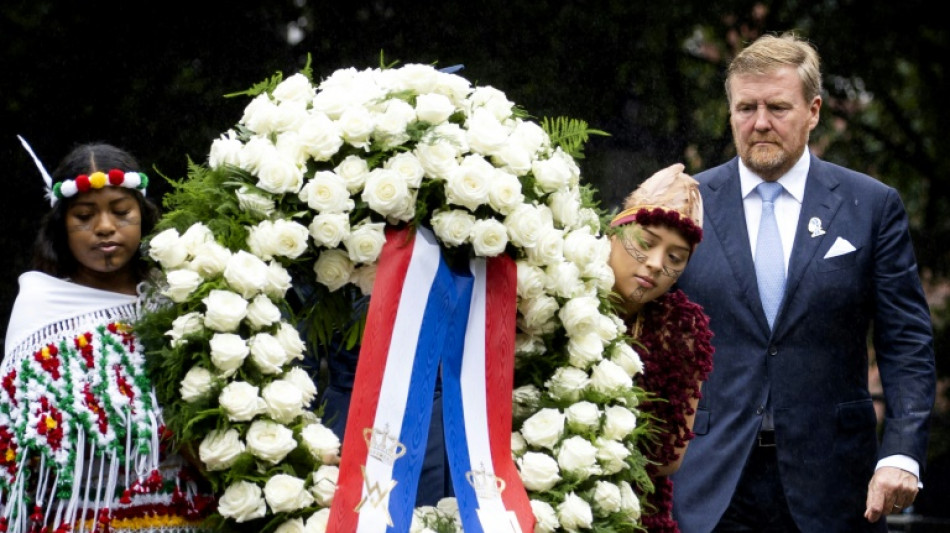
Dutch king makes historic apology for slavery / Photo: Remko de Waal - ANP/AFP

 UK court orders Prince Harry, others to pay Daily Mail £9.5mn

 Aligned Launches $ALIGN, the Native Token of Its Full Ethereum Stack
 Bitcoin jumps, stocks bounce as traders weigh US Treasury action

 Man City boss Maresca hit with Doku injury blow
 Iraola wants to sign wingers to boost Liverpool's attacking options
 Maresca needs time to succeed after 'big changes' at Man City

 Meghan faces difficult return to the UK

 Archer double strengthens England's grip on first Test against Pakistan

 MEXC Lists Ondo Tokenized Stock Moderna (MRNAON), Expanding Access to U.S. Biotech Exposure

 Japan axes Netflix collaboration after outcry over dating show

 Stocks tread cautiously as traders weigh US Treasury action

 STARTRADER Launches XAUUSD247, Extending Gold CFD Access Across the Full Week

 Spurs agree deal to sign Man City's Savinho: reports

 US-sanctioned ICC head warns against 'demise of international rule of law'
 Top India court orders new steps to protect threatened elephants
 Djibouti football federation accused of misusing funds

 Australia charges man with trying to pass Ukraine military intel to Russia

 Ex-Pakistan PM Khan taken back to jail after hospital checks: govt

 China, Indonesia hold talks on security, defence

 Train to nowhere? South Korea's lonely push for peace with the North

 Australia's Hussey mulls role with England for Ashes series

 Indian captain 'scapegoat' in Britain's Russia shadow fleet case, wife says
 Rosenior seeks to match Paris FC's capital ambition as Ligue 1 returns

 Inter set for Serie A title defence as Milan get Amorim reboot

 'Greatest' Springboks face All Blacks in clash of juggernauts

Dutch King Willem-Alexander issued a historic royal apology Saturday for the Netherlands' involvement in slavery, saying he felt "personally and intensely" affected.
His speech before thousands of descendants of slaves from the South American nation of Suriname and the Caribbean islands of Aruba, Bonaire and Curacao got a positive reception, but many said they wanted the Netherlands to pay compensation.
"Today I'm standing here in front of you as your king and as part of the government. Today I am apologising personally," Willem-Alexander said to loud cheers.
"I am intensely experiencing this with my heart and soul," the monarch said.
The "Keti Koti" ("breaking the chains" in Surinamese) event to commemorate 150 years of the abolition of slavery in former Dutch colonies, was held under a light drizzle in the capital's Oosterpark gardens.
Many of the participants wore colourful Surinamese clothes.
Dutch Prime Minister Mark Rutte had officially apologised in December on behalf of the government.
It was not certain whether the monarch would follow suit for a trade that had brought vast riches to his ancestors in the House of Orange.
But the king said: "Slave trading and slavery is recognised as a crime against humanity."
"The monarchs and rulers of the House of Orange took no steps against it," he said.
"Slavery illustrates the injustices of these laws," prevalent at the time which allowed trade in human beings, the king said in his speech, aired live on television.
"Today, I am asking for forgiveness for the crystal-clear lack of action".
- 'We need reparations' -
Those present widely welcomed the apology.
"He told the people from Suriname he was sorry," said Abmena Ryssan, 67, who was dressed in bright robes and exotic headgear -- a three-legged cooking pot adorned with Surinamese flags.
"Maybe he can now do something for black people," Ryssan told AFP.
"We need reparations," added Lulu Helder, a teacher whose ancestors were slaves.
"He took responsibility, so I forgive him," said Arnolda Vaal, 50, dressed in a slave woman's traditional outfit.
Since the Black Lives Matter movement emerged in the United States, the Netherlands has embarked on an often difficult debate about its colonial and slave trading past that turned it into one of the world's richest countries.
Dutch royals have often found themselves at the centre of the debate.
A study released in June found that the royal family earned 545 million euros ($595 million) in today's terms between 1675 and 1770 from the colonies, where slavery was widespread.
The current king's ancestors, Willem III, Willem IV and Willem V, were among the biggest earners from what the Dutch report called the state's "deliberate, structural and long-term involvement" in slavery.
- Slavery funded Dutch 'Golden Age' -
In 2022 King Willem-Alexander announced that he was ditching the royal Golden Coach that traditionally transported him on state occasions because it had images of slavery on the sides.
One side panel had a picture called "Tribute of the Colonies" depicting kneeling black people handing over produce like cocoa and sugarcane to their white masters.
Rutte in December also described slavery as a "crime against humanity" when he delivered the long-awaited apology, and Dutch ministers travelled to seven former colonies.
The king said days later, in his Christmas address, that the government apology was the "start of a long journey".
Slavery was formally abolished in Suriname and other Dutch-held lands on July 1, 1863, but only ended in 1873 after a 10-year "transition" period.
The Dutch funded their "Golden Age" of empire and culture in the 16th and 17th centuries by shipping around 600,000 Africans as part of the slave trade, mostly to South America and the Caribbean.
M.Qasim--SF-PST