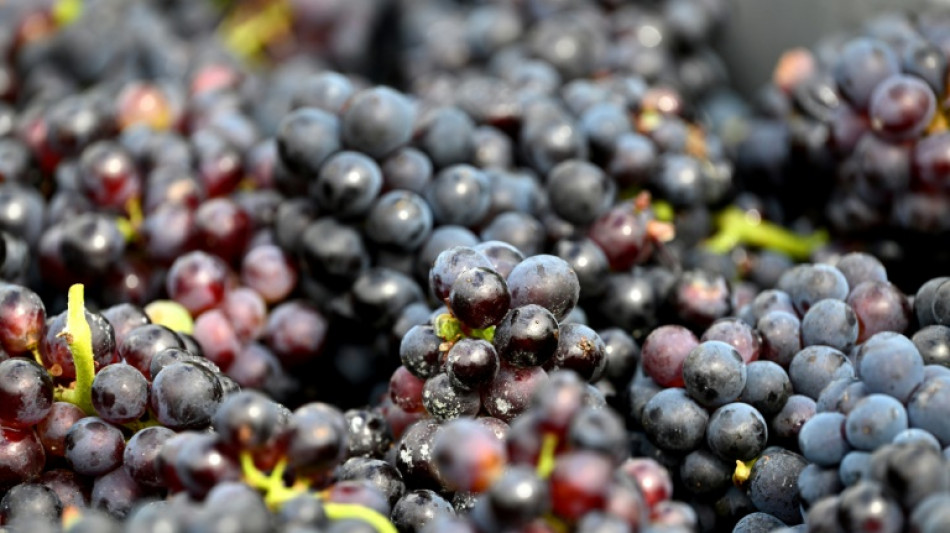
600-year-old pinot noir grape found in medieval French toilet / Photo: FRANCOIS NASCIMBENI - AFP/File

 Golf star Rahm quitting LIV tour over 'unacceptable' terms

 Thousands march fearing return of a Bolsonaro presidency in Brazil

 French PM denies police ordered to confront student protesters

 Rubio touts US power, calls on Europe to emerge from 'slumber'

 Trump says 'we don't think' Russian plague is bio-weapon

 Five children among 26 killed in Ukraine after Russian strikes

 Man City should 'accept' punishment for rule breaches, says Lineker

 US woman who survived botched execution is awake and speaking

 From 1800s to modern pharma: a Nobel-winning chemistry quest

 Southampton boss Eckert given suspended ban over 'Spygate'

 Russia warns of 'false' information as second plague case reported

 IEA ready to release more oil reserves if necessary

 HSBC 'consults' over UK unit job cuts amid AI adoption

 UK court quashes five ex-traders' Libor rate rigging convictions

 XM Receives “Global Customer Experience Leader Award 2026” at the TrustFinance Performance Awards

 Stocks slide as oil climbs on Mideast flareup

 Heavy casualties in Ukraine after Russian strikes

 French wine harvest set to hit historic low

 Kyiv 'cannot agree' to EU membership limiting food exports: minister

 Arteta targets more Arsenal glory after signing new deal until 2030

 Russell hit with Singapore grid penalty for taking new power unit

 Spotify expands audiobooks to more than 180 markets

 French-Japanese duo wins chemistry Nobel for solving molecular 'mystery'

 England's Nations League surge helps heal World Cup wounds

 Mayor of opposition stronghold Izmir defects to Erdogan party

A 600-year-old grape seed discovered in the toilets of a medieval French hospital is genetically identical to the grapes still being used to make pinot noir wine, scientists said Tuesday.
The seed reveals that people in France have been cultivating this immensely popular variety of grape since at least the 1400s, the scientists said in a new study.
It is not possible to say whether the fruit was "eaten like table grapes or whether people made wine from it at the time", study co-author Laurent Bouby told AFP.
But the research provides a link between modern France -- one of the world's largest wine-producing and -consuming countries -- and its distant wine-loving past.
Another study co-author, Ludovic Orlando, pointed out that the Hundred Years' War between England and France finally wrapped up in the mid-1400s.
And the brief life of France's patron saint, Joan of Arc, was also in the 15th century.
"She could have eaten the same grapes as us," the paleogeneticist at the University of Toulouse told AFP.
The seed was found in a toilet in a 15th-century hospital in Valenciennes in northern France. At the time, toilets were sometimes used as rubbish bins, the researchers explained.
The study, which was published in the journal Nature Communications, involved sequencing the genome of 54 grape seeds dating from the Bronze Age -- from around 2,300 BC -- to the Middle Ages.
It confirms that generations of winegrowers had been using what are today called "clonal propagation" techniques, such as preserving cuttings of particular grape varieties for 600 years, the researchers said.
Ancient texts had offered indications this was happening, "but outside of paleogenomics, it is very difficult to characterise this technique", said Bouby of the Institute of Evolutionary Science of Montpellier.
But the new research found evidence this technique was being used in many areas as far back as the Iron Age, around 625–500 BC.
- Aged like fine wine -
The oldest grapes analysed in the study were from wild vines in the French region of Nimes dated to around 2,000 BC.
Domesticated vines then started to appear between 625 and 500 BC in France's southern Var region.
This lines up with when colonising Greeks were believed to have introduced viticulture -- cultivating grapevines -- to France, after founding the city of Marseille.
Orlando said it was already known that wine was traded at the time by the Greeks and the Etruscans, because of wine jugs called amphora that lasted through the centuries.
But the DNA of the grape seeds, particularly those from the ancient Roman period, revealed long-distance exchanges of domesticated grape varieties from places including Spain, the Balkans, the Caucasus and the Middle East.
It also showed there was plenty of genetic mixing of domesticated grape varieties and local wild vines during the Roman period, particularly in northern France.
In the future, "it would be very interesting to work closely with historians who have access to texts describing certain winegrowing techniques" to find out more, Orlando said.
Pinot noir, which is often associated with France's Burgundy region, is the fourth most widely grown grape in the world, according to the study.
L.AbuTayeh--SF-PST