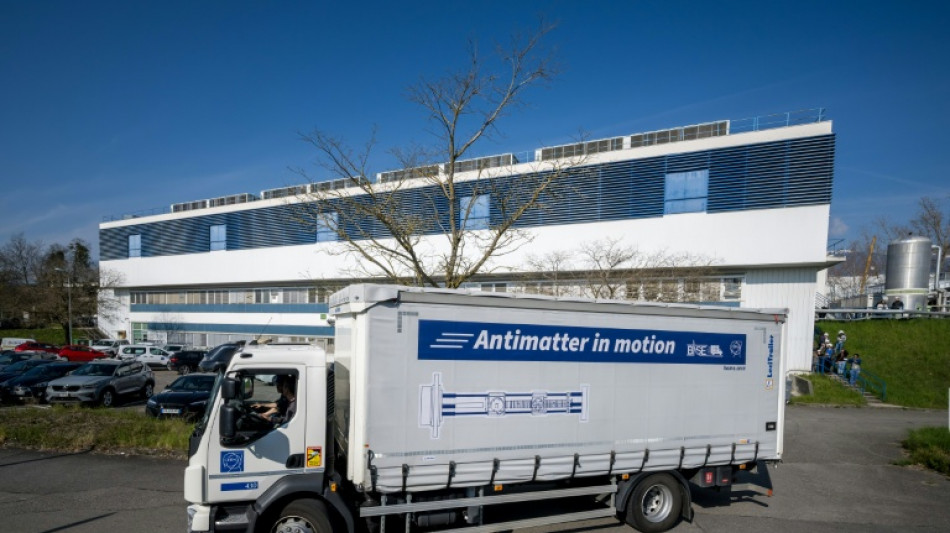
In world first, antimatter taken on test drive at CERN / Photo: Fabrice COFFRINI - AFP

 El Nino a 'terrifying' threat to coral reefs: UN biodiversity expert

 Barcola must get used to Liverpool highs and lows, says Iraola

 Versus Trade Wins Best ECN/STP Broker APAC 2026, Marking Third UF Awards Recognition

 Three dead as Istanbul sees heaviest rainfall in 80 years

 US producer prices see biggest jump since 2022 in added challenge to Trump

 Swiatek avoids seed exodus to breeze into Wuhan last eight
 PM condemns 'chaos' as violent protests grip Albania

 'I couldn't breathe', Russell Brand's alleged rape victim says

 Pope's cancer operation already reshaping papacy

 Zverev cruises past De Minaur to reach Shanghai semi-finals

 Ukraine's Zelensky defies Trump with Russian refinery strikes

 Holders Australia edge New Zealand 24-22 to open Rugby league World Cup

 'Ocarina of Time': Nintendo gives Zelda classic a modern makeover

 France charges teen shooter citing revenge for bullying in school

 Martinez blames 'anger' for dig at Man Utd hierarchy

 Crowds build as Albanian PM tours protest aftermath

 China-North Korea bridge opens, 12 years late

 Asian Cup in Saudi Arabia could be postponed but 'no hurry' to decide: AFC

 Conrad wields axe after South Africa loss to Australia

 School roof collapse kills teacher, 27 children in NW Pakistan

 Haze turns Indonesia skies orange, shuts schools in East Timor

 California puts first US billionaire tax to the vote
 School headscarf ban meets resistance in Austria

 World's top cocoa producer aims for a climate-tough bean

 Why is Shell facing lawsuits over climate disasters in Brazil and the Philippines?

CERN scientists on Tuesday pulled off the unprecedented feat of transporting antiprotons by road, successfully test-driving the world's first antimatter delivery system, with an eye to one day supplying research labs across Europe.
"The particles returned... so this was a success," CERN physicist Stefan Ulmer told reporters after the large truck came back from a 10-kilometre drive around the campus of Europe's main physics laboratory.
While that might not sound like a big distance, Ulmer, a spokesman for CERN's BASE experiment probing the asymmetry between matter and antimatter in the universe, said it marked the "starting point to a new era".
Visible matter and its mysterious twin antimatter are believed to be almost identical, except their charges and magnetic properties are reversed.
Scientists today still wonder why our universe contains far more matter than antimatter, when the Big Bang should have created an equal amount.
When antimatter comes in contact with matter it annihilates, disappearing in a flash of energetic particles.
Moving antimatter particles about is therefore a major challenge -- one that has now seemingly been overcome.
- Antimatter factory -
"It's fantastic!" said Francois Butin, the technical coordinator of CERN's so-called antimatter factory -- the only place in the world where antiprotons can be produced, stored and studied.
"This opens up so many possibilities," he told AFP.
The antimatter factory's particle accelerator and decelerator generate fluctuations that impact the measurements, limiting their precision.
To overcome this problem, scientists have found a way to trap antiprotons inside a special ion trap, allowing them to be transferred to other, quieter facilities where they can be studied with greater precision.
"We want to understand something about the fundamental symmetries of nature, and we know that if we do these experiments outside of this accelerator facility, we can measure 100 to 1,000 times better," Ulmer said.
To prepare for the world's first attempt at antimatter transport, a cloud of 92 antiprotons were captured and stored in a portable cryogenic Penning trap.
They were cooled to 8.2 Kelvin, or -268 Celsius to slow them down, while a strong vacuum system ensures they do not annihilate by colliding with the residual gas in the trap.
- 'Big success' -
Tensions were running high as dozens of CERN scientists sporting hard hats gathered at the antimatter factory to watch as what looked like a large filing cabinet, containing the 850-kilogramme trap, was gingerly lifted by a giant yellow ceiling crane and transported across the lab.
They had practiced these careful manoeuvres previously, but then came the groundbreaking step: loading the giant box onto a flatbed truck, and taking it for a spin.
"The most critical part is on the road, because there you have additional vibrations," Marcus Jankowski, responsible for safety in CERN's experimental physics department, told AFP.
The truck, emblazoned with "Antimatter in Motion" on its sides and flanked by a yellow van and red car with flashing lights, slowly made its way through the CERN campus.
Ulmer followed in his car, the whole time keeping an eye on a monitor on his phone indicating the antimatter's vital signs, where the characteristic frequency that antiprotons vibrate at takes the M-shaped form of two peaks.
The height of the peaks indicates the number of antiprotons in the trap, he explained, warning that if the shape shifts into a single peak, that would indicate that the antiprotons had annihilated.
During the drive, the shape seemed to alter some, but Ulmer later explained that it was the detector's resonant frequency that had shifted by a few hertz.
"The particles are still at the same position," he said jubilantly after the drive.
"Everything went smoothly... It's a very big success."
Eventually, CERN aims to send antiprotons to a range of labs across Europe, starting with its dedicated precision laboratory in Dusseldorf, an eight-hour drive away in Germany.
"This means we’d have to keep the trap's superconducting magnet at a temperature below 8.2K for that long." Christian Smorra, head of the BASE-STEP experiment, said in a statement.
The greatest challenge, he said, would meanwhile be when the antimatter arrives at its destination: "to transfer the antiprotons to the experiment without them vanishing".
S.AbuJamous--SF-PST