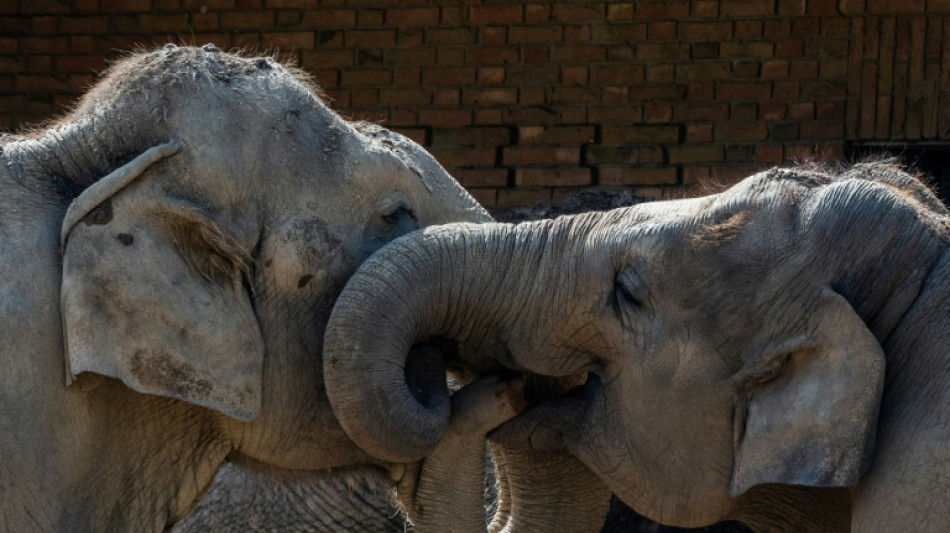
The secret to an elephant's grace? Whiskers / Photo: John MACDOUGALL - AFP

 Rahm reaches separation deal with LIV in bankruptcy court

 UN chief urges nations to end 'war on nature'

 Newcastle boss Jaissle says Fernandez-Pardo just needs a goal

 Infantino offers apology but 'no answers' at FIFA meeting over World Cup plan

 Don't exclude Turkey from 'Made in Europe' plan: minister to AFP

 French duo Justice to score 'GTA VI': game maker

 El Nino a 'terrifying' threat to coral reefs: UN biodiversity expert

 Barcola must get used to Liverpool highs and lows, says Iraola

 Versus Trade Wins Best ECN/STP Broker APAC 2026, Marking Third UF Awards Recognition

 Three dead as Istanbul sees heaviest rainfall in 80 years

 US producer prices see biggest jump since 2022 in added challenge to Trump

 Swiatek avoids seed exodus to breeze into Wuhan last eight

 PM condemns 'chaos' as violent protests grip Albania

 'I couldn't breathe', Russell Brand's alleged rape victim says

 Pope's cancer operation already reshaping papacy

 Zverev cruises past De Minaur to reach Shanghai semi-finals

 Ukraine's Zelensky defies Trump with Russian refinery strikes

 Holders Australia edge New Zealand 24-22 to open Rugby league World Cup

 'Ocarina of Time': Nintendo gives Zelda classic a modern makeover

 France charges teen shooter citing revenge for bullying in school

 Martinez blames 'anger' for dig at Man Utd hierarchy

 Crowds build as Albanian PM tours protest aftermath

 China-North Korea bridge opens, 12 years late

 Asian Cup in Saudi Arabia could be postponed but 'no hurry' to decide: AFC

 Conrad wields axe after South Africa loss to Australia

An elephant's trunk can surpass a human's height and lift trees -- a marvel of strength that's conversely so gentle it can grasp a tortilla chip without breaking it.
So how do the thick-skinned animals with poor eyesight pull off such delicate tasks? In a word, whiskers.
New research published Thursday in the journal Science details how the whiskers that cover an elephant's trunk have unique properties that lend the largest land mammals remarkable dexterity.
Elephants are born with about 1,000 of these bristles, lead author Andrew Schulz told AFP, many of them anchored in the trunk's wrinkles to act like feelers and help the animals assess their surroundings.
A team of engineers, materials scientists and neuroscientists analyzed the geometry, porosity and material properties of these whiskers, and expected them to mimic the whiskers found on mice or rats -- circular at a cross-section, solid and uniformly stiff.
In fact, elephant whiskers are almost blade-like, with a porous architecture similar to sheep horns, which helps with shock absorption while eating.
And a gradiated shape and structure from base to tip allows for an amplified sense of touch, Schulz said.
"The craziest finding that we had, I think, was that these whiskers have this transition from a really, really rigid base to a very, very soft tip," said the researcher at the Max Planck Institute for Intelligent Systems in Stuttgart, Germany.
Part of elephants' whisker evolution is to prevent breakage, said Schulz. Unlike most mammals with whiskers, those of elephants don't grow back.
- Elephant-inspired advances -
Many animals have sensory hairs that can act as a radar, but few quite so precise as the elephant's.
Schulz said a rat's whiskers, for example, also picks up vibrations -- but it's akin to smashing down a handful of keys on a piano.
To an elephant's whiskers, it's more like hitting specific notes.
Researchers voiced excitement that cat whiskers have a similar kind of material intelligence and stiffness gradient.
The elephant's gradiated structure can help with things like object differentiation while foraging and eating -- which they spend the vast majority of their time doing.
Elephants are also well-documented using their trunks for social touch -- "they're using the outside of their trunk," Schulz said, "so they're using those portions that are covered in the whiskers."
Caitlin O'Connell-Rodwell -- a behavioral ecologist and elephant expert who has focused on how the giant mammals communicate and detect signals through their feet -- called the findings "fascinating."
"This is really exciting for me to see just more affirmation of how sensitive their trunks really are," she told AFP.
"There's some really interesting, intriguing thoughts for the next steps, for what one could ask in terms of the behavioral application of this," O'Connell-Rodwell said.
"Not only would this allow them to say, reach up into a tree and feel around for fruit or a seed pod with better agility, but it also has implications for communication."
There's also a wealth of technological possibilities elephant whiskers could inspire, not least when it comes to robotics, Schulz said.
And "part of the novelty of this work is functional gradients exist everywhere in biology," the researcher said.
The stiff base-to-soft tip structure also appears in rotator cuffs or ACL ligaments, he said for example -- and better understanding those structures and how they might impact sensing could perhaps allow for improved repair techniques.
L.Hussein--SF-PST