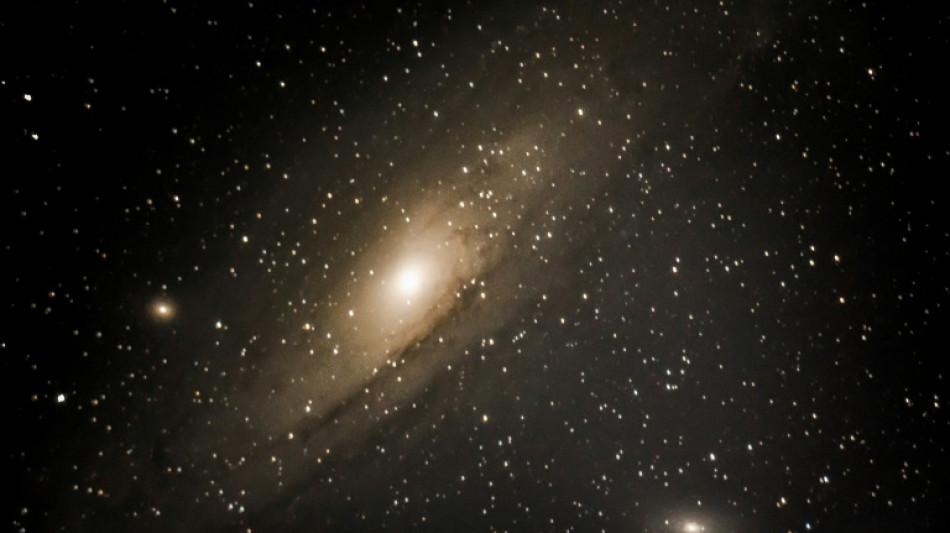
Chance glimpse of star collapse offers new insight into black hole formation / Photo: Ye Aung THU - AFP

 Rahm reaches separation deal with LIV in bankruptcy court

 UN chief urges nations to end 'war on nature'

 Newcastle boss Jaissle says Fernandez-Pardo just needs a goal

 Infantino offers apology but 'no answers' at FIFA meeting over World Cup plan

 Don't exclude Turkey from 'Made in Europe' plan: minister to AFP

 French duo Justice to score 'GTA VI': game maker

 El Nino a 'terrifying' threat to coral reefs: UN biodiversity expert

 Barcola must get used to Liverpool highs and lows, says Iraola

 Versus Trade Wins Best ECN/STP Broker APAC 2026, Marking Third UF Awards Recognition

 Three dead as Istanbul sees heaviest rainfall in 80 years

 US producer prices see biggest jump since 2022 in added challenge to Trump

 Swiatek avoids seed exodus to breeze into Wuhan last eight
 PM condemns 'chaos' as violent protests grip Albania

 'I couldn't breathe', Russell Brand's alleged rape victim says

 Pope's cancer operation already reshaping papacy

 Zverev cruises past De Minaur to reach Shanghai semi-finals

 Ukraine's Zelensky defies Trump with Russian refinery strikes

 Holders Australia edge New Zealand 24-22 to open Rugby league World Cup

 'Ocarina of Time': Nintendo gives Zelda classic a modern makeover

 France charges teen shooter citing revenge for bullying in school

 Martinez blames 'anger' for dig at Man Utd hierarchy

 Crowds build as Albanian PM tours protest aftermath

 China-North Korea bridge opens, 12 years late

 Asian Cup in Saudi Arabia could be postponed but 'no hurry' to decide: AFC

 Conrad wields axe after South Africa loss to Australia

A watched pot never boils and love happens when you least expect it -- turns out, the same logic applies to capturing a star as it collapses into a black hole.
At least that proved true for one group of researchers whose work took a turn when they accidentally witnessed what appears to be an example of the astronomical unicorn, a "surprise" discovery they detailed in findings published Thursday in the journal Science.
It's the strongest observational record yet of the long-theorized phenomenon that some stars simply fade into black holes, the authors say.
Lead author and astrophysicist Kishalay De told AFP the project began as something quite different, a study of stars under infrared light in the neighboring Andromeda Galaxy.
But the team encountered an unusual stellar object that brightened... and then dimmed until it disappeared.
"That's where the mystery really started," said De, a professor at New York's Columbia University and researcher at the Flatiron Institute.
Researchers were using long-term observations from NASA's NEOWISE mission, which used a space telescope that surveyed the sky in infrared to detect and characterize near-Earth objects.
They were able to piece together a large data set, going back through those archives and others more than a decade to study what they'd seen.
It's not the first time scientists have spotted a convincing example of a "failed supernova" -- when a star's core collapses directly into a black hole and starts shedding its turbulent outer layers without a dazzling explosion.
Another prime candidate was identified in research published about a decade ago.
De said this new observation offers another clue -- and one that comes from the closest galaxy to ours, about 2.5 million light-years from Earth, meaning it was much brighter and easier to examine.
Daniel Holz -- a University of Chicago astrophysicist focused on black holes, who was not involved in the study -- told AFP the "serendipitous" nature of the latest example makes it particularly exciting.
Because it popped up within a larger-scale data collection, there was a backlog of images to analyze -- what Holz likened to "baby pictures," or earlier documentation that could tie together the research.
- 'Dying gasp' -
Scientists have long carried out efforts trying to find individual stars in nearby galaxies that abruptly disappear, "but to catch them in the act is hard," Holz said, explaining that the death of a star often comes after billions of years of living.
"You have to be really lucky," he said. "You can't just look at one star and say, 'I'm just going to sit here and wait.'"
De said that's precisely why this new research could be door-opening.
When stars die they're thought to shed their outer layers and thus appear brighter for a time -- in this case, that shift "was flagged to us in infrared light, and that's what led to the discovery," De said.
"It really points us to a completely new method of identifying the disappearance of stars, by not just looking for the individual stars disappearing, but to look for the infrared brightening that's associated with the process," De said, what he called the star's "dying gasp."
The astronomer also said the star identified was slightly smaller than one scientists would "nominally expect to turn into a black hole."
At the end of its life, De said it would have been approximately five times the mass of the Sun -- giant, but about half the size they might have anticipated.
"What this really tells us is that what we've assumed about the landscape of stars that turn into black holes might be much wider than what we've anticipated in the past," he said.
Holz said this latest research is an "exciting step" in "teasing out the role of black holes in the universe."
"This is another example of, you know, they're really out there," he said. "And that's just really, unbelievably cool."
S.Abdullah--SF-PST