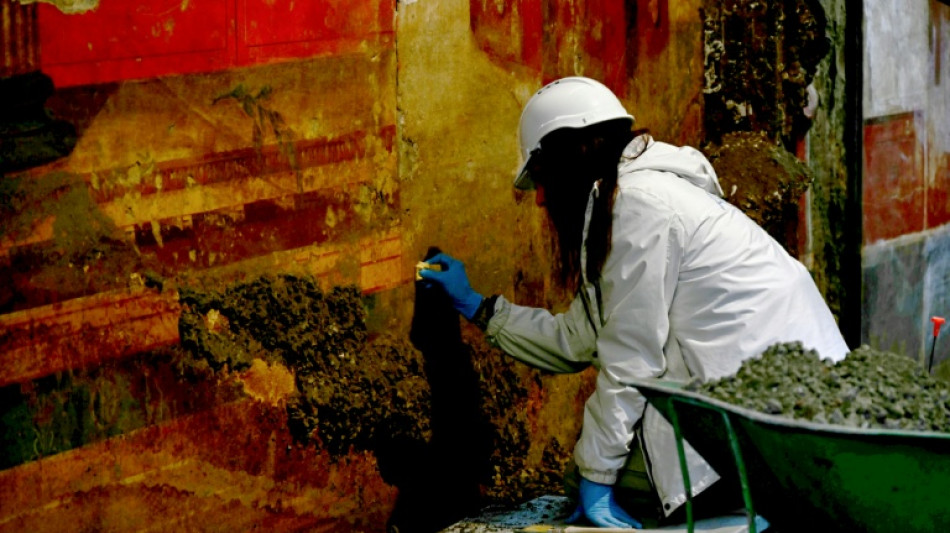
'Virgin' frescoes emerge from Pompeii suburb / Photo: Filippo MONTEFORTE - AFP

 Rahm reaches separation deal with LIV in bankruptcy court

 UN chief urges nations to end 'war on nature'

 Newcastle boss Jaissle says Fernandez-Pardo just needs a goal

 Infantino offers apology but 'no answers' at FIFA meeting over World Cup plan

 Don't exclude Turkey from 'Made in Europe' plan: minister to AFP

 French duo Justice to score 'GTA VI': game maker

 El Nino a 'terrifying' threat to coral reefs: UN biodiversity expert

 Barcola must get used to Liverpool highs and lows, says Iraola

 Versus Trade Wins Best ECN/STP Broker APAC 2026, Marking Third UF Awards Recognition

 Three dead as Istanbul sees heaviest rainfall in 80 years

 US producer prices see biggest jump since 2022 in added challenge to Trump

 Swiatek avoids seed exodus to breeze into Wuhan last eight
 PM condemns 'chaos' as violent protests grip Albania

 'I couldn't breathe', Russell Brand's alleged rape victim says

 Pope's cancer operation already reshaping papacy

 Zverev cruises past De Minaur to reach Shanghai semi-finals

 Ukraine's Zelensky defies Trump with Russian refinery strikes

 Holders Australia edge New Zealand 24-22 to open Rugby league World Cup

 'Ocarina of Time': Nintendo gives Zelda classic a modern makeover

 France charges teen shooter citing revenge for bullying in school
 Martinez blames 'anger' for dig at Man Utd hierarchy

 Crowds build as Albanian PM tours protest aftermath

 China-North Korea bridge opens, 12 years late

 Asian Cup in Saudi Arabia could be postponed but 'no hurry' to decide: AFC
 Conrad wields axe after South Africa loss to Australia

Amid the remains of a sumptuous villa near Pompeii, the hard-hatted conservationist scraped away centuries-old ash to reveal a vibrant red fresco.
For the first time on Thursday, visitors were allowed in to see the renovations underway at Villa Poppaea, a pleasure palace of Ancient Rome destroyed by the eruption of Vesuvius in 79 AD.
"It's important, now that we're almost finished, to start reopening the villa and allowing everyone to visit it," said Arianna Spinosa, the director of the archaeological site near Naples, southern Italy.
The villa was the home of the Emperor Nero's second wife, Poppaea Sabina -- whom some believe he later killed -- and was being renovated at the time of the volcanic eruption.
The latest discoveries were found in its oldest section, which date back to the middle of the first century BC.
"Each excavation is a surprise," Spinosa told AFP during a visit to the ruins, which on a wet February morning resembled a building site.
"We certainly expected to find some of the frescoes that could be seen on the other wall, but the surprises were, of course, far more numerous.
"First of all, because of the colours that appeared, so vivid in their authenticity."
Among the discoveries were the legs of a graceful bird set against the backdrop of a yellow frieze emerging out of the mud, a peacock missing only its head.
It was found in the villa's most impressive room, the main salon, which has a mirrored wall.
The peacock, a sacred animal associated with the goddess Juno, is "one of the decorative motifs that recurs very frequently in the decoration of the villa", noted Giuseppe Scarpati, the site's chief archaeologist.
- 'Virgin surfaces' -
Depicting birds, fish and fruit, the newly-discovered frescoes are breathtaking in their intricacy, but it is their colours that really stand out.
"This vibrant red panel bears original, untreated pigments," Spinosa explained.
Such "virgin surfaces" are hugely valuable to those studying the villa and its former occupants, she said.
The villa is part of Oplontis, an archaeological site of Roman-era buildings between Pompeii and Herculaneum, in the modern town of Torre Annunziata.
The Villa Poppaea, a grand residential complex also known as Villa A, was discovered by chance during the construction of a canal at the end of the 16th century.
Excavations began in the 18th century.
In 1974, archaeologists found the remains of a second building, so-called Villa B, during the construction of a school sports hall.
Unlike the first building, Villa B, which was used for the processing of wine and oil, is closed to the public.
Elena Gravina, the chief conservator of the Villa Poppaea, said it was a site of "exceptional quality, both in design and quality".
Archaeologists had identified bright red cinnabar and Egyptian blue pigments, which "were very expensive and difficult to obtain at the time", she told the first visitors Thursday.
"They testify to the commercial connections and the wealth of the patrons, as well as the skill and expertise of the artisans."
From now on, groups of up to ten people will be able to visit the site each Thursday morning, obtaining a glimpse of the frescoes but also the experts at work, in the dirt and under scaffolding.
Only 50 to 60 percent of the overall area of the villa has been excavated so far, so there is still work to be done.
"We don't know its boundaries to the north, east, or west. Potentially, the villa could still hold many surprises for us," Scarpati told AFP.
L.Hussein--SF-PST