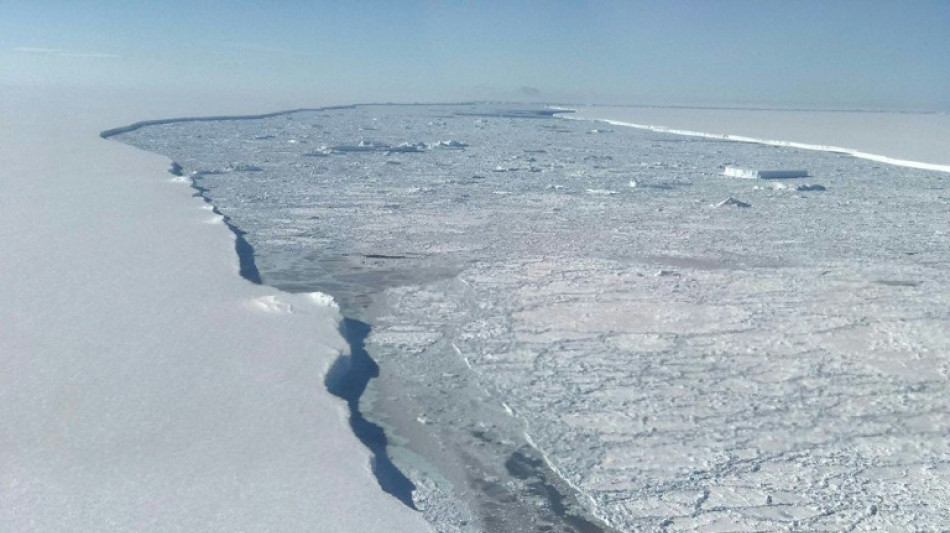
World's biggest ice sheet could cause massive sea rise without action: study / Photo: HO - NASA/AFP/File

 Messi on target again but Miami downed by Columbus

 In Washington's political cauldron, a fight over foie gras
 Flavio Bolsonaro: political heir in his father's shadow

 Ravens grab last-second win in Rio as Commanders stop Seahawks

 USA rallies to capture 11th consecutive Presidents Cup

 Phillies clinch, Astros wrap up division on final day of MLB season

 Commanders hand champion Seahawks their first loss

 Dupont scores twice to send Toulouse top of Top 14

 Ireland beat Israel but no handshakes due to war in Gaza

 Tense standoff over flashpoint N.Ireland parade lasts into night

 Stunned McNulty wins 'miracle' road race world title

 Re-released 'Avengers: Endgame' snaps-up N. America box office lead

 American McNulty wins shock road race world title

 Serbia's President Aleksandar Vucic announces resignation

 Tuchel urges Bellingham to play with 'rage'

 Russian strikes on Ukraine kill 8

 Bavuma, Miller hit centuries as South Africa clinch series

 Spain bring in Le Normand for injured Garcia

 UK Labour party meets buoyed by Burnham but seeking concrete plans

 Nor'easter lashes US east with punishing rain and wind

 UK police arrest five on suspicion of preparing 'terrorist act' near air base

 Washington denounces Iran's truce proposal as 'cynical'

 Armani sprinkles glitter on discreet elegance at Milan show

 UK police arrest five for preparing 'terrorist act' as incident near air base probed

 อเล็กซ์ โบดี และศาสตราจารย์ ดร. ดีเทอร์ ลาซิก ลงนามสัญญาสำหรับ ALPHA WHEY และ BODI เครื่องดื่มให้พลังงาน

The world's biggest ice sheet could cause "several metres" of sea-level rise over centuries if the global temperature rises more than 2°C, according to a British study published Wednesday.
Researchers at Durham University concluded that if global greenhouse emissions remain high, the melting East Antarctica Ice Sheet (EAIS) could cause nearly half a metre of sea-level rise by 2100. Their analysis was published in the scientific journal Nature.
If emissions remain high beyond that, the EAIS could contribute around one to three metres to global sea levels by 2300, and two to five metres by 2500, they said.
However, if emissions were dramatically reduced, EAIS could contribute around two centimetres of sea level rise by 2100, according to the assessment.
This would represent far less than the ice loss expected from Greenland and West Antarctica.
"A key conclusion from our analysis is that the fate of the East Antarctic Ice Sheet remains very much in our hands," said lead author Chris Stokes, from Durham University's Department of Geography.
"This ice sheet is by far the largest on the planet, containing the equivalent of 52 metres of sea level and it's really important that we do not awaken this sleeping giant.
"Restricting global temperature increases to below the 2°C limit set by the Paris Climate Agreement should mean that we avoid the worst-case scenarios, or perhaps even halt the melting of the East Antarctic Ice Sheet, and therefore limit its impact on global sea level rise," he added.
- Computer simulations -
The study did note that the worst scenarios projected were "very unlikely".
World leaders agreed at the 2015 UN Climate Change Conference in Paris to limit global warming to well below 2°C and pursue efforts to limit the rise to 1.5°C.
The research team, which included scientists from the UK, Australia, France and the US, analysed how the ice sheet responded to past warm periods when making their predictions.
They ran computer simulations to model the effects of different greenhouse gas emission levels and temperatures on the ice sheet by the years 2100, 2300 and 2500.
They found evidence to suggest that three million years ago, when temperatures were around 2-4°C higher than present, part of the EAIS "collapsed and contributed several metres to sea-level rise".
"Even as recently as 400,000 years ago -- not that long ago on geological timescales -- there is evidence that a part of the EAIS retreated 700 km inland in response to only 1-2°C of global warming," they added.
Nerilie Abram, a co-author of the study from the Australian National University in Canberra, warned the sheet "isn't as stable and protected as we once thought."
S.Barghouti--SF-PST