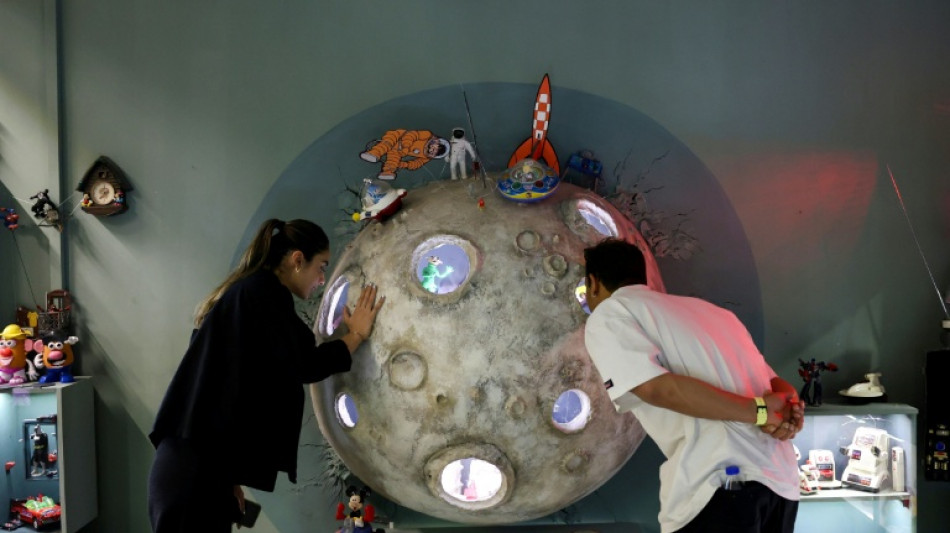
Tehran toy museum brings old childhood memories to life / Photo: - - AFP

 فاطمة بوش ترفع شعار 'ليحيا المسيح الملك' في ختام ملكة جمال الكون

 أين الأمن القومي العربي؟.. تحليل نقدي لغياب الرؤية المشتركة

 Crude Oil Prices Rise on Reports of Houthi Attack on Saudi Refinery

 El Nino’s Weakening Grip on Tamil Nadu Rainfall Hinges on Potential Cyclone

 Black Friday Discounts Cut Prices on Two Top-Rated Wiper Blades

 Twickenham Grounds Team Prepares Pitch for Six Matches in Three Days

 Luxembourg City Plans €13 Million Abrigado Centre for 2029

 Two A1 Crashes Create Kilometres of Rush-Hour Congestion

 South Africa Places 36 Hospitals on Standby for Possible Imported Ebola Cases

 Tamil Nadu Secures Rs 58,214 Crore in Investments at Vettri Conclave

 فرنسا تدعو لتجريم "الفصل العنصري القائم على الجنس" دولياً
Inside a restored house in central Tehran, toys from every era, from ancient Persia to Soviet Russia and the United States, share the same space, stirring childhood memories from long ago.
"I always thought that the target audience would be children and teenagers," said 46-year-old Azadeh Bayat, founder of the museum, which opened last year after six years of renovations.
"But now even adults visit the museum frequently," she told AFP.
Bayat, a researcher in children's education, has gathered more than 2,000 toys from around the world.
"By discovering the toys of their parents and grandparents, children learn to better understand and connect their own world with that of older generations," she said.
In the museum, a clay animal figurine from ancient Persia stood alone in a glass case.
Nearby, a group of wooden "matryoshka" dolls, in traditional Russian dress with rosy cheeks, stood on one shelf, gleaming across from brightly painted Soviet tin cars.
An Atari console, one of the early versions of video games from the 1980s, sits among the displays.
American Barbie dolls, which were once heavily restricted in Iran as a symbol of Western influence, were also on display.
Their popularity pushed Iranian authorities to create the modestly dressed "Sara and Dara" dolls as local equivalent in the early 2000s.
For Maedeh Mirzaei, a 27-year-old employee in the gold sector, the experience at the museum was nostalgic.
"There was so much publicity around the two Iranian dolls, their faces appeared on books and notebooks everywhere," she said.
Across the room, a museum worker demonstrated to a group of visiting schoolchildren the mechanics of a wooden acrobat puppet, known as "Ali Varjeh", or "Ali the Jumper", whose movements come to life with the pull of a string.
The museum recently held an event themed around the Belgian character Tintin, as well as other shadow puppetry shows.
"I remember playing with friends in the street or at home with these toys," said 31-year-old Mehdi Fathi, a fitness instructor who was visiting the museum.
"Some children nowadays may think that our dolls were silly and primitive," he said.
"But those toys helped us grow."
T.Samara--SF-PST

