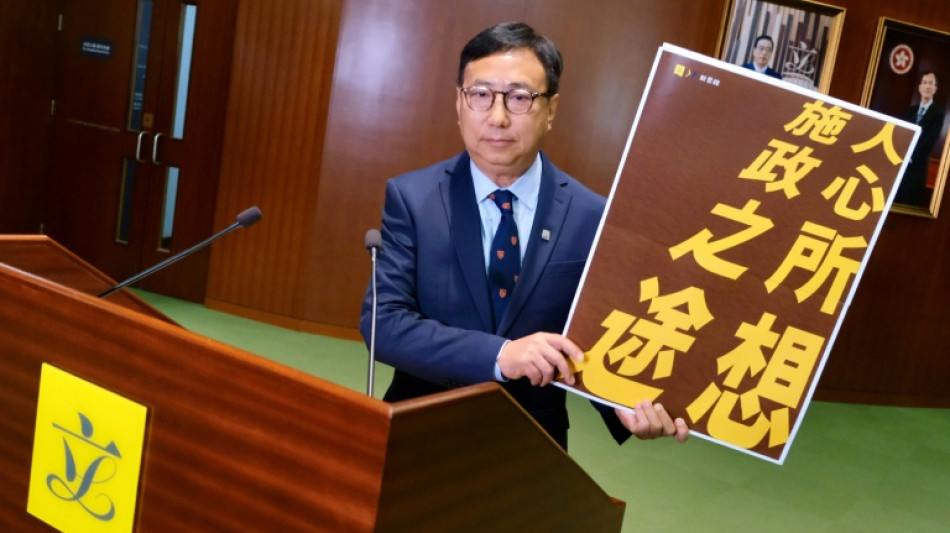
Hong Kong legislature now an 'echo chamber', four years after shake-up / Photo: Tommy WANG - AFP

 Waze rejects Malaysia's data security claims after civil servant ban
 'Call of Duty' seeks to win back fans with warfare spectacle

 Volvo Cars shares plunge on losses, job cuts
 France braces for new protests as Macron seeks to restore order

 Kering shares tumble as Gucci fails to reassure investors
 West Bank attack wounds 5 as Israel PM cancels events
 Ahead of APEC summit, Trump comes knocking on Kim's door
 Emergency nurseries rescue DR Congo's Ebola orphans

 Bezzecchi tops Australian MotoGP practice as wallaby hops onto track
 Under-threat Ospreys bet on new ground and Australian 'stardust'

 India stirs up its gastronomy with French cooking schools

 Williams, Santos lead Bears over Patriots
 China's first AI film hits cinemas but ticket sales lag

 Barcelona aiming to put Real Madrid out of sight in Clasico

 Taiwan shuts down as Typhoon Champi approaches
 370 books in 20 months: S.African author defends her use of AI
 76ers rally to stun Cavs in James's first home game for Philadelphia

 How are Ukraine strikes, Mideast war driving US fuel prices?
 Colombia's Indigenous Guard up in arms over new president's agenda

 From tech giants to anonymous nonprofits, the biggest donors in US midterms
 Israel's far-right Ben Gvir seeks new ground in election

 Trump slams NBA's LeBron James for national anthem actions
 Australia sanctions North Koreans over 'fraudulent' IT work, cybercrime
 UK singer-songwriter Raye wins Mercury Prize for second album
 Antonelli needs ‘perfect weekend’ to realise title dream

On their last day at work, Hong Kong's lawmakers -- the first batch chosen under Beijing's mantra of "patriots administering Hong Kong" -- posed for group pictures, celebrating a job well done after four years of opposition-free politics.
But despite their smiles, around a third of them will not seek another term in December's election, with the self-described non-establishment figure Tik Chi-yuen being among those bowing out.
"It used to be that (the legislature) had the benefit of free expression... Now it is more uniform. There are multiple voices but they are not diverse enough," said Tik, comparing it with his experience as a rookie lawmaker in the 1990s.
Tik and some of his fellow departing lawmakers reflect how Hong Kong no longer tolerates even mild dissent in the legislative chamber, and that attempts to change the system from within have failed, according to scholars and observers.
The city had two decades of spirited opposition politics, which took off in the final years of British colonial rule and grew into a pro-democracy coalition in the 2010s before being wiped out.
"(Nowadays) a lot of the speeches have an echo chamber effect... The culture is monotonous, and those who are relatively lively have given up re-election," said Kenneth Chan, a political scientist at Hong Kong Baptist University.
Departing legislators have cited reasons such as age and party strategy.
More than a dozen lawmakers declined to be interviewed by AFP.
City leader John Lee last week criticised those who "intentionally distorted" the changes in candidate lineups, adding it was natural for Beijing authorities to "express their care" on electoral issues.
- Rubber stamp? -
Beijing overhauled Hong Kong's electoral system in 2021 to ensure only "patriots" could hold office, following the city's huge and sometimes violent pro-democracy protests two years prior.
Before he started his four-year term, Tik vowed to get fellow lawmakers to debate the hot-button issue of universal suffrage to elect Hong Kong's leader.
"I very much regret that I was unable to propose that motion," he said, adding he had been too optimistic about having room to manoeuvre.
Asked if he felt he could go against Beijing's wishes on certain bills, Tik replied, "There are red lines after the imposition of the national security law (in 2020). Whether you like it or not, that's the reality."
But veteran lawmaker Lo Wai-kwok, 72, said he preferred the new model over the filibuster tactics adopted by opposition "saboteurs" during the 2010s when he was first elected.
"We have become more efficient in reviewing the government's proposals, funding applications and bills," Lo told AFP.
In terms of the number of bills passed, the latest cohort was the most productive since 2004.
Andrew Leung, the outgoing president of the legislature, did not agree that the institution had become a rubber stamp.
"If we are rubber stamp, we will not propose so many comments," Leung said, referring to the approval of a homegrown national security law last year.
An NGO-affiliated policy researcher, who spoke on condition of anonymity, said lawmakers were "passive" and that led to weaker government accountability.
"Overall the lawmakers asked far fewer questions. This affected the transparency of various public policies," the source said, referring to the vetting of government budgets.
A September survey showed that only 30 percent were satisfied with the legislature, while 50 percent said they were not, according to a local think tank.
- Time to 'mobilise' -
The first election held after Beijing's 2021 overhaul -- which involved national security vetting and higher nomination thresholds for candidates -- had a record low turnout of 30 percent.
It also saw the rise of candidates with little local experience but strong ties to the Chinese state, nicknamed "national team" politicians, a trend expected to continue.
"Traditionally, more than half of Hong Kong voters supported pro-democracy parties. It is hard to imagine they felt closely connected to the legislature created in 2021," said Chan, the political scientist.
December's race will once again be devoid of the two largest pro-democracy parties: the Civic Party disbanded in 2023 and the Democratic Party is winding down.
Chan said Hong Kong officials were pulling all the stops to get people to vote.
"When every candidate is a patriot, and many of them belong to the 'national team'... Then the (turnout) reflects the government's ability to mobilise, and not the public's level of interest," he said.
U.Shaheen--SF-PST