The fastest warming continent: Europe's deadly heatwaves / Photo: Tiziana FABI - AFP/File

 Alex Bodi pushes ahead with expansion: ALIX LASERS showroom planned for Bucharest
 Fossil fuels off COP31 agenda as global output keeps rising

 Haze not 'a threat' to Singapore F1 race: organisers

 COP31 organisers say to seek 'ambitious' action with their text

 Bartunkova thrashes Muchova to reach China Open semi-finals
 Drone hits Yandex data centre, in first such attack on Russia

 Oil prices surge and stocks sink on fresh inflation worries

 AI startup Manus raises $500m after Meta acquisition blocked by China

 From refuge to repatriations: Malaysia's Myanmar U-turn

 Morikawa says LIV players face 'business decision' after Rahm exit
 Tenzing Norgay's son says Himalayas sending climate warning

 On your bike! Bottas opts for two wheels to reach Singapore GP

 Alcaraz, Sinner, Osaka commit to Australian Open '1 Point Slam'

 Dodgers beat Braves to advance in MLB playoffs, Rays oust Yankees

 'A sun as black as my lungs': how corruption crucified a polluted Albania city

 The British historian helping the French rediscover de Gaulle
 Dodgers beat Braves to advance, Guardians survive in MLB playoffs

 Latin American, Caribbean women top Nobel literature buzz
 US says Fiji-based Chinese official paid bribes for Beijing

 After botched US execution, Christa Pike was nearly taken off life support

 Guinea-Bissau junta urges military unit loyal to ex-president to disarm

 As species decline, green turtles offer glimmer of hope

 Brothers Scott and Beauden Barrett named to start for All Blacks

 EU trade chief seeks to dial down China tensions
 'Never again Bolsonaro': thousands march ahead of Brazil election runoff

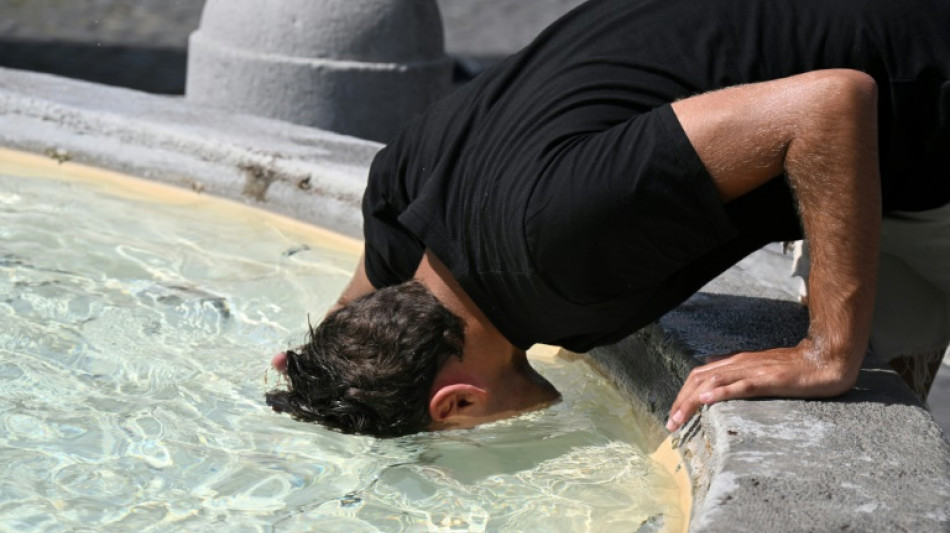
The sizzling temperatures experienced by several countries in southern Europe over the past days are part of a series of brutally hot, dry summers caused by climate change.
Spain has been sweltering under its fourth heatwave of the season, while Greece is struggling for the second time in a month against major wildfires.
Emissions of greenhouse gases are enabling increasingly intense and long-lasting heatwaves, especially in Europe, which the World Meteorological Organization says is the world's fastest warming continent.
AFP looks back at a series of heatwaves in Europe that have left tens of thousands of people dead.
- 2022: hottest ever -
The summer of 2022 was the hottest in Europe's recorded history, and caused the worst drought in centuries and devastating wildfires in France and Spain.
Two heatwaves, one in mid-June and one in July, also made it one of the deadliest summers in years, according to the Nature Medicine journal, which estimates the heat killed more than 61,000 people.
France recorded the biggest rise in heat compared to its previous summer average, with a jump of 2.43 degrees Celsius (36.37 Fahrenheit), Nature's figures showed.
The mercury topped 40C for the first time in the UK in July.
- 2021: blistering heat in Greece -
Between late July and early August, Greece endured the country's worst heatwave in over 30 years.
In Spain, temperatures hit 47C in parts of the south.
The resulting drought sparked large wildfires along the Mediterranean, from Turkey to Spain.
- 2019: Northern Europe swelters -
The summer of 2019 brought two heatwaves, one in late June and one in mid-July.
In France, temperatures hit an all-time record 46C in the southern town of Verargues.
In late July, northern Europe sizzled, with temperatures of 42.6C recorded at Lingen in northwestern Germany.
- 2018: drought drains the Danube -
The second half of July and beginning of August 2018 saw very high temperatures across much of Europe.
The Danube fell to its lowest level in 100 years in some areas, exposing World War II tanks in Serbia submerged since the conflict.
- 2017: months of mugginess -
Much of Europe, but especially the south, sweated in a series of heatwaves from late June well into August.
Spain experienced a record 47.3C on July 13 in the southern town of Montoro.
- 2015: back-to-back heatwaves -
It was heatwave after heatwave throughout the summer of 2015.
In Britain, roads melted and trains were delayed in what was at the time the hottest July on record.
- 2007: Greek forests ablaze -
Central and southern Europe were parched throughout June and July.
In Greece, the worst forest fires in half a century -- some believed to be the result of arson but others the product of heat and drought -- consumed four percent of the country's forests.
- 2003: 70,000 dead -
Britain, France, Italy, Spain and Portugal all experienced exceptional heat in the first half of August.
An EU study of 16 nations puts the number of excess deaths across the bloc during the heatwave as high as 70,000.
In France, most of the estimated 15,000-20,000 fatalities were elderly people left to fend for themselves. Since then the country has devised new systems to protect vulnerable people from the heat.
G.AbuGhazaleh--SF-PST