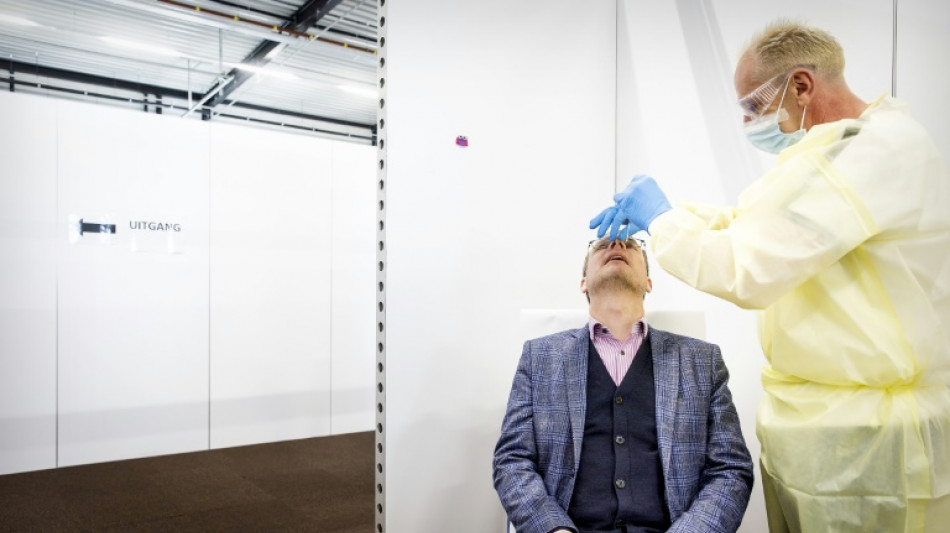
Global Covid cases up 80% as new subvariant rises / Photo: Koen van Weel - ANP/AFP/File

 Alex Bodi pushes ahead with expansion: ALIX LASERS showroom planned for Bucharest
 Fossil fuels off COP31 agenda as global output keeps rising

 Haze not 'a threat' to Singapore F1 race: organisers

 COP31 organisers say to seek 'ambitious' action with their text

 Bartunkova thrashes Muchova to reach China Open semi-finals
 Drone hits Yandex data centre, in first such attack on Russia

 Oil prices surge and stocks sink on fresh inflation worries

 AI startup Manus raises $500m after Meta acquisition blocked by China

 From refuge to repatriations: Malaysia's Myanmar U-turn

 Morikawa says LIV players face 'business decision' after Rahm exit

 Tenzing Norgay's son says Himalayas sending climate warning

 On your bike! Bottas opts for two wheels to reach Singapore GP

 Alcaraz, Sinner, Osaka commit to Australian Open '1 Point Slam'

 Dodgers beat Braves to advance in MLB playoffs, Rays oust Yankees

 'A sun as black as my lungs': how corruption crucified a polluted Albania city

 The British historian helping the French rediscover de Gaulle

 Dodgers beat Braves to advance, Guardians survive in MLB playoffs

 Latin American, Caribbean women top Nobel literature buzz

 US says Fiji-based Chinese official paid bribes for Beijing

 After botched US execution, Christa Pike was nearly taken off life support

 Guinea-Bissau junta urges military unit loyal to ex-president to disarm

 As species decline, green turtles offer glimmer of hope

 Brothers Scott and Beauden Barrett named to start for All Blacks

 EU trade chief seeks to dial down China tensions

 'Never again Bolsonaro': thousands march ahead of Brazil election runoff

The number of new Covid-19 cases reported worldwide rose by 80 percent in the last month, the World Health Organization said on Friday, days after designating a new "variant of interest".
The WHO declared in May that Covid is no longer a global health emergency, but has warned that the virus will continue to circulate and mutate, causing occasional spikes in infections, hospitalisations and deaths.
In its weekly update, the UN agency said that nations reported nearly 1.5 million new cases from July 10 to August 6, an 80 percent increase compared to the previous 28 days.
However the number of deaths fell by 57 percent to 2,500.
The WHO warned that the reported number of cases and deaths do not reflect the true numbers, in part because countries carry out far less testing and monitoring than during earlier stages of the pandemic.
Many of the new cases came in the Western Pacific region, which saw infections jump by 137 percent, the WHO said.
Several countries in the Northern Hemisphere, including the United States, United Kingdom, France and Japan have seen a summer uptick in cases in recent weeks.
Experts have suggested that summer gatherings and travel, declining immunity and a new subvariant may have all played a role in the increase.
On Wednesday, the WHO designated the Omicron subvariant EG.5 as a "variant of interest" following a steady rise in its prevalence.
More than 17 percent of all reported cases were EG.5 in mid-July, up from 7.6 percent a month before, according to the WHO.
- Subvariant poses 'low' risk -
EG.5, which has been unofficially nicknamed "Eris" online, is considered to be a descendant of the XBB lineage of the virus.
It seems to be more transmissible than other circulating variants, likely due to a mutation in its spike protein, and the WHO said it has shown an ability to evade immunity.
But there is no sign that EG.5 causes more severe Covid symptoms and it poses a "low" risk to global public health, the WHO said, comparing its threat to other recent Omicron subvariants.
Nonetheless, WHO chief Tedros Adhanom Ghebreyesus warned that "the risk remains of a more dangerous variant emerging that could cause a sudden increase in cases and deaths".
France's Health Minister Aurelien Rousseau called for vigilance, while emphasising that Covid numbers remain at low levels.
"We will have to live with the resurgence of this virus for several seasons to come," he said in a statement sent to AFP.
Antoine Flahault, director of the Institute of Global Health at the University of Geneva, told AFP that the true Covid situation remained unclear "just about everywhere in the world".
"Health authorities urgently need to reinstate a reliable Covid health monitoring system," he said, calling for wastewater to be analysed to detect virus trends.
While the impact of Covid has been greatly diminished due to high levels immunity from either vaccination or prior infection, the virus still poses a threat -- including long Covid, for which symptoms can last for months or years.
The WHO has urged countries to ramp up vaccination efforts.
Pharmaceutical firms Pfizer/BioNTech, Moderna and Novavax are all working on updating their Covid vaccines to target XBB subvariants.
B.AbuZeid--SF-PST