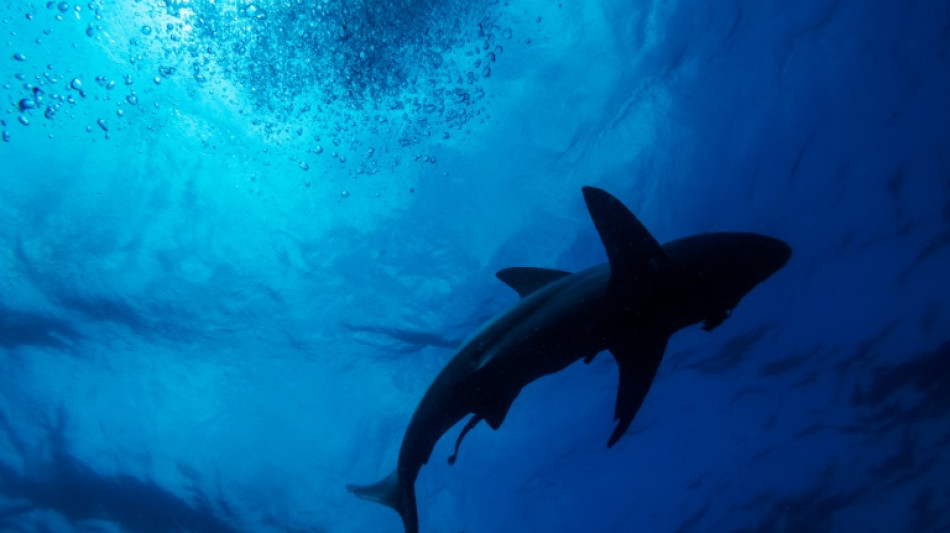
Global wildlife summit to vote on shark protections / Photo: Michele Spatari - AFP/File

 William and Harry: Britain's warring royal brothers

 UN holds second informal poll for next leader

 In US mining hub, black lung rates soar

 Champions Arsenal embrace being 'hunted' as Premier League returns

 World No.2 Rybakina retires from Cincinnati clash with Swiatek

 'I heard you missed me': Melania Trump jokes about month out of spotlight

 Amazon Prime Video to invest $2 bn in Latin America productions

 Panama Canal to reduce shipping over El Nino-fueled drought

 Maradona trial on hold over possible medical evidence mix-up

 'Green dilemma': China's solar boom hurt birds, says study

 Pegula hangs on to dispatch Anisimova, reach Cincinnati semi-finals

 US charges woman with IS-inspired plot to blow up New York State Capitol

 What a record-breaking El Nino could mean for the world

 Duplantis edges Karalis to win Lausanne Diamond League pole vault

 Alcaraz to return for US Open title defence

 China's rapid solar expansion hurt bird diversity: study

 President Paul Biya back in Cameroon after 73 days away

 Newcastle boss Jaissle unfazed by lack of respect

 US Open purse to top $100 mn as Grand Slams form player council

 Hull aim to silence critics after unexpected promotion to Premier League

 Pakistan hit back against England after Cox and Root fifties

 Walmart reports mixed results as gas prices drag on US sales growth

 Wang downs Sindhu to break Indian hearts at badminton worlds

 As Europe's rivers recede, shippers scramble to limit damage

 Alonso won't confirm Fernandez will remain at Chelsea after Man City link

Delegates at a global summit on trade in endangered species will on Friday decide whether to approve a proposal to protect sharks, a move that could drastically reduce the lucrative and cruel shark fin trade.
If approved, dozens of species of the requiem shark and the hammerhead shark families would have their trade tightly controlled under the Convention on International Trade in Endangered Species (CITES).
The shark initiative has been one of the most discussed at this year's CITES summit in Panama, with the proposal co-sponsored by the European Union and 15 countries.
A vote had been expected Thursday but was postponed until Friday, the final day of the summit, as debates over illegal and unregulated hunting of hippos for their meat and ivory dragged on between the European Union and African countries.
Delegates are considering 52 proposals to change species' protection levels. Other species up for possible boosted protections are glass frogs, crocodiles, guitarfish, and some turtle species.
If the new raft of shark protections is applied, "it would be a historic decision," Panamanian delegate Shirley Binder, who presided over the meeting, told AFP earlier in the summit.
"For the first time, CITES would be handling a very large number of shark species, which would be approximately 90 percent of the market," she said.
Insatiable appetite in Asia for shark fins, which make their way onto dinner tables in Hong Kong, Taiwan and Japan, has spurred their trade.
Despite being described as almost tasteless and gelatinous, shark fin soup is viewed as a delicacy and is enjoyed by the very wealthy, often at weddings and expensive banquets.
Shark fins, representing a market of about $500 million per year, can sell for about $1,000 a kilogram (2.2 pounds).
- From villain to darling -
Sharks have long been seen as the villain of the seas they have occupied for more than 400 million years, drawing horror with their depiction in films such as "Jaws" and occasional attacks on humans.
However, these ancient predators have undergone an image makeover in recent years as conservationists have highlighted the crucial role they play in regulating the ocean ecosystem.
According to the Pew Environment Group, between 63 million and 273 million sharks are killed every year, mainly for their fins and other parts.
With many shark species taking more than 10 years to reach sexual maturity, and having a low fertility rate, the constant hunting of the species has decimated their numbers.
In many parts of the world, fisherman lop the shark's fins off at sea, tossing the shark back into the ocean for a cruel death by suffocation or blood loss.
The efforts by conservationists led to a turning point in 2013, when CITES imposed the first trade restrictions on some shark species.
"We are in the middle of a very large shark extinction crisis," Luke Warwick, director of shark protection for the NGO Wildlife Conservation Society (WCS), told AFP at the beginning of the summit.
CITES, which came into force in 1975, has set international trade rules for more than 36,000 wild species.
Its signatories include 183 countries and the European Union.
U.Shaheen--SF-PST