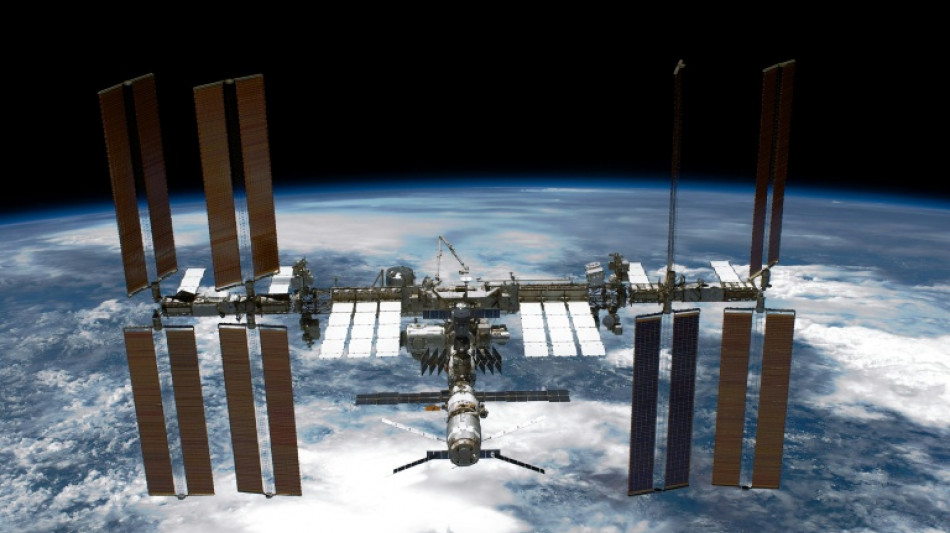
The coming end of ISS, symbol of an era of global cooperation / Photo: NASA - GETTY IMAGES NORTH AMERICA/AFP/File

 Myanmar leader lands in Malaysia for migrant return talks

 Indian central bank hikes rates for first time since 2023

 US military on Okinawa face curfew, alcohol ban after murder case

 Fierce lobbying in EU over 'forever chemicals'

 Dodgers beat Braves and Padres avoid sweep in MLB playoffs

 Mourning, war and elections as Israel marks October 7

 Messi says Argentina retirement is 'saddest day of my career'

 Oil rises and stocks fall as Hormuz worries flare

 Pacific presses world for help 'surviving' climate change at pre-COP summit

 Verstappen revival to be put to the test in steamy Singapore

 US woman who survived botched execution is conscious, speaking: lawyers

 Climate champion Australia digging more coal

 Emotion, tears as Messi retires from Argentina national team

 Dodgers push Braves to the brink of MLB playoff exit

 Crisis-stricken Haiti postpones elections
 N. Korea's Kim pledges 'invariable support' in Putin birthday letter

 OGRD Alliance Advances PLPC Multi-Asset Platform Following APHELAR Milestone, Expanding Licensing and Strategic Capital Frameworks

 Emotion, tears as Messi prepares for Argentina farewell

 Kane eyes Ronaldo record after matching England cap mark

 Spain fight back to beat Croatia, Kane adds to record for England

 Merino double helps Spain beat Croatia, reach Nations League quarters

 US stocks hit fresh records as oil stabilizes on rising supplies

 As Messi bows out, Argentines say 'thank you'

 Ronaldo opens door for Portugal return, apologises for walkout

 'Nobody seems to care': Russian city shrugs off plague reports

When the International Space Station comes back to Earth in 2030, it will mark the end of three decades of peaceful international cooperation -- and an era when space became central to our daily lives.
Since November 2000, there have always been several humans on board the football field-sized scientific laboratory, whipping around the planet at eight kilometres per second.
With a new crew of astronauts set to blast off for the station as soon as next week, some of those who have helped the station from the ground are nostalgic about its looming demise.
"The ISS is a cathedral to human cooperation and collaboration across borders, languages and cultures," John Horack, the former manager of NASA's Science and Mission Systems Office, told AFP.
"For more than 25 years, we have had people in space, 24/7/365," added Horack, who now holds the Neil Armstrong Chair in aerospace policy at Ohio State University.
"It is a testament to how we can 'figure it out' rather than 'fight it out' when we wish to interact with each other."
The ISS was first proposed in the aftermath of the Cold War, illustrating a newfound spirit of cooperation between space race rivals Russia and the United States.
While many ties between Russia and the West have been severed over Moscow's war in Ukraine, cooperation has continued on board the space station.
"The history of human spaceflight is first and foremost the space race," Lionel Suchet of France's space agency CNES told AFP.
"This is a very interesting moment in the evolution of space exploration," said Suchet, who coordinated several early ISS projects after witnessing its predecessor, the Mir space station, de-orbiting in 2001.
- Back to Earth -
However, the ISS is getting old and its equipment is outdated.
NASA announced last year it had selected Elon Musk's SpaceX to build a vehicle that can push the station back into Earth's atmosphere in 2030, where it will break up.
"This large rocket engine will slow down the ISS, and enable it to have a precise re-entry over the Pacific Ocean, far from land, people or any other potential hazards," Horack explained.
Several spacecraft and telescopes -- including Mir -- have met a similar fate, splashing down at an isolated spot in the ocean called Point Nemo.
After 2030, the only space station orbiting Earth will be China's Tiangong.
For the future, the US is focusing more on space stations built and operated by private companies.
"We are moving into an era where space stations have a much more commercial dimension," similar to what has already happened with rockets and satellites, Horack said.
National space agencies would then need to pay these companies to stay on board.
Several companies, including Jeff Bezos's Blue Origin and Axiom Space, are already working on plans to build the first commercial space station.
Suchet emphasised that "the business model will still be largely institutional because countries are always interested in sending astronauts into low-Earth orbit".
Scientific research and exploration also remain an "objective of all humanity", he added, pointing to treaties that govern how nations are supposed to act in space.
Whether these treaties will hold once humans make it to the Moon -- the US and China both have plans to build lunar bases -- remains to be seen.
- 'Quite sad' -
For Horack, the end of the ISS could be seen as "quite sad".
His children "had a lifetime of going out into the backyard to watch the ISS fly over".
But the end of this era will mark the opening of another, he added.
"We must grow as humans in our space-faring capacity, in our exploration of space, and in the use of space to generate social, economic, educational and quality of life outcomes for all people everywhere."
He finished by quoting the former head of the European Space Agency, Jean-Jacques Dordain: "If you want to go fast, go alone. If you want to go far, go together."
K.AbuTaha--SF-PST