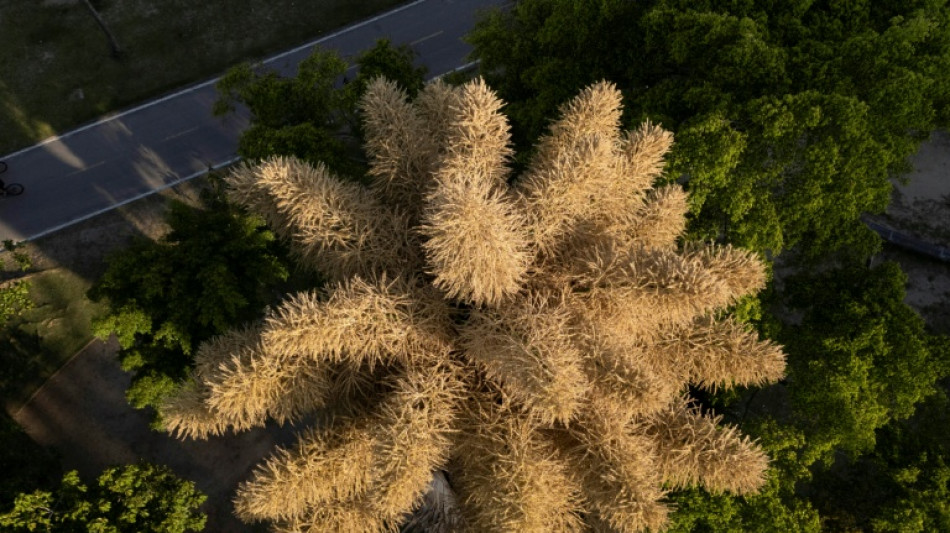
'In her prime': Rare blooming of palm trees in Rio / Photo: Pablo PORCIUNCULA - AFP

 Stocks retreat as bond yield fears persist, oil rises

 ARKBRIDGE’s David Mali Highlights AI-Driven Risk Management at the Finance Magnates London Summit

 Zuckerberg buys Gothic castle in Ireland: spokesman

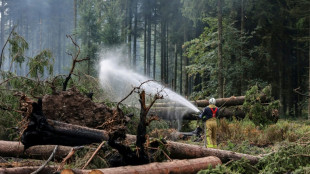 Belgium's fire of the century now 'under control'

 Evergrande's Xu Jiayin: from real-estate tycoon to life in prison

 Spurs eyeing move for Man City's Savinho and Marmoush - reports

 Springboks captain Kolisi to miss first All Blacks Test

 Japan to launch probe for Mars moons in October: space agency

 From beach to Bulls: relaxed Tsunoda savours rare F1 drive

 Prince Harry: key dates in life of returning UK royal

 North Korea launches missiles, Seoul says, after Trump floats Kim meet

 Oil jumps on Iran war tensions, offsetting bond yield fears

 Germany identifies far-right suspect in deadly 1970 antisemitic attack

 PrimeXBT Expands Swap-Free Trading to PXTrader 2.0

 Record number of locations in France top 40C over summer: AFP analysis

 Trump pledges 'economic warfare' on Iran, prompting Tehran derision

 'Girl with a Pearl Earring' in Japan, perhaps for the last time

 Russian strikes kill 13 in Kyiv, surrounding region

 'Simply lovely': Verstappen signs new Red Bull contract until 2030

 Australia coach Walters heading to St Helens after World Cup

 China jails founder, fines disgraced property giant Evergrande

 Russian strikes kill 12 in Kyiv, surrounding region

 US India ambassador's Kashmir remarks rile Pakistan; envoy summoned

 In Senegal's Saint-Louis, traces of slave-trading past fade away

 Russian strikes kill 9 in Kyiv, surrounding region

An extraordinary botanical spectacle is drawing crowds in Rio de Janeiro: several talipot palm trees, planted more than six decades ago, are blooming for the first -- and last -- time in their lives.
The trees, growing in Rio's Aterro do Flamengo park and the Botanical Garden, were planted in the 1960s by the legendary landscape architect Roberto Burle Marx.
Now, some six decades later, these giants have reached the peak of their existence in the Brazilian seaside city.
The talipot palm (Corypha umbraculifera), native to southern India and Sri Lanka, is one of the largest palm species on the planet, some reaching more than 30 meters (98 feet) tall.
It flowers only once in its entire life, if it reaches between 40 and 70 years of age.
"The talipot palm only fruits once in its lifetime, and can produce up to five million fruits," Marcus Nadruz, from the Research Institute of the Rio de Janeiro Botanical Garden, told AFP.
The inflorescences, or flower clusters on stems, began to unfurl in October, forming enormous crowns atop the palm trees that teem with millions of tiny yellowish blossoms.
The entire process, from the opening of the first flowers to the ripening of the fruit, will take about a year, explained Nadruz.
But this splendor has an inevitable end. Once the fruit falls, the palm trees will slowly begin to die.
"I was born in 1961, so she's my age and in her prime," said Deborah Faride, who traveled to see the trees from Sao Paulo and was taking pictures of them with a friend.
"We're the same age and we're blooming together. Just one detail: the talipot is going to die. And I'm going to continue, God willing."
The Botanical Garden plans to collect the seeds to cultivate new seedlings to replace these older plants, and will also distribute them for landscaping projects in public spaces.
S.AbuJamous--SF-PST