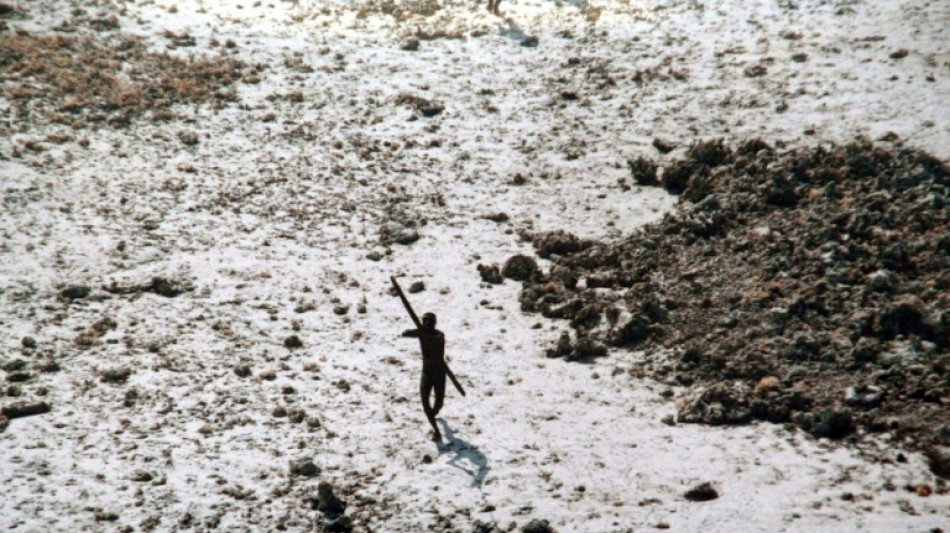
Encroaching world threatens India's last 'uncontacted' tribe / Photo: Handout - Indian Coast Guard/AFP/File

 Kung wins Vuelta time-trial as Mas retains lead

 DR Congo school fire leaves at least 14 children dead

 USA and France ease into women's Basketball World Cup semis

 ECB lifts borrowing costs amid energy shock, opens door for more hikes

 France defeat China to reach women's basketball World Cup semis

 Tribal Launches Campfire, Letting Business and Technical Teams Build on Salesforce Together

 Yemen's Houthis seize key city on Red Sea

 US producer inflation tops expectations as diesel costs jump

 Rubio ends South America swing with Peru security talks

 Defiant Iran seeks to bruise Trump ahead of midterms

 France withdraws support for Infantino in FIFA presidential election

 Evolution Metals & Technologies Provides Initial Revenue Guidance of $400-460mm for Fiscal Year 2027

 Clark-led USA thrash Hungary to move into women's World Cup semi-finals

 Vance takes spotlight as Republicans close Trump-heavy convention
 Russian skater Valieva loses neutral status

 Will Israel's right exploit sanctions in run-up to vote?
 'Metal Gear' creator moves to Xbox after Playstation cancellation

 Indonesia rescues six orangutans from fires in a week

 Macron urges Europe to develop 'crewed spaceflight' programme

 Deals worth billions to be signed as UAE leader visits Germany
 Zamanat Targets GCC’s $250 Billion SME Financing Gap With Up to $100 Million Tokenized Private Credit Fund

 Sri Lanka court revokes monk's pardon, orders return to prison

 'Hopeless, stuck, afraid': US deportees in limbo in Cameroon
 Mount Fuji ends hiking season with landslide, two rescues
 Seahawks beat Patriots again in NFL opener
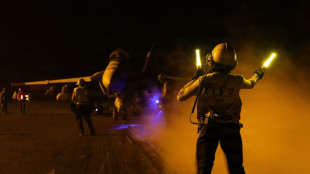
One of the last outsiders to make authorised visits to India's only "uncontacted" tribe says it may be time to reconnect with the isolated people -- in order to shield them from an encroaching world.
Anthropologist Anstice Justin, 71, took part in the government's limited contact missions to the restricted North Sentinel island in the Andaman Sea between 1986 and 2004.
The island's inhabitants are famously resistant to engaging with outsiders, and even killed a US missionary who made an illegal visit in 2018.
What little is known about the Sentinelese -- who live on the 10-kilometre (six-mile) wide island, covered in rainforest and ringed by coral reefs -- comes from the government missions.
But even those trips resulted in extremely limited understanding of the people. "We don't even know how they identify themselves," Justin told AFP on the main Andaman Island -- a different world, but just two hours away by boat.
Justin, himself from another group in the Andaman and Nicobar archipelago, recounted his first trip in 1986 to North Sentinel.
- 'Eyes on, hands off' -
He waded through lagoon waters with saltwater crocodiles, landing on a white sand beach, carrying a sack of coconuts as a sign of goodwill.
"We saw smoke curling, emitting from the forest," said Justin, a former deputy director of the government's Anthropological Survey of India.
"After a few minutes, we saw the Sentinelese emerging from the forest," he added.
The islanders, who government estimates put at 50 people and are designated a "Particularly Vulnerable Tribal Group", made headlines in 2018 when they used bows and arrows to shoot dead an American missionary, John Allen Chau.
Chau broke the government "tribal reserve" exclusion limit stretching five kilometres out to sea, dodging coastguards and marine police.
But Justin, who visited the islands more than 30 times, said his experience was very different.
"What we observed was that there was no sign of unfriendliness, of, allow me to use a term, ferociousness," Justin said.
Observations show the people use narrow outrigger canoes, live in large communal huts, carry spears, bows and arrows, and wear fibre waistbelts, as well as necklaces and headbands.
Justin said that the government's protection policy was well-intentioned -- but that the modern world was not allowing the Sentinelese to be left on their own.
"The present policy that the Andaman and Nicobar administration has adopted is 'eyes on, hands off' -- that means distant observation," Justin said, speaking in the archipelago's capital Sri Vijayapuram -- formerly known as Port Blair, a city of more than 100,000 people.
Outside contact with other islanders had a "devastating impact" in the past with diseases brought in, according to rights group Survival International, noting populations of the Great Andamanese peoples collapsed by as much as 99 percent.
"The Sentinelese have made it clear that they do not want contact," Survival International argues.
- 'Fool's paradise' -
Andaman police chief HGS Dhaliwal said his officers were doing everything possible to protect the island from outsiders, but Justin warned that social media–driven publicity seekers were increasingly difficult to deter.
"It is sometimes a challenge to be able to prevent any kind of incident in totality," Dhaliwal added.
"We do have surprise patrols, but still there have been a couple of incidents where poachers came within five kilometres of the island, and there have been other detections and detentions."
Police in February arrested two fishermen who entered the waters around the island, and last year arrested US citizen Mykhailo Viktorovych Polyakov, who landed for five minutes carrying a can of Diet Coke and a coconut in a bid to become a YouTube star.
"We would be living in a fool's paradise if we assume they are living in their own insulated world," Justin added.
"The self-contained community survived for several thousand years, but with some kind of peaceful situation -- unlike the present day's disturbing situation, where everyone is keen to 'glorify' themselves by seeing the Sentinelese."
Fame-seeker Polyakov, who was arrested in March 2025, pleaded guilty to breaking the protected zone, and was allowed to return to the United States after serving a 25-day jail term and paying a 15,000 rupee ($161) fine.
Justin said that highly-regulated meetings may help the Sentinelese by giving them warnings.
"In the long run, self-contained people may not be able to survive in this competitive world," he said. "We'd at least be able to tell them, 'there are other people who are trying to disturb you'."
P.AbuBaker--SF-PST