
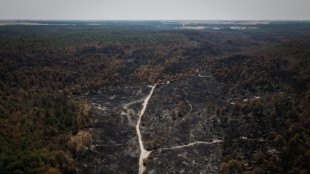
2023's record heat partly driven by 'mystery' process: NASA scientist / Photo: DAVID SWANSON - AFP/File

 Brazil's Lula urges tariffs resolution in call with Trump

 Ukraine says 'cynical' Russian strike on shopping centre killed 14

 Heatwave-hit Europe logs over 30,000 excess summer deaths: first figures

 Give LIV Golf 'one more shot,' says DeChambeau

 Duplantis hits the high notes for athletics anthem

 Malaysia's JDT claims unbeaten run world record

 Bolivian economy minister fired after Congress vote
 Russell roars to Dutch GP sprint pole, Antonelli fifth

 Russell takes pole for Dutch GP sprint

 England start life after Bazball with rout of Pakistan

 'Duck run' pest control catching on in S.Africa's winelands

 UK, Canada, Australia slam Israel ending probe into aid worker killings

 Spurs spending spree vital to raise standards: De Zerbi

 US, Canada try to wrap up trade deal before latest Trump deadline

 World No.1 Sinner withdraws from US Open with knee injury

 Judge allows UK rugby brain injury court case to continue to trial

 Trump announces temporary tariff relief on ground beef imports

 Pope to visit San Marino, address Italian political event

 All Blacks just as good as Springboks, says captain Savea

 Romania holding suspected 'low-level agent' after pistols found near Berlin: Germany

 UK forecasts 'biggest' El Nino will smash records, spark hottest year

 Cyclist Alaphilippe attracts tributes as reports say he has quit

 Top-ranked An, holder Yamaguchi reach badminton worlds semi-finals

 Iran president says time to end war while in position of strength

 Antonelli fastest in sole Dutch GP practice session

It's no secret human activity is warming the planet, driving more frequent and intense extreme weather events and transforming ecosystems at an extraordinary rate.
But the record-shattering temperatures of 2023 have nonetheless alarmed scientists, and hint at some "mysterious" new processes that may be under way, NASA's top climatologist Gavin Schmidt tells AFP.
The following are excerpts from an interview with Schmidt:
- Can you put what we saw in 2023 into perspective? -
It wasn't just a record. It was a record that broke the previous record by a record margin.
We started with La Nina, this cool phenomenon in the tropical Pacific. That was still around until March. And then in May, we started to see the development of an El Nino, the warm phase of that cycle.
It normally affects the temperatures in the following year. So that would be 2024. But what we saw in 2023 was that the temperatures globally seemed to go up with the El Nino event, in a much greater way than we'd ever seen it before.
The long term trends we understand, and it's being driven by the greenhouse gases, it's being driven by anthropogenic effects. We're expecting that to continue, decade by decade, until we stop emitting greenhouse gases into the atmosphere, which we haven't done yet.
But what happened in 2023 was that, and then plus something. And that 'plus something' is much larger than we expect, or as yet can explain.
- What are the leading hypotheses for that 'plus something'? -
There have been emails and conversations going on around the world, among the scientists who are looking at this, and people say, 'Oh, let's look at the Earth's energy imbalances. Let's look at the aerosols, let's look at the El Nino, at what's happening in the Antarctic, in the North Atlantic.' And everybody has lots of ideas, but it doesn't quite add up.
It may be that El Nino is enough. But if I look at all of the other El Ninos that we've had, none of them did this. So either this El Nino is really super special, or the atmosphere is responding to this El Nino in a very special way. Or there's something else going on. And nobody has yet really narrowed these possibilities.
That long-term trend is still within the bounds of what we've been predicting for many years. But the specifics of what happened in 2023 are a little mysterious.
- What should we expect for 2024? -
It matters why 2023 was the way it was, because does that mean it's going to continue? Does that mean the impacts are going to start to accelerate? We don't know! And that's problematic.
2023 did not follow the old patterns. If the old patterns come back, and 2023 was just a blip, then 2024 will be very close to 2023. If it's not a blip, if it's something systematic that's changed, or that's changing, then you would expect 2024 to actually be warmer. Because you have the warmth that you would expect, and then there's this extra thing.
And that has implications for the weather, and heat waves, and intense rainfall, and coastal flooding, and all the rest of it, that we can expect this year.
X.AbuJaber--SF-PST