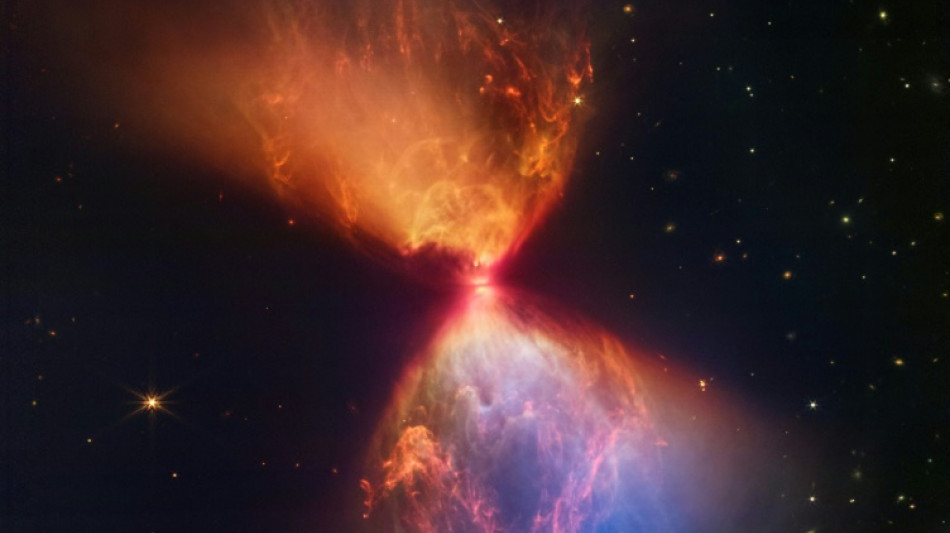
Webb telescope reveals blazing hourglass around forming star / Photo: Handout - ESA, NASA, CSA, STScI/AFP

 Lyon down Palace in Europa League, Sunderland leave it late

 UniCredit says receives ECB green light for Commerzbank takeover
 New York City pension fund asks Anthropic to delay IPO

 Venezuela's Maduro denies US torture charges as 'false accusations'

 Somalia sets May presidential election despite insecurity

 Chelsea's Caicedo eager to be more of a leader

 Rahm reaches separation deal with LIV in bankruptcy court

 UN chief urges nations to end 'war on nature'

 Newcastle boss Jaissle says Fernandez-Pardo just needs a goal

 Infantino offers apology but 'no answers' at FIFA meeting over World Cup plan

 Don't exclude Turkey from 'Made in Europe' plan: minister to AFP

 French duo Justice to score 'GTA VI': game maker

 El Nino a 'terrifying' threat to coral reefs: UN biodiversity expert

 Barcola must get used to Liverpool highs and lows, says Iraola

 Versus Trade Wins Best ECN/STP Broker APAC 2026, Marking Third UF Awards Recognition

 Three dead as Istanbul sees heaviest rainfall in 80 years

 US producer prices see biggest jump since 2022 in added challenge to Trump

 Swiatek avoids seed exodus to breeze into Wuhan last eight
 PM condemns 'chaos' as violent protests grip Albania

 'I couldn't breathe', Russell Brand's alleged rape victim says

 Pope's cancer operation already reshaping papacy

 Zverev cruises past De Minaur to reach Shanghai semi-finals

 Ukraine's Zelensky defies Trump with Russian refinery strikes

 Holders Australia edge New Zealand 24-22 to open Rugby league World Cup

 'Ocarina of Time': Nintendo gives Zelda classic a modern makeover

The James Webb Space Telescope unveiled its latest image of celestial majesty on Wednesday, an ethereal hourglass of orange and blue dust being shot out from a newly forming star at its centre.
The colourful clouds are only visible in infrared light, so had never been seen before being captured by Webb's Near-Infrared Camera (NIRCam), NASA and the European Space Agency said in a statement.
The very young star, known as protostar L1527, is hidden in darkness by the edge of a rotating disk of gas at the neck of the hourglass.
However light spills out from the top and bottom of the disk, lighting up the hourglass-shaped clouds.
The clouds are created by material ejected from the star colliding with surrounding matter, the statement said. The dust is thinnest in the blue sections and thickest in the orange parts, it added.
The protostar, which is just 100,000 years old and at the earliest stage of star formation, is not yet able to generate its own energy.
The surrounding black disk, which is around the size of our solar system, will feed material to the protostar until it eventually reaches "the threshold for nuclear fusion to begin," the statement said.
"Ultimately, this view of L1527 provides a window into what our Sun and solar system looked like in their infancy," it added.
The protostar is located in the Taurus molecular cloud, a stellar nursery home to hundreds of nearly formed stars around 430 light years from Earth.
Operational since July, Webb is the most powerful space telescope ever built, and has already unleashed a raft of unprecedented data as well as stunning images. Scientists are hopeful it will herald a new era of discovery.
One of the main goals for the $10-billion telescope is to study the life cycle of stars. Another main research focus is on exoplanets, planets outside Earth's solar system.
J.AbuHassan--SF-PST