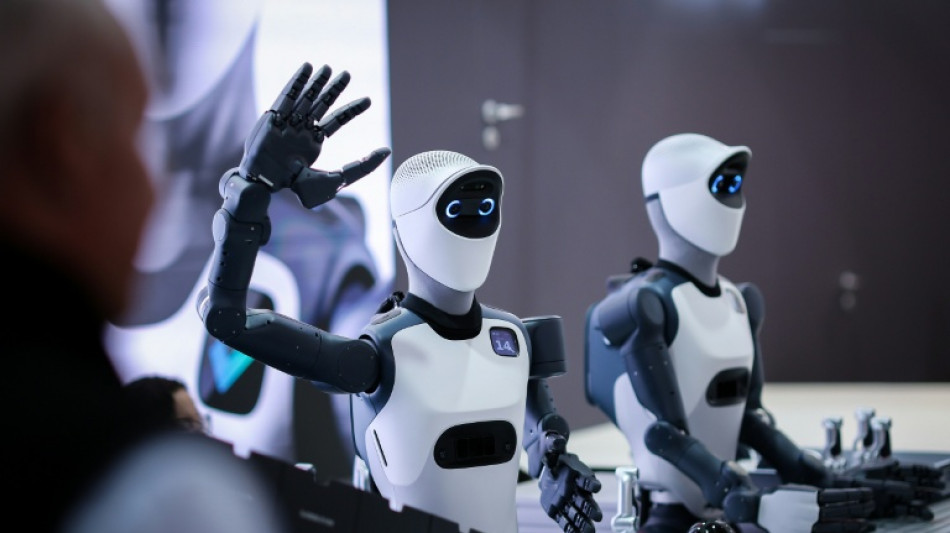
AI-powered robots offer new hope to German factories / Photo: RONNY HARTMANN - AFP

 Nigeria's Tinubu confirms 32 dead after military plane crash

 'Reckless' AI firms can't control models, says whistleblower

 Switching on brain cells: the Nobel-winning science of optogenetics

 Quebec votes as separatist surge poses test for Canada PM

 Euro slides as concerns about French debt mount

 Former Trump press secretary Leavitt joins Fox News

 Djokovic advances to China Open final as Medvedev out for hitting fan with ball
 Disgraced former US House speaker dies at 84

 Euro slides as worries about French debt grow

 US withdraws all bomber aircraft from UK airbase

 Drone hits Ethiopia IDP camp as fears grow of regional war

 US-German trio wins medicine Nobel for illuminating the brain

 England captain Kane driven by desire for records says Tuchel

 N.Irish court hears challenge to disputed Orangemen parade

 Talking points from the Bahrain Grand Prix in Malaysia

 Yemen, Saudi Arabia target Houthis in new campaign as war escalates

 US-German trio wins medicine Nobel for work on optogenetics
 Swiatek, Zheng survive three-set tests in China Open third round
 Hasan says Test cricket momentum turning for Bangladesh

 Intense heat puts births in jeopardy, UN tells Fiji talks

 US arrests woman accused of spying for China on Taiwan leader's family

 Yemen military announces broad strikes against Houthis

 Zuckerberg skewered again on screen in 'The Social Reckoning'

 Fiji urges 'just' climate transition, financing at pre-COP gathering

 Thailand's Jeeno overcomes late wobble to win Lotte Championship

A blue-eyed humanoid robot carefully opens a box and places a tool inside as a crowd of visitors watch the demonstration of "physical AI" skills at a major industrial trade fair in Germany.
Made by German startup Agile Robots, it was among a host of robots showing off their moves at the event, underlining hopes of a coming AI-powered boost for Germany's long-struggling factories.
Embedding the technology into industrial processes, where Europe already has deep expertise, is seen as a key route for the continent to catch up in the artificial intelligence race against the United States and China.
Such AI-boosted robots make it possible to "actually solve industrial problems", Rory Sexton, chief executive of Agile Robots, told AFP in an interview.
From next year, he added, the company plans to begin fitting out German factories, particularly those in the automotive industry, a crucial sector for Europe's biggest economy.
Artificial intelligence used for real-world, hands-on tasks -- so-called physical AI -- was in focus this year in Hanover at the world's biggest industrial technology fair, which brings together more than 3,000 exhibitors.
Chancellor Friedrich Merz visited the Agile Robots stand, where he talked to Zhaopeng Chen, the Chinese founder of the Munich-based startup.
In a speech at the fair, Merz threw his support behind the drive to encourage German manufacturers, many of whom still rely on traditional techniques, to step up their use of AI.
AI should be "embedded in the key sectors of our industry and especially" in small- and medium-sized firms, the backbone of the German economy, to create "industrial added value and high-quality jobs", he said.
- 'Dark side' of AI -
But, like in many other industries, German manufacturers are playing catch-up against China when it comes to making humanoid robots.
Merz witnessed China's progress in the field first-hand during a visit to the country in February, when he saw displays of Chinese-made robots performing kung fu and boxing.
The maker of those robots, Unitree, and other Chinese manufacturers were also out in force at the Hanover fair, as they have been in previous years.
Still, Sexton of Agile Robots insisted that "we'll soon be able to do what (Unitree) are doing", and shrugged off such impressive public displays.
Rather than dancing or martial arts, Agile Robots is focused on "value-added tasks for industry", such as electronic wiring in cars or phone assembly, he said.
He emphasised that Germany offers an "ecosystem of suppliers" and "very strong expertise in mechanical engineering and automation", both crucial in the race for AI.
Companies are also hopeful about the technological developments -- 58 percent of industrial firms surveyed by German digital business association Bitkom believe humanoid robots could help plug skilled labour shortages.
The country also has deep pools of industrial data to draw on from its factories, according to Antonio Krueger, head of the German Research Centre for Artificial Intelligence (DFKI).
"This is something we have at a level of quality far superior to the United States or China," he told AFP.
But, critics say, the use of this data is still often too piecemeal and isolated, with no overarching strategy to bring it together cohesively.
Not everyone in Hanover was convinced that AI was the solution to the woes of Germany manufacturers, who have long been struggling with issues from high energy costs to weak demand.
Jochen Heinz, an executive from German factory machinery maker SW Machines, cautioned that AI can sometimes make mistakes by, for instance, giving misleading instructions for repairs or incorrectly claiming to have detected problems.
"With AI, I also see the dark side of the force," he said.
H.Nasr--SF-PST