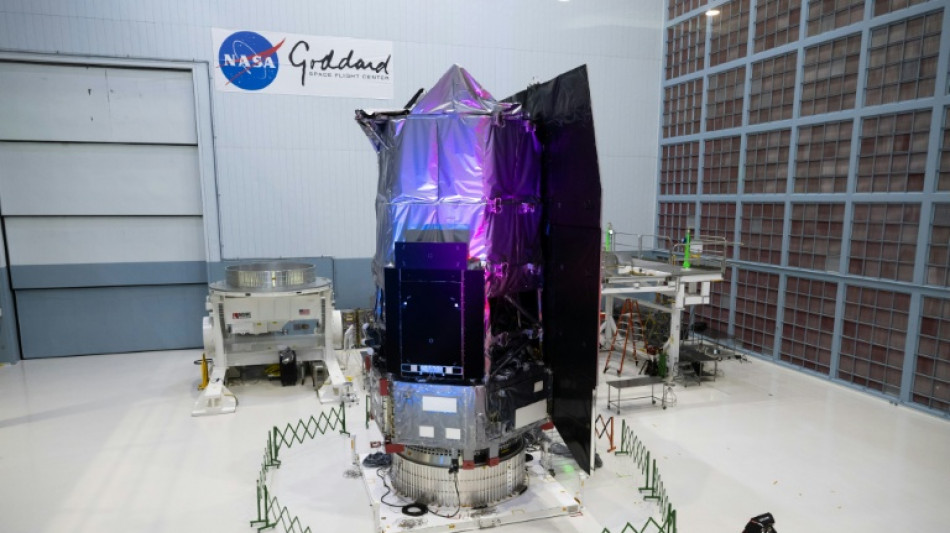
NASA unveils new space telescope to give 'atlas of the universe' / Photo: SAUL LOEB - AFP

 Two dead as Istanbul endures heaviest rainfall in 80 years

 After latest Nepal flood, survivors fear for future

 EU leaders clash over budget as spectre of French elections looms

 'No place to breathe': life in Indonesia's fire epicentre

 'Can't sleep': Spain's housing crunch upends lives

 Musk calls on Ukraine's Zelensky to 'go' after satellite slowdown row

 Still smiling at 117, Albanian may be world's oldest woman

 Pope has 'good night' in hospital: Vatican

 China's economy seen missing target as global shocks bite: AFP poll

 Costa Rica opens jail inspired by El Salvador mega-prison

 Same-sex couple takes fight for equality to Slovakian court

 'High hopes' as Indonesian women get a football league, again

 'Expectations high' for Bordeaux-Begles' Champions Cup hat-trick bid, says Depoortere

 Rennie urges All Blacks to stay focused against 'hurting' Wallabies

 Palmeiras beat Fluminense 2-1 in Libertadores semi-final first leg

 Brewers blasts leave Dodgers on brink

 Tech stock lead rout after US inflation fuels rate hike bets

 Al-Fayed survivors say UK police missing 'bigger picture'

 Online 'witch hunt' sweeps up Asians misidentified as US rape accused

 Prospect of Bolsonaro win looms large over Brazil's Indigenous

 Freed from Belarus, founder of Lady Gaga's biggest fan site tells his story

 Behind AI's carbon footprint, a potential climate tool

 Trump's new press secretary faces scrutiny over credentials

 PSG 'got lucky' to win Man City thriller, says Luis Enrique

 Real Madrid comeback stuns Roma as Mourinho enjoys happy reunion

NASA unveiled a new telescope on Tuesday to scan vast swathes of the universe for planets outside our solar system and probe the mysteries of dark matter and dark energy.
The Roman space telescope is expected to discover tens of thousands of planets, possibly offering clarity abut how many could be out there.
"Roman will give the Earth a new atlas of the universe," NASA administrator Jared Isaacman told a news conference at the Goddard Space Flight Center in Maryland, where the telescope went on display.
The 12-metre (39-feet), silvery contraption with massive solar panels will be transported to Florida ahead of a launch into space aboard a SpaceX rocket planned for September at the earliest.
Roman, which took more than $4 billion and over a decade to build, is named after astronomer Nancy Grace Roman, nicknamed the "Mother of Hubble" for her role in developing the landmark space telescope.
Thirty-six years after Hubble launched into space, revolutionizing astronomical observations, NASA hopes Roman will help to shed light on questions that remain unresolved.
Boasting a field of view at least 100 times larger than Hubble's, the telescope will sweep across vast regions of space from its position 1.5 million kilometres (930,000 miles) from Earth.
The telescope will send 11 terabytes of data a day down to Earth, said Mark Melton, a systems engineer at Goddard Space Flight Center.
"In the first year, we'll have sent down more data than Hubble will have for its entire life," he told AFP.
The telescope's wide-angle lens will allow NASA to conduct a census of the objects that make up our universe, said Nicky Fox, associate administrator for NASA's Science Mission Directorate.
"Roman will discover tens of thousands of new planets outside our solar system. It will reveal billions of galaxies, thousands of supernovae and tens of billions of stars," she said.
This wealth of information will enable NASA to tease out areas of interest that can then be investigated by complementary telescopes, such as the James Webb Space Telescope.
- Study the invisible -
But Roman will also study the invisible -- dark matter and dark energy, whose origins remain unknown but which are thought to constitute 95 percent of our universe.
Dark matter is believed to be the glue that holds galaxies together, while dark energy pulls them apart by making the universe expand faster and faster over time.
Thanks to its infrared vision, the telescope will be able to observe light emitted by celestial bodies billions of years ago, effectively looking back in time to hopefully discover more about the two phenomena.
Complementing the work of Europe's Euclid space telescope and the Vera Rubin Observatory in Chile, Roman will probe "how the dark matter structures itself throughout cosmic time" and "calculate how fast galaxies are moving away from us," Darryl Seligman, an assistant professor of physics and astronomy at Michigan State University, told AFP.
These discoveries could fundamentally change our understanding of the structure of our universe, said astrophysicist Julie McEnery, who led the Roman project.
"If Roman wins a Nobel Prize at some point, it's probably for something we haven't even thought about or questioned yet," said Melton.
O.Mousa--SF-PST