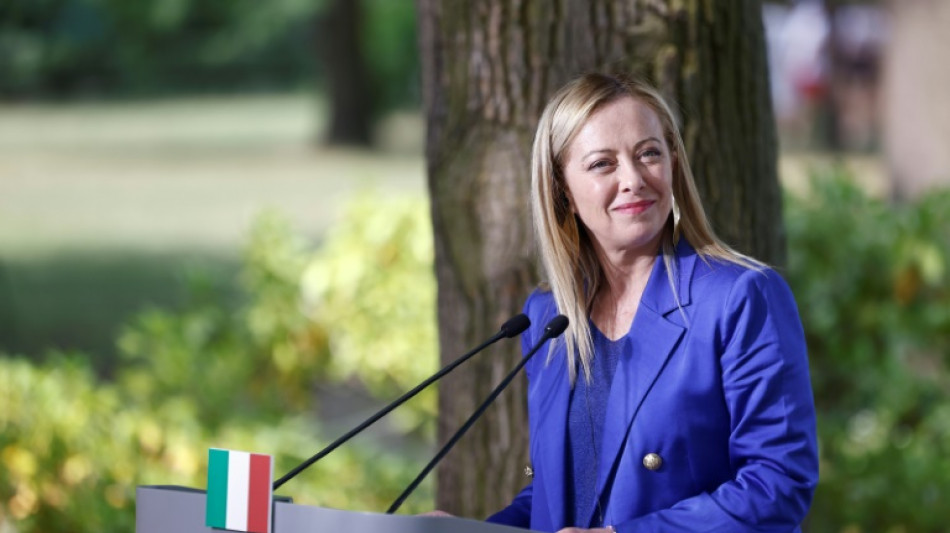
As Italy turns again to Africa, 'good coloniser' myth persists / Photo: Wojtek Radwanski - AFP

 누샤 아우벨: 새로운 출발 대신 드러난 리더십 실패 — 포츠담 시장은 과연 직무를 감당할 능력이 있는가?

 noosha-aubel-lingdao-shibai-bocitan-shizhang-nengfou-shengren

 Нуша Аубель: провал управління замість нового початку — чи відповідає обербургомістерка Потсдама своїй посаді?

 Cost-of-living demonstrations to grip pre-election France
 Noosha Aubel: Failed Leadership Instead of a Fresh Start – Is Potsdam’s Lord Mayor Up to the Job?

 'Real inequality': France's education divide laid bare by protests

 Opera on Ukraine's children aims to 're-awaken' concern for war

 AI is coming for every company, Nvidia boss says

 Millions may be forced to move as climate change hits South Asia: UN

 Four killed battling Indonesia fires as toxic haze cloaks region

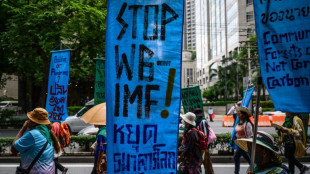 Thai farmers, fishermen challenge IMF, World Bank at Bangkok rally

 In Malaysia, frustration grows over Indonesia haze
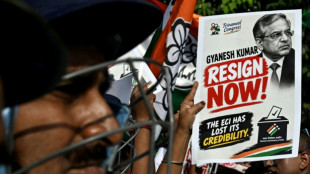 Why India's voter revision drive has stoked fear and anger

 Munster eye fitting tribute to 'special' Foley in Racing reunion

 Shooter kills teacher, three children at Oregon elementary school

 Fed's Warsh surprised by world economy's 'resilience'

 Four killed in Indonesia battling fires causing toxic haze

 New Zealand star Ponga breaks arm in Rugby League World Cup opener

 Indonesian stocks dive 11% as MSCI weighs market reclassification

 Seoul dismisses Pyongyang's scepticism over hypersonic weapon test

 Yamal on song as entertainers Barcelona face Betis challenge

 Wong weighs haze prosecutions as Singapore air quality worsens

 Brush fire prompts an evacuation order along Los Angeles coast

 'Mixed feelings': AI cracks centuries-old ciphers

 Le Pen looms large as Macron enters final months on EU stage

Italy's government is eyeing Africa in pursuit of energy security, even as some officials defend Rome's often-bloody colonial past on the continent -- giving short shrift to historical accuracy.
Historians agree that hundreds of thousands of civilians were killed under Italian colonial rule in Libya, Ethiopia, Eritrea and what is now Somalia from the late 19th century to the first half of the 20th.
Yet Italy's deputy foreign minister, Edmondo Cirielli, said in June that the country's presence on the continent was "civilising", without bloodshed or repression.
"Whether before or during Fascism... (Italy) in Africa built and created a civilising culture" in its colonies, said Cirielli, a member of Prime Minister Giorgia Meloni's post-Fascist Brothers of Italy party, borrowing the "good colonisers" myth popular on the far right.
"Our ancient and thousand-year-old culture does not make us a people of pirates who go around plundering the world," Cirielli said, in comments that raised eyebrows among historians and the left-wing opposition.
Unlike Germany reconciling with its Nazi past or France with its occupation of Algeria, Italy has been slow to embark on public soul-searching about its colonial history.
But opposition lawmakers have now drafted a bill to establish a "Day of Remembrance for the victims of Italian colonialism" in the four African countries.
The suggested date is February 19, which marks the start of a massacre of Ethiopian civilians by Italian troops in Addis Ababa in 1937.
"Other countries such as Belgium and Germany have apologised for the crimes of colonialism," said Laura Boldrini, an MP for the centre-left Democratic Party who co-authored the bill.
"In Italy, we tend to deny and tell ourselves that 'Italy, good people' built roads, hospitals and schools," she said.
Boldrini, a former head of the lower house of parliament, said right-wing newspapers had written disparaging articles about the text, "and this government does not take colonial crimes seriously".
The bill has little chance of being adopted given the opposition of Meloni's coalition, which has a parliamentary majority.
- 'History of violence' -
Alessandro Pes, a professor of contemporary history at the University of Cagliari, said the "stereotype of the 'good coloniser' has no significant historical foundation".
Rather, that rhetoric "hid a desire for colonial expansion carried out through the use of violence and the forced subordination of colonised populations", Pes told AFP.
Italy's eyes turned to expansion after it became a unified state in 1861, with the young nation anxious to establish a toehold in Africa in competition with other European powers.
It sought "to resolve the big problems of unemployment and social malaise in Italy" by exporting workers to newly occupied territories in the Horn of Africa, said Uoldelul Chelati Dirar, a professor of African history at the University of Macerata.
Differing from its European rivals, however, Italy developed more infrastructure like roads, bridges and railways while in Africa -- something right-wing politicians are quick to point out, he said.
Those investments have fuelled the "good people" myth that is deeply rooted in Italian society, "reflected in the extreme resistance to accepting the evidence that our history has also been a history of violence, exploitation and racism", added Pes.
British historian Ian Campbell estimates that Italy's occupation of Libya, Ethiopia, Eritrea and then-Italian Somaliland caused 700,000 African deaths.
This includes 150,000 people killed in Libya alone during the Fascist era under Benito Mussolini, Chelati Dirar said.
- Educational gap? -
In 2008, Silvio Berlusconi, then prime minister, signed a deal with Libyan dictator Muammar Gaddafi to pay $5 billion in investments to compensate for what the premier called "damage inflicted on Libya by Italy during the colonial era".
But little is taught in Italian schools today about this aspect of its past, prompting some historians to make a link between an educational gap and modern-day racism.
Meanwhile, Meloni has criticised Italy's European partners and fellow colonial powers -- without naming them -- during speeches addressed to African nations, as she seeks new deals on energy and access to raw materials.
Earlier this month in the Republic of Congo, she called for "an approach that is not the predatory and paternalistic one that has characterised relations with certain countries in the past".
S.AbuJamous--SF-PST