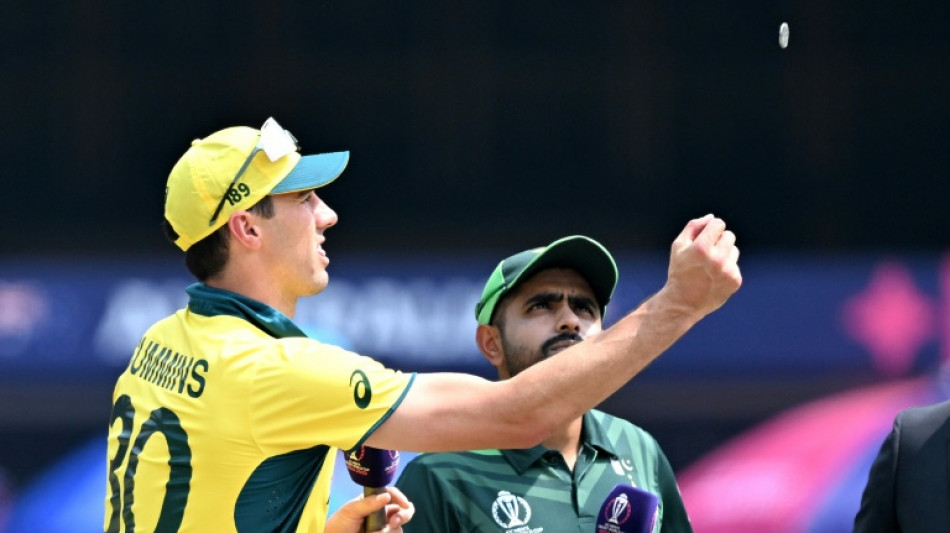
Coin tosses are not 50/50: researchers find a slight bias / Photo: Sajjad HUSSAIN - AFP/File

 누샤 아우벨: 새로운 출발 대신 드러난 리더십 실패 — 포츠담 시장은 과연 직무를 감당할 능력이 있는가?

 noosha-aubel-lingdao-shibai-bocitan-shizhang-nengfou-shengren

 Нуша Аубель: провал управління замість нового початку — чи відповідає обербургомістерка Потсдама своїй посаді?

 Cost-of-living demonstrations to grip pre-election France

 Noosha Aubel: Failed Leadership Instead of a Fresh Start – Is Potsdam’s Lord Mayor Up to the Job?

 'Real inequality': France's education divide laid bare by protests
 Opera on Ukraine's children aims to 're-awaken' concern for war

 AI is coming for every company, Nvidia boss says

 Millions may be forced to move as climate change hits South Asia: UN

 Four killed battling Indonesia fires as toxic haze cloaks region
 Thai farmers, fishermen challenge IMF, World Bank at Bangkok rally

 In Malaysia, frustration grows over Indonesia haze

 Why India's voter revision drive has stoked fear and anger

 Munster eye fitting tribute to 'special' Foley in Racing reunion
 Shooter kills teacher, three children at Oregon elementary school

 Fed's Warsh surprised by world economy's 'resilience'
 Four killed in Indonesia battling fires causing toxic haze
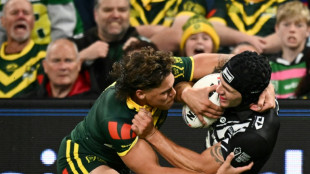 New Zealand star Ponga breaks arm in Rugby League World Cup opener
 Indonesian stocks dive 11% as MSCI weighs market reclassification
 Seoul dismisses Pyongyang's scepticism over hypersonic weapon test

 Yamal on song as entertainers Barcelona face Betis challenge

 Wong weighs haze prosecutions as Singapore air quality worsens

 Brush fire prompts an evacuation order along Los Angeles coast

 'Mixed feelings': AI cracks centuries-old ciphers

 Le Pen looms large as Macron enters final months on EU stage
Want to get a slight edge during a coin toss? Check out which side is facing upwards before the coin is flipped –- then call that same side.
This tactic will win 50.8 percent of the time, according to researchers who conducted 350,757 coin flips.
For the preprint study, which was published on the arXiv database last week and has not yet been peer-reviewed, 48 people tossed coins of 46 different currencies.
They were told to flip the coins with their thumb and catch it in their hand -- if the coins fell on a flat surface that could introduce other factors such as bouncing or spinning.
Frantisek Bartos, of the University of Amsterdam in the Netherlands, told AFP that the work was inspired by 2007 research led by Stanford University mathematician Persi Diaconis -- who is also a former magician.
Diaconis' model proposed that there was a "wobble" and a slight off-axis tilt that occurs when humans flip coins with their thumb, Bartos said.
Because of this bias, they proposed it would land on the side facing upwards when it was flipped 51 percent of the time -- almost exactly the same figure borne out by Bartos' research.
While that may not seem like a significant advantage, Bartos said it was more of an edge that casinos have against "optimal" blackjack players.
It does depend on the technique of the flipper. Some people had almost no bias while others had much more than 50.8 percent, Bartos said.
For people committed to choosing either heads or tails before every toss, there was no bias for either side, the researchers found.
None of the many different coins showed any sign of bias either.
Happily, achieving a fair coin flip is simple: just make sure the person calling heads or tails cannot see which side is facing up before the toss.
- 'It's fun to do stupid stuff' -
Bartos first heard of the bias theory while studying Bayesian statistics during his master's degree, and decided to test it on a massive scale.
But there was a problem: he needed people willing to toss a lot of coins.
At first he tried to persuade his friends to flip coins over the weekend while watching "Lord of the Rings".
"But nobody was really down for that," he said.
Eventually Bartos managed to convince some colleagues and students to flip coins whenever possible, during lunch breaks, even while on holiday.
"It will be terrible," he told them. "But it's fun to do some stupid stuff from time to time."
The flippers even held weekend-long events where they tossed coins from 9am to 9pm. A massage gun was deployed to soothe sore shoulders.
Countless decisions have been made by coin tosses throughout human history.
While writing his paper, Bartos visited the British Museum and learned that the Wright brothers used one to determine who would attempt the first plane flight.
Coin tosses have also decided numerous political races, including a tied 2013 mayoral election in the Philippines.
But they are probably most common in the field of sport. During the current Cricket World Cup, coin tosses decide which side gets to choose whether to bat or field first.
I.Saadi--SF-PST