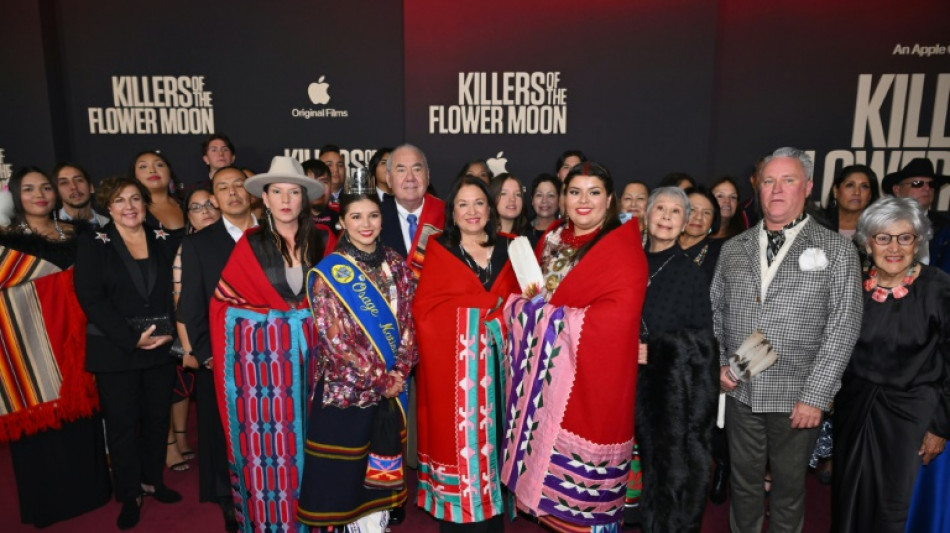
Scorsese 'Flower Moon' epic based on real Native American past / Photo: ANGELA WEISS - AFP/File

 Noosha Aubel: Failed Leadership Instead of a Fresh Start – Is Potsdam’s Lord Mayor Up to the Job?

 'Real inequality': France's education divide laid bare by protests

 Opera on Ukraine's children aims to 're-awaken' concern for war

 AI is coming for every company, Nvidia boss says

 Millions may be forced to move as climate change hits South Asia: UN

 Four killed battling Indonesia fires as toxic haze cloaks region

 Thai farmers, fishermen challenge IMF, World Bank at Bangkok rally

 In Malaysia, frustration grows over Indonesia haze

 Why India's voter revision drive has stoked fear and anger

 Munster eye fitting tribute to 'special' Foley in Racing reunion

 Shooter kills teacher, three children at Oregon elementary school

 Fed's Warsh surprised by world economy's 'resilience'

 Four killed in Indonesia battling fires causing toxic haze

 New Zealand star Ponga breaks arm in Rugby League World Cup opener

 Indonesian stocks dive 11% as MSCI weighs market reclassification

 Seoul dismisses Pyongyang's scepticism over hypersonic weapon test

 Yamal on song as entertainers Barcelona face Betis challenge

 Wong weighs haze prosecutions as Singapore air quality worsens

 Brush fire prompts an evacuation order along Los Angeles coast

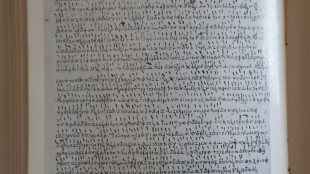 'Mixed feelings': AI cracks centuries-old ciphers

 Le Pen looms large as Macron enters final months on EU stage

 Three children, one teacher killed in Oregon elementary school shooting
 Man Utd teetering towards crisis as Man City cloud hangs over Premier League

 Trump's new press secretary defends 'lawyer' title

 Wallabies coach has 'faith' as All Blacks juggernaut awaits

Martin Scorsese's new film "Killers of the Flower Moon" recounts how the Osage nation of Native Americans gained significant oil wealth in the early 20th century and the murderous plot by outsiders to seize it.
Ahead of the movie's US release, AFP looks at the real-life story behind the film, which was adapted from US author David Grann's 2017 book of the same name.
- Who are the Osage? -
The Osage, a Native American nation which grew out of the Ohio and Mississippi River valleys, was forcibly relocated by the US government in the late 19th century westward to a reservation in what would later become the central state of Oklahoma.
As the new proprietors of the land, the nation in 1906 negotiated a rare agreement with the federal government giving Osage members exclusive mineral rights which could not be transferred or sold, only inherited.
Not long after, prospectors discovered that the Osage Reservation lied on an enormous oil reserve.
With demand for oil skyrocketing, the Osage quickly gained wealth.
In 1923 alone, according to Grann, the nation earned the equivalent of more than $400 million in today's money.
White settlers flocked to the area to take advantage of the black gold windfall.
They set up businesses, married members of the tribe or became managers of the Osage members' fortunes.
In 1921, Congress passed a racist law requiring Native Americans to have a guardian of the oil wealth appointed until they proved their "competency."
- What was the Reign of Terror? -
From 1921 to 1925, a series of murders and suspicious deaths struck the Osage Nation, who have dubbed the period the "Reign of Terror."
Mollie Kyle Burkhart's family was particularly hard-hit. Her sister Anna Kyle Brown was shot in the head in 1921, and their mother Lizzie died a few months later of suspected poisoning.
Rita Smith, another of Mollie's sisters, and husband Bill died after a bomb exploded in their home in 1923.
Their distant cousin, Henry Roan, was also found shot in the head the same year.
The Osage nation states on its website that at least 60 people were killed during this period, but that there were potentially even more murders, as some suspicious deaths were never investigated.
- Federal investigation -
With the death toll mounting, US authorities relaunched an investigation in 1925 under the auspices of the Bureau of Investigation, a forerunner of today's FBI.
After months of investigation, the federal officials uncovered an intra-family plot.
Burkhart's husband Ernest, a white settler, and his uncle William Hale, a wealthy white rancher, had orchestrated the murders in order to take control of their oil rights.
Ernest Burkhart and Hale, after attempting to cover up the crimes, were convicted of murder and received life sentences in 1926 and 1929.
Grann alleges in his book that other murders, which went without convictions due to a lack of evidence, are almost all attributed to people from outside the nation seeking to seize Osage oil rights.
- Today -
Around a quarter of the shares of the reservation's oil rights are held today by non-Osages. Most of the oil has since dried up, however, and royalty checks now amount to only a few thousand dollars.
The Osage Nation is nonetheless pushing for federal legislation that would allow the non-Osages' shares to be gifted or sold back to the nation.
The murders of the 1920s left an indelible mark on the memory of the Osage community, which was heavily involved in the making of Scorsese's film.
Alongside stars Leonardo DiCaprio and Robert De Niro, the film features Osage actors, props made by Osage craftworkers and involved work with Osage language experts.
A.AbuSaada--SF-PST