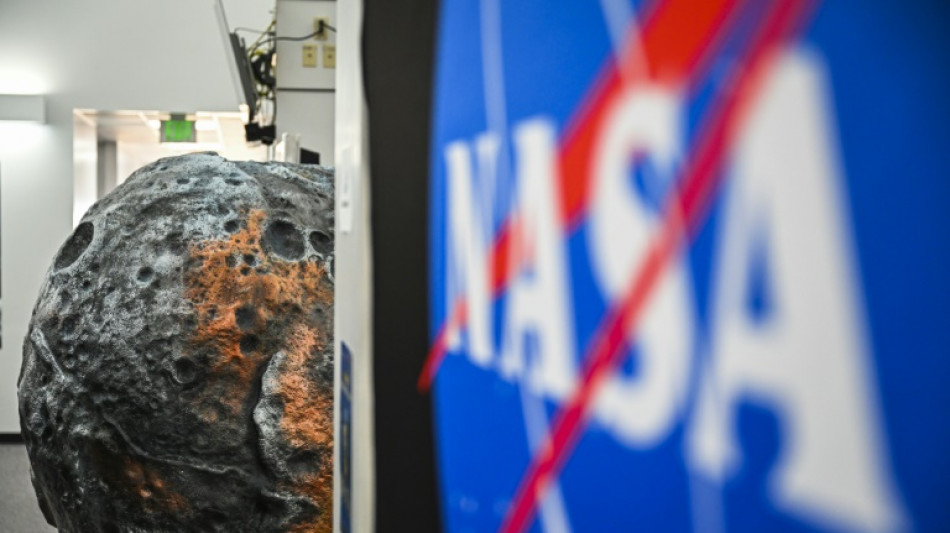
NASA set to journey to a metal-rich asteroid / Photo: CHANDAN KHANNA - AFP

 Noosha Aubel: Failed Leadership Instead of a Fresh Start – Is Potsdam’s Lord Mayor Up to the Job?

 'Real inequality': France's education divide laid bare by protests

 Opera on Ukraine's children aims to 're-awaken' concern for war

 AI is coming for every company, Nvidia boss says

 Millions may be forced to move as climate change hits South Asia: UN

 Four killed battling Indonesia fires as toxic haze cloaks region

 Thai farmers, fishermen challenge IMF, World Bank at Bangkok rally

 In Malaysia, frustration grows over Indonesia haze

 Why India's voter revision drive has stoked fear and anger

 Munster eye fitting tribute to 'special' Foley in Racing reunion

 Shooter kills teacher, three children at Oregon elementary school

 Fed's Warsh surprised by world economy's 'resilience'

 Four killed in Indonesia battling fires causing toxic haze

 New Zealand star Ponga breaks arm in Rugby League World Cup opener

 Indonesian stocks dive 11% as MSCI weighs market reclassification

 Seoul dismisses Pyongyang's scepticism over hypersonic weapon test

 Yamal on song as entertainers Barcelona face Betis challenge

 Wong weighs haze prosecutions as Singapore air quality worsens

 Brush fire prompts an evacuation order along Los Angeles coast

 'Mixed feelings': AI cracks centuries-old ciphers

 Le Pen looms large as Macron enters final months on EU stage

 Three children, one teacher killed in Oregon elementary school shooting

 Man Utd teetering towards crisis as Man City cloud hangs over Premier League

 Trump's new press secretary defends 'lawyer' title

 Wallabies coach has 'faith' as All Blacks juggernaut awaits

It's a world like no other: a metal-rich asteroid that could be the remnants of a small planet, or perhaps an entirely new type of celestial body unknown to science.
A NASA probe is set to blast off Friday bound for Psyche, an object 2.2 billion miles (3.5 billion kilometers) away that could offer clues about the interior of planets like Earth.
"We've visited either in person or robotically worlds made of rock, worlds made of ice and worlds made of gas... but this will be our first time visiting a world that has a metal surface," lead scientist Lindy Elkins-Tanton told reporters during a briefing this week.
NASA and SpaceX are targeting Friday at 10:19 am Eastern Time (1419 GMT) for launch from Kennedy Space Center, aboard a SpaceX Falcon Heavy rocket, with a backup window on Saturday if weather conditions are unfavorable.
Trailing a blue glow from its next-generation electric propulsion system and flanked by two large solar arrays, the van-sized probe should arrive at its destination in the Asteroid Belt, between Mars and Jupiter, in July 2029.
- Studying cores of rocky planets -
Over the following two years, it will deploy its suite of advanced instruments to look for evidence of an ancient magnetic field, probe its chemical composition, and study the minerals and topography of Psyche.
Scientists think Psyche, named after the goddess of the soul in Greek mythology, could be part of the iron-rich core of a "planetesimal," a building block of all rocky planets.
It could also be something else -- a leftover piece of an iron-rich, primordial solar system object that's not yet been documented.
"This is our one way to see a core," said Elkins-Tanton. "We say tongue in cheek that we're going to outer space to explore inner space."
Psyche is thought to have an irregular, potato-like shape, measuring 173 miles (280 kilometers) across at its widest point -- though it's never actually been seen up close.
Until recently, scientists thought it was overwhelmingly composed of metal -- but analyses based on reflected radar and light now indicate that metal probably comprises between 30-60 percent, with the rest being rock.
- Solar electric propulsion -
The mission will include several technological innovations.
The Psyche spacecraft, named after the asteroid, will test out next generation communications based on lasers, rather than radio waves -- a step NASA compares to upgrading old telephone lines on Earth to fiber optics.
Deep Space Optical Communications, as the system is called, "was designed to demonstrate 10 to 100 times the data-return capacity of state-of-the-art radio systems used in space today," said Abi Biswas of NASA's Jet Propulsion Laboratory in a statement.
Psyche also uses a special kind of propulsion system called "Hall-effect thrusters" that harnesses the energy from solar panels to create electric and magnetic fields that, in turn, expel charged atoms of xenon gas.
The thrust it exerts is roughly equal to the weight of an AA battery in your hand. But in the void of space, the spacecraft will accelerate continuously to tens of thousands of miles per hour.
Such systems avoid the need to carry thousands of pounds of chemical fuel into space, and Psyche will be the first time they are used beyond lunar orbit.
E.Aziz--SF-PST