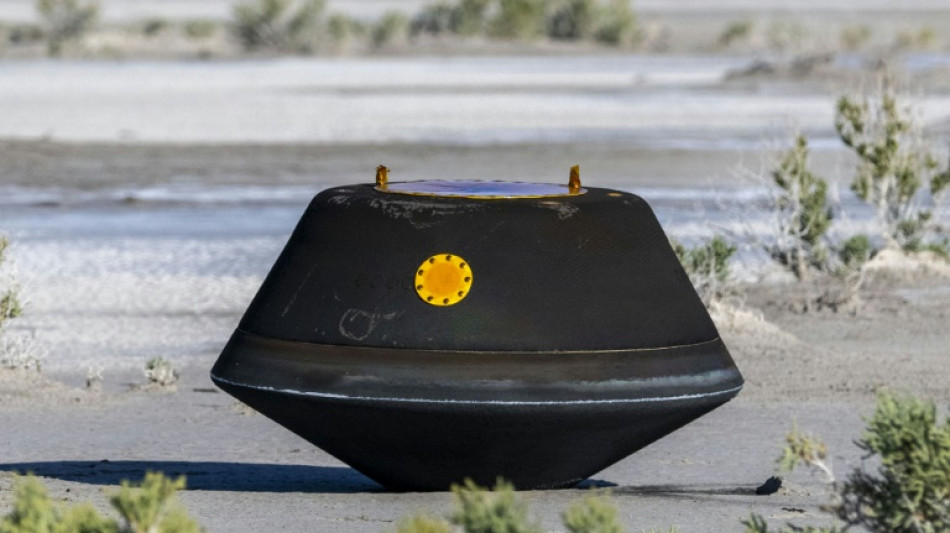
NASA to unveil first images of historic asteroid sample / Photo: Keegan BARBER - NASA/AFP/File

 Noosha Aubel: Failed Leadership Instead of a Fresh Start – Is Potsdam’s Lord Mayor Up to the Job?

 'Real inequality': France's education divide laid bare by protests

 Opera on Ukraine's children aims to 're-awaken' concern for war

 AI is coming for every company, Nvidia boss says

 Millions may be forced to move as climate change hits South Asia: UN

 Four killed battling Indonesia fires as toxic haze cloaks region

 Thai farmers, fishermen challenge IMF, World Bank at Bangkok rally

 In Malaysia, frustration grows over Indonesia haze

 Why India's voter revision drive has stoked fear and anger

 Munster eye fitting tribute to 'special' Foley in Racing reunion

 Shooter kills teacher, three children at Oregon elementary school

 Fed's Warsh surprised by world economy's 'resilience'

 Four killed in Indonesia battling fires causing toxic haze

 New Zealand star Ponga breaks arm in Rugby League World Cup opener

 Indonesian stocks dive 11% as MSCI weighs market reclassification

 Seoul dismisses Pyongyang's scepticism over hypersonic weapon test

 Yamal on song as entertainers Barcelona face Betis challenge

 Wong weighs haze prosecutions as Singapore air quality worsens

 Brush fire prompts an evacuation order along Los Angeles coast

 'Mixed feelings': AI cracks centuries-old ciphers

 Le Pen looms large as Macron enters final months on EU stage

 Three children, one teacher killed in Oregon elementary school shooting
 Man Utd teetering towards crisis as Man City cloud hangs over Premier League

 Trump's new press secretary defends 'lawyer' title

 Wallabies coach has 'faith' as All Blacks juggernaut awaits

NASA is set to reveal on Wednesday the first images of the largest asteroid sample ever collected in space, something scientists hope will yield clues about the earliest days of our solar system and perhaps the origins of life itself.
The OSIRIS-REx mission collected rock and dust from the asteroid Bennu in 2020, and a capsule containing the precious cargo successfully returned to Earth a little over two weeks ago, landing in the Utah desert.
It is now being painstakingly analyzed in a specialized clean room at NASA's Johnson Space Center in Houston.
The space agency will hold a live streamed news conference at 11:00 am Eastern Time (1500 GMT) to share photographs and preliminary scientific analysis.
OSIRIS-REx wasn't the first mission to rendezvous with an asteroid and bring back samples for study -- Japan succeeded in the feat twice, returning bits of space pebbles in 2010 and 2020.
But the substantial amount of material -- 250 grams (half a pound) -- as opposed to the 5.4 grams returned by Japan's Hayabusa2 -- is a key difference.
NASA chose to sample Bennu because it is believed to be rich in organic compounds.
Scientists think similar asteroids could have delivered organic building blocks to Earth along with water through collisions billions of years ago.
Bennu's orbit, which intersects that of our planet, also made the roundtrip journey easier than going to the Asteroid Belt, which lies between Mars and Jupiter.
NASA researchers have so far been heartened by the discovery of "bonus particles," described as black dust and debris coating the sample collector.
Back in October 2020, when OSIRIS-REx probe shot nitrogen gas at Bennu to collect its sample, a flap meant to seal it got wedged open with a piece of rock, allowing some of the finer material to flow out of the collector without escaping altogether.
"The very best 'problem' to have is that there is so much material, it's taking longer than we expected to collect it," said deputy OSIRIS-REx curation lead Christopher Snead, in a statement.
"It's really spectacular to have all that material there."
It's thought that Bennu formed from pieces of a larger asteroid in the asteroid belt, following a massive collision between one and two billion years ago.
Data gathered by the spacecraft revealed the particles making up its exterior were so loosely packed that if a person were to step onto the surface, they might sink in, much like stepping into a pit of plastic balls.
In addition to scientific insights, better understanding of Bennu's composition could prove useful if humanity ever needs to steer it away.
While it has no chance of hitting Earth through the mid 2100s, the chances rise to around 1 in 1750 between then and the year 2300, NASA says.
D.Qudsi--SF-PST