Historic NASA asteroid mission set for perilous return / Photo: Jason Connolly - AFP

 Millions may be forced to move as climate change hits South Asia: UN

 Four killed battling Indonesia fires as toxic haze cloaks region

 Thai farmers, fishermen challenge IMF, World Bank at Bangkok rally

 In Malaysia, frustration grows over Indonesia haze

 Why India's voter revision drive has stoked fear and anger

 Munster eye fitting tribute to 'special' Foley in Racing reunion

 Shooter kills teacher, three children at Oregon elementary school

 Fed's Warsh surprised by world economy's 'resilience'

 Four killed in Indonesia battling fires causing toxic haze

 New Zealand star Ponga breaks arm in Rugby League World Cup opener

 Indonesian stocks dive 11% as MSCI weighs market reclassification

 Seoul dismisses Pyongyang's scepticism over hypersonic weapon test

 Yamal on song as entertainers Barcelona face Betis challenge

 Wong weighs haze prosecutions as Singapore air quality worsens

 Brush fire prompts an evacuation order along Los Angeles coast

 'Mixed feelings': AI cracks centuries-old ciphers

 Le Pen looms large as Macron enters final months on EU stage

 Three children, one teacher killed in Oregon elementary school shooting
 Man Utd teetering towards crisis as Man City cloud hangs over Premier League

 Trump's new press secretary defends 'lawyer' title

 Wallabies coach has 'faith' as All Blacks juggernaut awaits

 Ailing UK director Mike Leigh wishes he could make '100 more films'

 Pixagram Announces Free Account Creation for 250 New Users Daily Through 2026

 Macron warns urgent to strike EU budget deal before French vote runup

 Zelensky rallies European allies as Trump ties slump

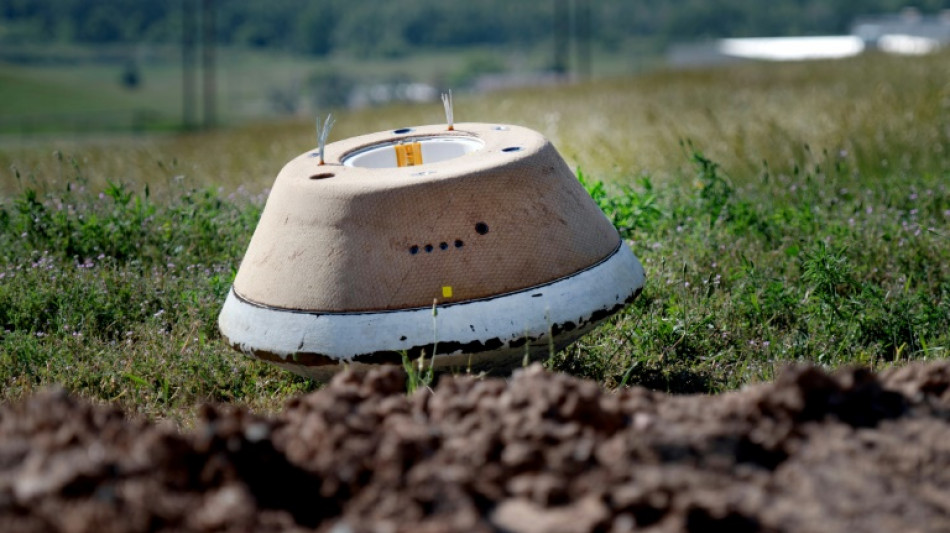
NASA's first mission to retrieve an asteroid sample and return it to US soil is expected to reach a perilous finale on Sunday with a descent into the Utah desert.
Scientists hope the material -- possibly the most ever retrieved by such a mission -- will provide humanity with a better understanding on the formation of our solar system and how Earth became habitable.
The US space probe OSIRIS-REx, launched in 2016, scooped up the sample from an asteroid called Bennu almost three years ago.
Touchdown is scheduled for Sunday at around 9:00 am local time (1500 GMT), at a military testing site in the western state.
Some four hours earlier, at about 67,000 miles (108,000 kilometers) away from Earth, the Osiris-Rex probe will release the capsule containing the sample.
The final descent lasts 13 minutes: the capsule enters the atmosphere at a speed of around 27,000 miles (43,000 kilometers) per hour and reaches a maximum temperature of 5,000 degrees Fahrenheit (2,800 degrees Celsius), NASA said.
If all goes well, two successive parachutes will bring the capsule to a soft landing on the desert floor, where it will be retrieved by prepositioned staff.
Hitting the target area of 250 square miles (650 square kilometers) is like "throwing a dart across the length of a basketball court and hitting the bullseye," Rich Burns, OSIRIS-REx project manager at NASA, told a press conference last month.
The night before landing, controllers will have a final opportunity to abort if conditions are not correct. If so, the probe would then circle the Sun before its next attempt -- in 2025.
"Sample return missions are hard. There's a number of things that can go wrong," said Sandra Freund, Lockheed Martin's OSIRIS-REx program manager.
Teams have meticulously prepared for the capsule's return -- even a "hard landing scenario" according to Freund -- in order to preserve the asteroid material in its pristine form.
A final dress rehearsal took place in August, with a replica capsule dropped from a helicopter.
- Texas 'clean room' -
Once the capsule is on the ground, a team will check its condition before placing it in a net, which will be lifted by helicopter and taken to a temporary "clean room."
The next day, the sample will be flown to a highly specialized laboratory at NASA's Johnson Space Center in Houston, Texas.
Scientists will open the capsule and separate pieces of the rock and dust over a period of days.
Some of the sample will be for studies now, with the rest stored away for future generations equipped with better technology -- a practice first started during the Apollo missions to the Moon.
NASA is expected to unveil its first results during a press conference on October 11.
Obtaining the sample involved a high-risk operation in October 2020: the probe came into contact with the asteroid for a few seconds, and a blast of compressed nitrogen was emitted to raise the dust sample which was then captured.
Bennu had surprised scientists during sample collection: during the few seconds of contact with the surface, the probe's arm had sunk into the soil, revealing a much lower density than expected.
However it allowed NASA to take far more than the initial target of 60 grams -- the agency thinks the sample could be up to some 250 grams of material.
That mass would be the "largest from beyond the orbit of the moon" NASA program executive Melissa Morris said.
- 'Seeds of life' -
The first samples brought to Earth by asteroids were carried out by Japanese probes in 2010 and 2020, with the latter found to contain uracil, one of the building blocks of RNA.
The finding lent weight to a longstanding theory that life on Earth may have been seeded from outer space when asteroids crashed into our planet carrying fundamental elements.
Asteroids like Bennu and Ryugu, one of the asteroids studied by Japan, may look similar but "can be very, very different," according to Morris.
Asteroids are interesting because they are composed of the original materials of the solar system.
The cupful of rocks may hold "clues we believe to some of the deepest questions that we asked ourselves as humanity," said University of Arizona at Tucson's Dante Lauretta, principal investigator on OSIRIS-REx.
The samples may represent the "seeds of life that these asteroids delivered at the beginning of our planet, leading to this incredible biosphere, biological evolution and to us being here today."
Bennu, 500 meters in diameter, orbits the Sun and approaches Earth every six years.
There is a small chance (1 in 2,700) that it will collide with the Earth in 2182, which would have a catastrophic impact.
NASA has studied ways to divert an asteroid's trajectory, and a better understanding of Bennu's composition could therefore prove useful.
D.AbuRida--SF-PST