US to invest $1.2 bn on facilities to pull carbon from air / Photo: Patrick T. Fallon - AFP/File

 Trump's new press secretary says China lacked 'proper' toilets

 India closes down New Delhi park ahead of 'cockroach' movement rally
 'Let us build': World Bank chief outlines jobs-led development agenda
 Broncos top Super Bowl champion Seahawks in overtime

 Brilliant Brewers sweep Dodgers to reach World Series

 Brewers complete Dodgers sweep to reach World Series
 High-flying Freiburg try to shut out the noise as fairytale run continues

 Flamengo secure 0-0 draw in La Plata in Copa Libertadores semi
 The final lap? Two days on the campaign trail with Trump

 Asian stocks rise as tech bounces from rout, eyes on Warsh

 Saudi organisers say 2027 Asian Cup 'on schedule' after attacks

 Right-wing Brazil influencers on 'mission' to seal Bolsonaro win

 Using AI to help find Mexico's legions of missing children

 Fiji to deploy solar-powered Australian military drones at sea

 'Multiple victims' in Oregon elementary school shooting, police say

 'Multiple victims' in Oregon elementary school shooting: police

 ChangeNOW Announces NOW AI After Resolving Website Integration Vulnerability

 Argentine demonstration over education cuts ends in clashes

 Argentine protesters, police clash at demo over university funding

 US stocks end higher as AI shares stabilize

 School roof collapse kills 32 children, teacher in Pakistan
 Lyon down Palace in Europa League, Sunderland leave it late

 UniCredit says receives ECB green light for Commerzbank takeover
 New York City pension fund asks Anthropic to delay IPO

 Venezuela's Maduro denies US torture charges as 'false accusations'

The US government said Friday it will spend up to $1.2 billion for two pioneering facilities to vacuum carbon out of the air, a historic gamble on a still developing technology to combat global warming that is criticized by some experts.
The two projects -- in Texas and Louisiana -- each aim to eliminate one million tons of carbon dioxide per year, equivalent in total to the annual emissions of 445,000 gas-powered cars.
It is "the world's largest investment in engineered carbon removal in history," the Energy Department said in a statement.
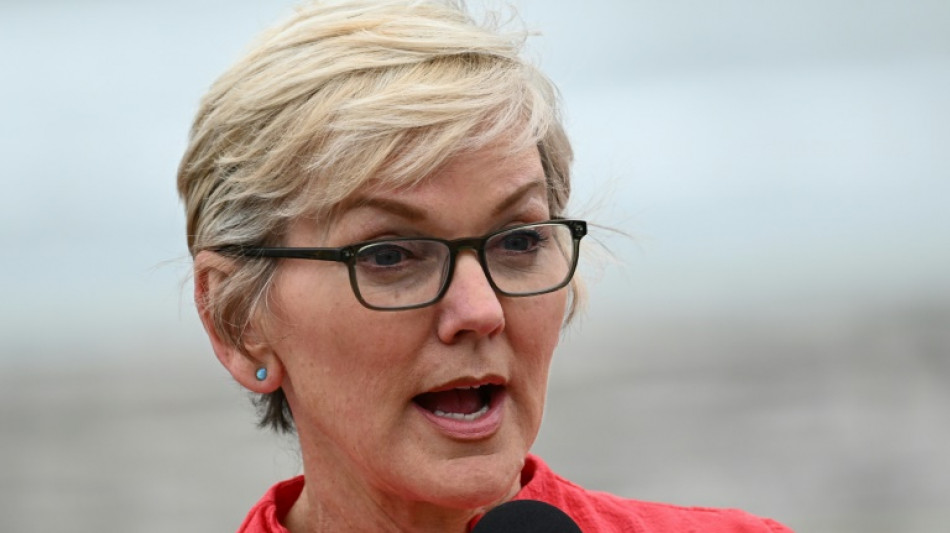
"Cutting back on our carbon emissions alone won't reverse the growing impacts of climate change," Energy Secretary Jennifer Granholm said in the statement. "We also need to remove the CO2 that we've already put in the atmosphere."
Direct Air Capture (DAC) techniques -- also known as Carbon Dioxide Removal (CDR) -- focus on that CO2 emitted into the air, which is helping to fuel climate change and extreme weather.
Each of the projects will remove 250 times more CO2 from the air than the largest carbon capture site currently in operation, the Energy Department said.
The UN's International Panel on Climate Change (IPCC) considers capturing carbon dioxide directly from the atmosphere one of the methods necessary to combat global warming.
But the sector is still marginal -- there are just 27 existing carbon capture sites commissioned worldwide, according to the International Energy Agency, though at least 130 projects are under development.
And some experts worry that use of the technology will be a pretext for continuing to emit greenhouse gases, rather than switching more quickly to clean energies.
Direct capture "requires a lot of electricity for extracting CO2 from the air and compressing it for pipes," Stanford University professor Mark Jacobson told AFP.
"Even in the best case, where the electricity is renewable, that renewable electricity is then prevented from replacing a fossil electricity source on the grid, such as coal or gas."
That means such technology is nothing more than a "gimmick," he said, adding: "It will only delay our solution to the climate problem."
- Storing CO2 underground -
US non-profit Battelle is the prime contractor on the Louisiana project, which will inject captured CO2 for storage deep underground.
It will partner with another American company, Heirloom, and the Swiss firm Climeworks, already a sector leader that operates a plant in Iceland with an annual capacity to capture 4,000 tons of CO2 from the air.
The Texas project will be led by the American company Occidental and other partners, including Carbon Engineering. It could be developed to eliminate up to 30 million tons of CO2 per year, according to a statement from Occidental.
"The rocks in the subsoil of Louisiana and Texas are sedimentary rocks, very different from Icelandic basalts, but they are perfectly viable for storing CO2," Helene Pilorge, an associate researcher at the University of Pennsylvania studying carbon capture, told AFP.
The two projects should create 4,800 jobs, according to the energy department. No start date is yet confirmed for either.
They will be funded by President Joe Biden's major infrastructure bill passed in 2021.
The Energy Department previously announced plans to invest in four projects to the tune of $3.5 billion.
Direct capture differs from carbon capture and storage (CCS) systems at source, such as factory chimneys, which prevent additional emissions from reaching the atmosphere.
In May, the Biden administration announced a plan to reduce CO2 emissions from gas-fired and coal-fired power plants, focusing in particular on this second technique.
I.Yassin--SF-PST