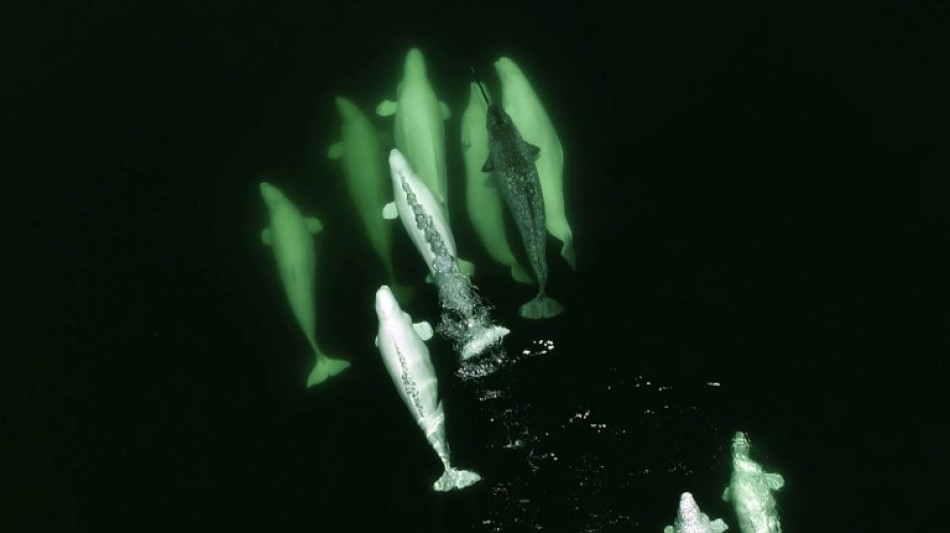
Narwhals' climate-vulnerable winter feeding crucial for survival: study / Photo: HO - GREMM/AFP

 'Multiple victims' in Oregon elementary school shooting: police

 ChangeNOW Announces NOW AI After Resolving Website Integration Vulnerability

 Argentine demonstration over education cuts ends in clashes

 Argentine protesters, police clash at demo over university funding

 US stocks end higher as AI shares stabilize

 School roof collapse kills 32 children, teacher in Pakistan

 Lyon down Palace in Europa League, Sunderland leave it late

 UniCredit says receives ECB green light for Commerzbank takeover

 New York City pension fund asks Anthropic to delay IPO

 Venezuela's Maduro denies US torture charges as 'false accusations'

 Somalia sets May presidential election despite insecurity

 Chelsea's Caicedo eager to be more of a leader

 Rahm reaches separation deal with LIV in bankruptcy court

 UN chief urges nations to end 'war on nature'

 Newcastle boss Jaissle says Fernandez-Pardo just needs a goal

 Infantino offers apology but 'no answers' at FIFA meeting over World Cup plan

 Don't exclude Turkey from 'Made in Europe' plan: minister to AFP

 French duo Justice to score 'GTA VI': game maker

 El Nino a 'terrifying' threat to coral reefs: UN biodiversity expert

 Barcola must get used to Liverpool highs and lows, says Iraola

 Versus Trade Wins Best ECN/STP Broker APAC 2026, Marking Third UF Awards Recognition

 Three dead as Istanbul sees heaviest rainfall in 80 years

 US producer prices see biggest jump since 2022 in added challenge to Trump

 Swiatek avoids seed exodus to breeze into Wuhan last eight
 PM condemns 'chaos' as violent protests grip Albania

Narwhals are likely more dependent on fat reserves and abundant prey in climate-threatened winter habitats than previously thought, researchers said Wednesday, warning of severe risks posed by global warming.
Scientists studying the long-horned marine mammals in the fjords off the eastern coast of Greenland during the summer found narwhals were largely unsuccessful in capturing prey.
"(This) suggests that they could actually rely on the wintering grounds to build up sufficient body reserves and energy stores to sustain year-round activities," said Philippine Chambault of the University of California Santa Cruz, co-author of the study published in the journal Biology Letters.
Researchers believe most narwhals spend their winters feasting off fish and squid under sea ice off the coast of Greenland, but Chambault said this cold-water habitat may essentially "disappear" because of climate change, with expected increases in ocean temperatures driving ice melt and potentially causing prey to relocate.
While the exact causes of the low summer feeding rate are not yet clear, researchers said it could be due to a decline or relocation of squid and cod, lower energy needs, or even because they are picky eaters.
Normally narwhal eating habits are hard to track because they dive deep, up to one kilometre (3,000 feet) and stay in the open water.
The researchers were able to study the foraging behaviours of 14 narwhals using so-called stomach temperature pills that could detect when the whales swallowed cold prey and icy water.
They also used acoustic tags tuned to the sound waves or "buzzes" emitted when narwhals narrow-in on their prey.
- 'Little flexibility' -
More than two-thirds of the hunting dives recorded over roughly 1,000 hours were deemed unsuccessful due to the presence of buzzes without an accompanying stomach temperature drop, said the study.
The researchers said the small sample size and limits to the detection capabilities of the equipment meant the feeding rates could be underestimated.
But they also worked with local indigenous Inuit communities to test their findings.
Inuit hunters examined the stomach contents of the narwhals caught during summer hunting season, confirming that the whales' stomachs were in fact "pretty empty", Chambault told AFP.
Diet limitation is just one factor complicating the species' survival.
Their preference for cold water and a strong tendency to remain within or near where they were born mean they are particularly sensitive to climate change.
This means they might "show very little flexibility to changing habitats," Chambault said.
O.Salim--SF-PST