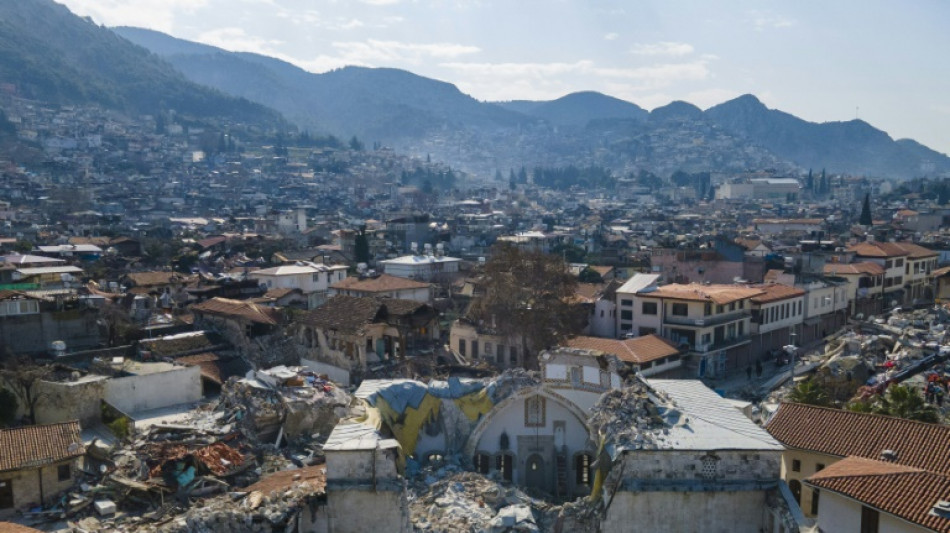
Once home to civilisations, fabled Antioch left in ruins / Photo: Yasin AKGUL - AFP

 'Multiple victims' in Oregon elementary school shooting: police

 ChangeNOW Announces NOW AI After Resolving Website Integration Vulnerability

 Argentine demonstration over education cuts ends in clashes

 Argentine protesters, police clash at demo over university funding

 US stocks end higher as AI shares stabilize

 School roof collapse kills 32 children, teacher in Pakistan

 Lyon down Palace in Europa League, Sunderland leave it late

 UniCredit says receives ECB green light for Commerzbank takeover
 New York City pension fund asks Anthropic to delay IPO

 Venezuela's Maduro denies US torture charges as 'false accusations'

 Somalia sets May presidential election despite insecurity

 Chelsea's Caicedo eager to be more of a leader

 Rahm reaches separation deal with LIV in bankruptcy court
 UN chief urges nations to end 'war on nature'
 Newcastle boss Jaissle says Fernandez-Pardo just needs a goal

 Infantino offers apology but 'no answers' at FIFA meeting over World Cup plan
 Don't exclude Turkey from 'Made in Europe' plan: minister to AFP

 French duo Justice to score 'GTA VI': game maker

 El Nino a 'terrifying' threat to coral reefs: UN biodiversity expert
 Barcola must get used to Liverpool highs and lows, says Iraola

 Versus Trade Wins Best ECN/STP Broker APAC 2026, Marking Third UF Awards Recognition

 Three dead as Istanbul sees heaviest rainfall in 80 years

 US producer prices see biggest jump since 2022 in added challenge to Trump
 Swiatek avoids seed exodus to breeze into Wuhan last eight
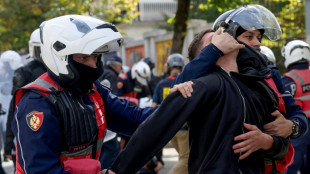 PM condemns 'chaos' as violent protests grip Albania

The smashed dome of the ancient mosque, considered to be Turkey's oldest, covers rubble that used to be a prayer hall.
Once a home to a myriad of civilisations, the southern city of Antakya lies in ruins after last Monday's 7.8-magnitude quake.
Fourteen centuries of history were ravaged in less than two minutes in Antakya, a fabled ancient Greek centre known throughout most of its history as Antioch.
Erected in AD 638, the Habib-i Neccar was "the first mosque built within modern-day Turkey's borders", according to the government's culture portal.
Only its walls have survived, leaving delicate yellow, red and blue paintings and calligraphy exposed to the winter sky.
"A bit of the Prophet Mohammed's beard was once preserved in a box" at the mosque, said Havva Pamukcu, a 50-year-old woman wearing a headscarf.
"I'm heartbroken," she said.
A few hundred metres away, a Greek Orthodox church erected in the 14th century -- and rebuilt in 1870 after another earthquake -- is also gone.
A white cross that once stood on its pointed roof now lies atop shattered walls and broken pieces of wood.
"All the walls have fallen. We're in despair," said Sertac Paul Bozkurt, a member of the council managing the church.
- 'Soil full of history' -
Antakya is in Hatay, a province tucked between the Mediterranean Sea and Turkey's border with Syria.
It was one of the worst affected by the earthquake and its aftershocks, which have claimed more than 35,000 lives across the region.
In the old city, several streets are still inaccessible, blocked by buildings flattened like pancakes and cars trapped under the debris.
Across more than two millennia, the city was home to Greek, Roman, Byzantine, Persian, Arab and Ottoman empires.
It was even placed under a French mandate between the end of the First World War and 1939, when the city became a part of modern-day Turkey.
A former general of Alexander the Great founded Antioch in 300 BC.
The city has suffered several earthquakes -- almost one every 100 years -- and is no stranger to rebuilding.
There were devastating quakes in 37 BC, 115 AD and 458 AD.
A quake in AD 526 is thought to have killed 250,000 people. In 1054, 10,000 are thought to have died.
"Antakya is the cradle of several historical events," said Hakan Mertkan, a doctoral student at the University of Bayreuth in Germany and author of a book on Antakya.
But it's also "a cradle of earthquakes, its soil full of history", he added.
- Crossroads of civilisations -
Turkey, like Syria, is on one of the world's most active fault lines.
But the region is also "at the centre of much of humanity's shared ancient history", said Aparna Tandon, senior programme leader at the International Centre for the Study of the Preservation and Restoration of Cultural Property.
The area impacted is home to six UNESCO World Heritage Sites.
Like Aleppo in Syria, Turkey's "crossroads of civilisations" was already "60 percent destroyed in 1822 after an earthquake", said Youmna Tabet, of the World Heritage Convention.
Fortunately, there does not seem to be as much damage at Turkey's other heritage sites, said Maria Liouliou, Tabet's colleague.
The fortress in Diyarbakir seems to have suffered only moderate damage, she said.
But the dangers are far from over now that the worst aftershocks have faded, experts warn.
What look like "simple cracks" to the "layman's eyes" can weaken a monument and cause it to collapse weeks later, said Samir Abdulac, who works at the International Council on Monuments and Sites, which seeks to protect historical places.
The experts AFP spoke to all insisted the "priority" was to save lives first. Safeguarding historical monuments must come later.
This was clear when AFP encountered a local official in Antakya, one of many families devastated by the disaster.
"I just lost my two brothers and a nephew. I am evacuating my wife and daughter today," said the official, who preferred to remain anonymous.
"I have no money, nothing. Frankly I have other priorities than cultural heritage."
R.Halabi--SF-PST