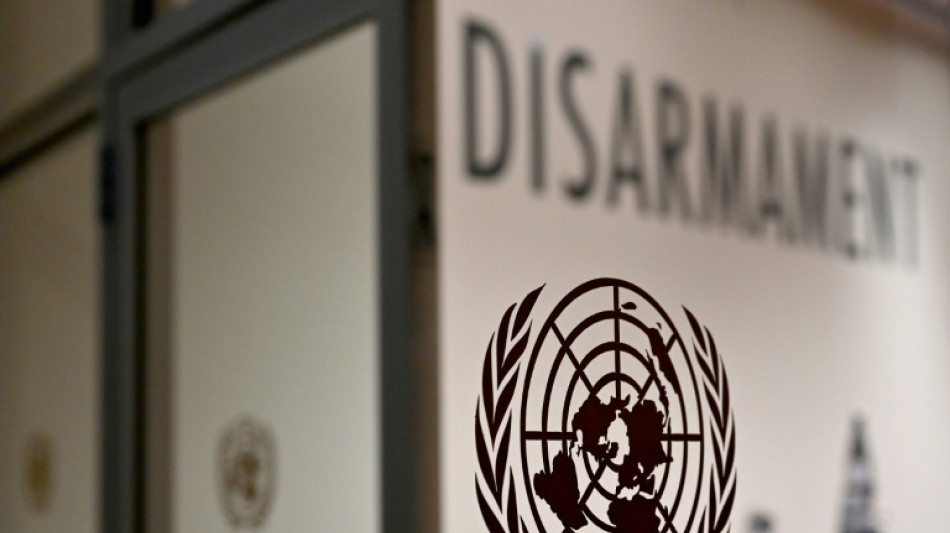
Global nuclear arms control under pressure in 2026 / Photo: ANGELA WEISS - AFP

 South African rugby player's death due to 'aortic dissection'
 France's Macron lands in Riyadh on surprise 'solidarity' visit

 Around the world, far right blames immigrants for French protests
 South Africa eases fuel pain as growth slows

 Woody Allen shoots new movie in Madrid

 Nvidia's Huang urges Europe to go all in on AI

 Five things to know as French bond yield tops 5%

 'Complete threat' Ngumoha excites Liverpool captain Van Dijk

 'The fishing's terrible': Deforestation devastates C.Africa river

 France's tourism sector worried about impact of riots

 Macron takes aim at Trump for using France riots for election gain
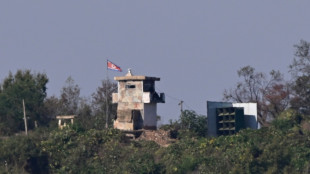 North Korea says 'new firepower units' in place, loudspeakers to return

 Indonesia leader hits out at market downgrade warning

 Macron slams 'stupid' comments based on AI videos by leaders on France riots

 'Public health crisis': Indonesians seek fire relief from state

 British Museum sells second set of Bayeux exhibition tickets
 Australian lawmaker loses both legs after 'targeted' attack

 UK approves drilling in controversial Jackdaw gas field

 Carrefour shares plunge after profit warning on French protests

 North Korea says 'new firepower units' in place after border threat

 Australia lawmaker loses both legs after 'targeted' attack

 Director Nick Paley channels childhood fears in new thriller 'Phony'

 'Daily struggle': Cubans dig wells in search of water
 Prized wild pepper at risk in Madagascar's shrinking forests
 World falling 'dangerously short' on climate action: UN chief

The fragile global legal framework for nuclear weapons control faces further setbacks in 2026, eroding guardrails to avoid a nuclear crisis.
The first half of the year will see two key events: the US-Russia bilateral treaty, New START, expires on February 5, and in April, New York hosts the Review Conference (RevCon) of the Treaty on the Non-Proliferation of Nuclear Weapons (NPT) -- the cornerstone of global nuclear security frameworks.
The RevCon, held every four to five years, is meant to keep the NPT alive. But during the last two sessions, the 191 signatory states failed to agree on a final document, and experts expect the same outcome in April.
"I think this is going to be a difficult RevCon," said Alexandra Bell, head of US-based global security nonprofit the Bulletin of the Atomic Scientists, at a UN-hosted online conference in early December.
"In terms of the current state and near future prospects of nuclear arms control architecture, things are bleak," she added.
Anton Khlopkov, director of Russian think-tank the Center for Energy and Security Studies (CENESS), took an even starker point of view, saying at the same event that "we are at the point of almost complete dismantlement of arms control architecture".
"We should be realistic in the current circumstances. At best, I think we should try to preserve what we have," he said.
- 'Crumbling' safeguards -
From US strikes on Iranian nuclear sites to Russia's test of the new Burevestnik nuclear-powered cruise missile and US President Donald Trump's remarks about possibly resuming nuclear tests -- the international nuclear landscape darkened in 2025.
At the same time, "the arms control architecture is crumbling", Emmanuelle Maitre of France's Foundation for Strategic Research (FRS) told AFP.
A key challenge hinges on a shift in global relations.
Nuclear control had been built over decades around a Moscow-Washington axis, but China's growing power and rapid technological advances have shifted the international playing field, which is simultaneously increasingly strained.
"The growing interlinkage between nuclear and conventional forces and the emergence of disruptive technologies (such as the US Golden Dome defence system and new hypersonic weapons) have transformed traditional nuclear deterrence into a multi-domain concept, especially in a multipolar world," said Peking University's Hua Han.
"This trilateral configuration introduces complexities far beyond the Cold War-era bilateral model. Increasing China-Russia cooperation further complicates deterrence calculations, particularly in the two main theatres of concern: Europe and the Asia-Pacific," she added, according to the minutes of an April event held by Pakistan's Center for International Strategic Studies.
A likely result of the changing landscape is the lapse of New START, which sets weapon limits and includes inspection systems.
"The entire inspection component is no longer functioning, the notifications when a missile is moved, etc, all of that has vanished. What remains is only the voluntary commitment to stay within the limits," said Maitre.
- 'Collective solutions' -
But allowing New START to lapse is "in American interest", according to Robert Peters of the influential Heritage Foundation, reflecting the stance of much of the US strategic community to avoid tying Washington's hands to Moscow alone.
Beijing, which currently has fewer weapons, has so far refused to engage in trilateral disarmament talks.
"China is the fastest growing nuclear power on the planet. It's building 100 new warheads a year and now has more ICBM (intercontinental ballistic missile) silos than the US has active Minuteman III silos," Peters said at a recent online International Institute for Strategic Studies event.
"New START does nothing to address" that issue, he added.
However, Maitre said, a New START lapse doesn't mean the world should expect serious consequences as early as February 6.
In both Washington and Moscow, "there is a small margin to bring some weapons back into service, but the numbers cannot be very significant. There are bottlenecks" that will slow any buildup, she said.
Nor will the lack of a final document from the RevCon cause "immediate or damaging consequences" to the NPT, she said.
But, she warned, fewer safeguards risks leaving the world without diplomatic tools to resolve tensions.
"The less functional the NPT becomes, the harder it is to forge collective solutions in the event of a crisis."
F.Qawasmeh--SF-PST