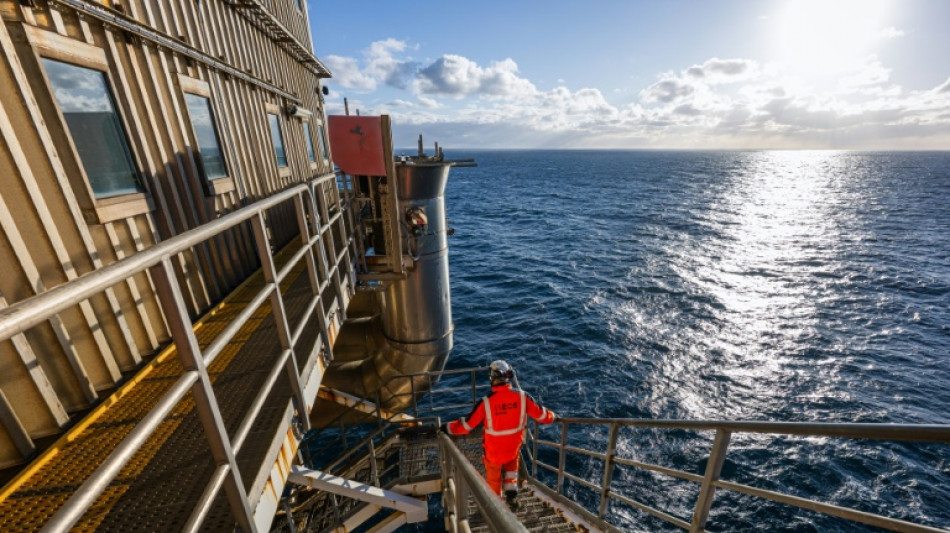
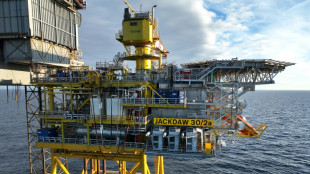
CO2 soon to be buried under North Sea oil platform / Photo: Jonathan NACKSTRAND - AFP

 South African rugby player's death due to 'aortic dissection'
 France's Macron lands in Riyadh on surprise 'solidarity' visit

 Around the world, far right blames immigrants for French protests

 South Africa eases fuel pain as growth slows

 Woody Allen shoots new movie in Madrid

 Nvidia's Huang urges Europe to go all in on AI

 Five things to know as French bond yield tops 5%
 'Complete threat' Ngumoha excites Liverpool captain Van Dijk

 'The fishing's terrible': Deforestation devastates C.Africa river

 France's tourism sector worried about impact of riots

 Macron takes aim at Trump for using France riots for election gain

 North Korea says 'new firepower units' in place, loudspeakers to return

 Indonesia leader hits out at market downgrade warning
 Macron slams 'stupid' comments based on AI videos by leaders on France riots
 'Public health crisis': Indonesians seek fire relief from state

 British Museum sells second set of Bayeux exhibition tickets

 Australian lawmaker loses both legs after 'targeted' attack

 UK approves drilling in controversial Jackdaw gas field

 Carrefour shares plunge after profit warning on French protests
 North Korea says 'new firepower units' in place after border threat
 Australia lawmaker loses both legs after 'targeted' attack

 Director Nick Paley channels childhood fears in new thriller 'Phony'
 'Daily struggle': Cubans dig wells in search of water
 Prized wild pepper at risk in Madagascar's shrinking forests

 World falling 'dangerously short' on climate action: UN chief

In the North Sea where Denmark once drilled for oil, imported European carbon dioxide will soon be buried under the seabed in a carbon capture and storage (CCS) project nearing completion.
CCS technology is one of the tools approved by the UN's Intergovernmental Panel on Climate Change (IPCC) and the International Energy Agency (IEA) to curb global warming, especially for reducing the CO2 footprint of industries like cement and steel that are difficult to decarbonise.
But the technology is complex and costly.
Led by British chemicals giant Ineos, the Greensand project 170 kilometres (105 miles) off the Danish coast consists of a deep, empty reservoir beneath a small, wind-swept oil platform in the North Sea.
In its first phase due to begin in the next few months, Greensand is slated to store 400,000 tonnes of CO2 per year.
It's "a very good opportunity to reverse the process: instead of extracting oil, we can now inject CO2 into the ground," Mads Gade, Ineos's head of European operations, told AFP.
Liquefied CO2 sourced mainly from biomass power plants will be shipped from Europe via the Esbjerg terminal in southwestern Denmark to the Nini platform above an empty oil reservoir, into which it will be injected.
"The reason why the North Sea is seen as a vault for CO2 storage is because of the enormous amounts of data that we have collected through over 50 years of petroleum production," said CCS coordinator Ann Helen Hansen at the Norwegian Offshore Directorate (Sodir).
This area of the North Sea is teeming with depleted oil and gas fields like Nini, as well as deep rock basins.
According to Sodir, the Norwegian part of the North Sea alone theoretically has a geological storage capacity of around 70 billion tonnes (70 Gt) of CO2. On the British side, the figure is 78 Gt, according to the British government.
In Denmark, the geological institute has no overall data, but the Bifrost project, led by TotalEnergies, estimates it could store 335 million tonnes of CO2.
By comparison, the European Union's greenhouse gas emissions amounted to about 3.2 Gt last year.
- Costly solution -
Under the Net-Zero Industry Act (NZIA), the EU has set a legally binding target to have a storage capacity of at least 50 million tonnes per year by 2030.
Installations are gradually being put in place.
Greensand plans to increase its carbon dioxide injection capacity to up to eight million tonnes per year by 2030.
In neighbouring Norway, the world's first commercial CO2 transport and storage service, dubbed Northern Lights, carried out its first CO2 injection in August into an aquifer 110 kilometers off Bergen on the western coast.
Its owners -- energy giants Equinor, Shell and TotalEnergies -- have agreed to increase annual capacity from 1.5 to five million tonnes of CO2 by the end of the decade.
And in Britain, authorities have just launched a second tender, after already awarding 21 storage permits in 2023. A first injection of CO2 is expected in the coming years.
But customers are still nowhere to be found.
For industrial actors, the cost of capturing, transporting and storing their emissions remains far higher than the price of purchasing carbon allowances on the market.
And even more so when it involves burying them at sea.
"Offshore is probably more expensive than onshore but with offshore there's often more public acceptance," said Ann Helen Hansen.
To date, the Northern Lights consortium has signed only three commercial contracts with European companies to store their CO2.
The consortium would probably never have seen the light of day without generous financial support from the Norwegian state.
While it supports the use of CCS for sectors that are hard to decarbonise, the Norwegian branch of Friends of the Earth says CCS has been used as an excuse to avoid having to exit the oil era.
"The idea that the region responsible for the problem could now become part of the solution is a very seductive narrative," said the head of this environmental NGO, Truls Gulowsen.
"But that's not really what we're seeing. Fossil fuels and climate emissions from the North Sea are far larger than anything we could ever put back there with CCS."
Q.Najjar--SF-PST