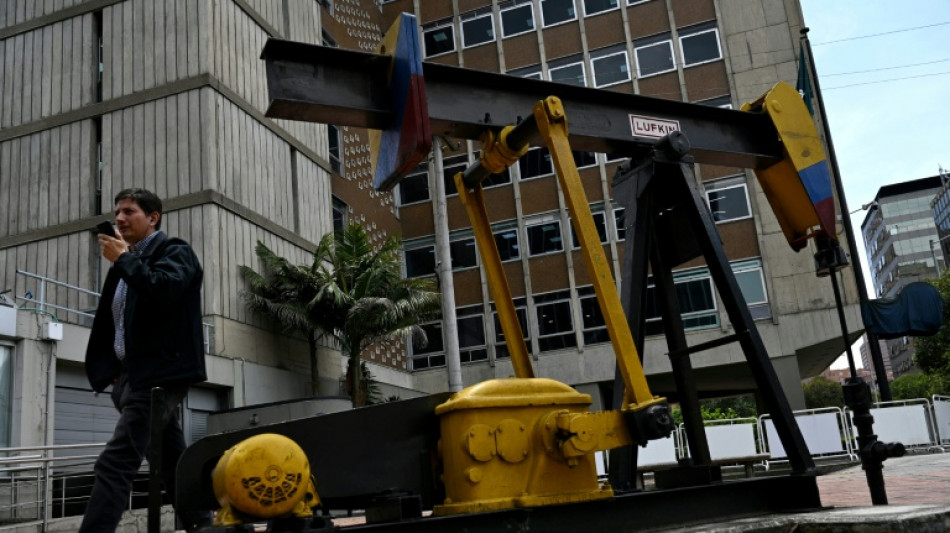
Colombian environmental activist honored amid threats and exile / Photo: Pablo VERA - AFP/File

 Trump says US moved bombers from UK base after 'threats'
 Brazilian stocks surge to record after Bolsonaro election lead
 Leaders to visit Pacific atoll at frontline of climate change

 ICC gives more details about arrest warrants for Taliban ministers
 Nigeria's Tinubu confirms 32 dead after military plane crash

 'Reckless' AI firms can't control models, says whistleblower

 Switching on brain cells: the Nobel-winning science of optogenetics

 Quebec votes as separatist surge poses test for Canada PM

 Euro slides as concerns about French debt mount
 Former Trump press secretary Leavitt joins Fox News

 Djokovic advances to China Open final as Medvedev out for hitting fan with ball

 Disgraced former US House speaker dies at 84

 Euro slides as worries about French debt grow
 US withdraws all bomber aircraft from UK airbase
 Drone hits Ethiopia IDP camp as fears grow of regional war

 US-German trio wins medicine Nobel for illuminating the brain
 England captain Kane driven by desire for records says Tuchel
 N.Irish court hears challenge to disputed Orangemen parade

 Talking points from the Bahrain Grand Prix in Malaysia

 Yemen, Saudi Arabia target Houthis in new campaign as war escalates

 US-German trio wins medicine Nobel for work on optogenetics

 Swiatek, Zheng survive three-set tests in China Open third round

 Hasan says Test cricket momentum turning for Bangladesh
 Intense heat puts births in jeopardy, UN tells Fiji talks
 US arrests woman accused of spying for China on Taiwan leader's family

Afro-Colombian woman Yuvelis Morales, a 25-year-old who has spent most of her adult life working to block the world's biggest oil companies from exploiting fragile ecosystems, won the environmental equivalent of a Nobel prize on Monday.
Morales spoke to AFP about standing up to such multinationals, protecting natural resources in her native Colombia during what she called "the beginning of the end" of the fossil fuel era, and facing the fear of death threats.
Born to a fishing family in the world's deadliest country for environmentalists, the recipient of this year's Goldman Environmental Prize began her activism at age 18.
She grew up on the banks of the Magdalena River, near Colombia's largest oil refinery, in a sweltering region long shaped by oil, conflict and poverty.
Successive Colombian governments have eyed fracking projects in the area, hoping to bring revenue and jobs.
But worried that fracking would threaten water supplies and local livelihoods, Morales organized protests.
Under the slogan "No to fracking," her campaign drew local support -- and national attention.
That pressure helped stop pilot projects backed by state oil company Ecopetrol and US energy giant ExxonMobil.
Morales said she was proud to receive the Goldman prize, often described as the "Green Nobel," alongside five other activists.
But speaking from the US state of California, Morales acknowledges her work has come at a cost.
In 2022, armed men came to her home to issue a warning.
Colombia is the deadliest country in the world for environmental defenders, with nearly 150 murdered in 2024 alone, according to Global Witness.
After receiving repeated threats, Morales decided to leave Colombia and sought asylum in France.
She spent several months in exile and prefers not to speak in detail about that period.
- Fighting fear -
Fear "will always be present because of the anxiety that comes with defending territory," Morales told AFP.
"You decide what to do with that fear," she said. "Whether it immobilizes us, or instead we denounce and shout to the world what is happening."
Morales said her opposition to projects that threaten the Magdalena is "non-negotiable."
The river, Colombia's longest, stretches about 1,540 kilometers (957 miles) and supports fishing, farming and transport across much of the country.
It is home to many Afro-Colombians, who make up about a tenth of Colombia's population.
Many live in poor, rural regions rich in oil and minerals, where communities have long borne the brunt of violence, exclusion and environmental damage.
Fracking, she said, "destroys community harmony, ends agricultural livelihoods, and displaces not only people but also fauna and flora."
But the activist said she is already focused on the next fight.
Her award comes as Colombia hosts a global summit on ending fossil fuels this week in Santa Marta, a city on the Caribbean coast.
Morales said she believes the moment marks "the beginning of the end of the era and expansion of fossil fuels" in Colombia.
President Gustavo Petro has halted new fracking contracts, though efforts to ban the practice in law have stalled in Congress.
"Petro can't finish his term" in August "without a ban on fracking," she insisted.
Morales compares the work of environmental defenders to a "shield."
"I will keep shouting to the world," she said. "We must live in our territories and never give them up."
N.Awad--SF-PST