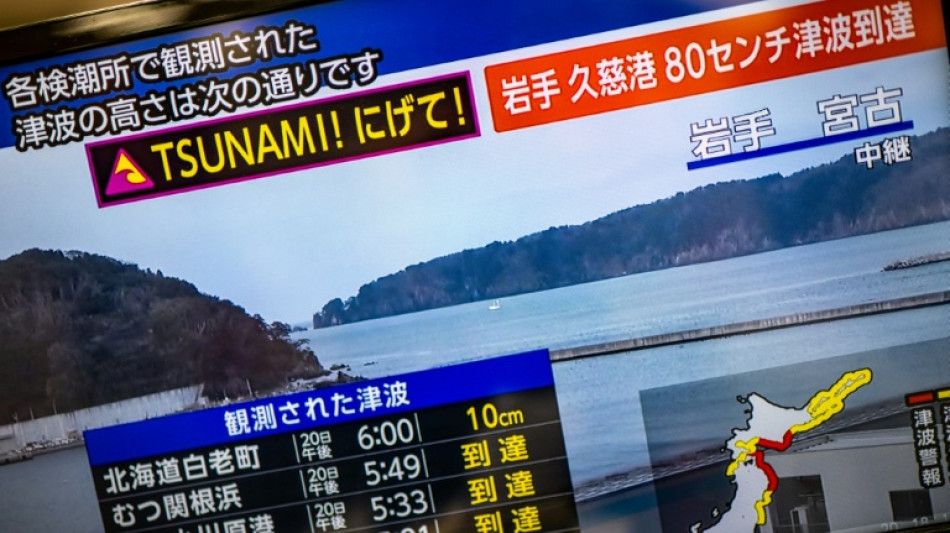
Japan issues warning after 7.7-magnitude quake hits north / Photo: Philip FONG - AFP

 South Africa's migrant exodus leaves employers short-handed
 US holds fire against Iran as reports emerge of stockpile concerns

 Marvel announces 'Black Panther III' at Comic-Con

 Will heatwaves push European holidaymakers to 'coolcations'?

 Messi-less Miami win on Casemiro debut, Berterame suffers head blow

 German police hunt suspect after deadly car ramming near Berlin Gay Pride

 US Federal Reserve expected to hold rates steady as inflation swirls

 Merz vows justice after deadly car ramming near Berlin Gay Pride event

 Joshua survives knockdowns, stops Prenga

 Ohtani delays throwing session over knee 'regression'

 One killed, 15 wounded as car hits crowd near Berlin Gay Pride
 Hodge, Hope give West Indies edge in rain-impacted Pakistan Test

 Scheffler surges at 3M Open with blistering back nine

 Brazil's right-wing party nominates Bolsonaro son to battle Lula

 Norris back on pole at Hungarian GP as rivals handed penalties

 Close to Madrid, those who escaped flames worry what is next

 Messi can skip All-Star Game after grueling World Cup, says MLS
 Hamilton stung by three-place grid penalty

 Howe uncertain if Guimaraes will stay with Newcastle amid Arsenal interest

 Varane concussions motivate Como to ban heading in academy teams

 'Amazing' Pogacar-Del Toro friendship lights up Tour de France

 Crisis-hit Flavio Bolsonaro launches presidential candidacy in Brazil

 As wildfires grip France and Spain, what are the risks from the smoke?

 Pogacar set to win Tour de France, Carapaz claims Queen stage

 India's education minister resigns, end called to Delhi protests
Japan issued a special advisory on Monday warning of an increased risk of earthquakes at magnitude 8.0 or stronger, after a powerful jolt rattled the country's north and prompted a tsunami warning.
The Japan Meteorological Agency's advisory came a few hours after a 7.7-magnitude earthquake struck in Pacific waters off northern Iwate prefecture at 4:53 pm (0753 GMT).
The jolt was so intense that it shook large buildings in the capital Tokyo, hundreds of kilometres (miles) from the epicentre.
The meteorological agency said that "the likelihood of a new, huge earthquake occurring is relatively higher than during normal times".
Municipalities in the affected region issued non-compulsory evacuation directives to more than 182,000 residents, according to the Fire and Disaster Management Agency.
Around 40 minutes after the quake, an 80-centimetre (31-inch) tsunami wave hit a port in Kuji in Iwate, according to the weather agency, which which had initially estimated the magnitude at 7.4 before revising it upwards.
The agency said the later advisory about another possible earthquake only reflected an elevated risk, rather than providing any specific predictions.
"Although the probability is low, there is a possibility of another major earthquake occurring; therefore, please review your earthquake preparedness measures in these areas," it said in a statement.
By the evening, authorities slightly downgraded the tsunami warning but kept an advisory for possible waves up to one metre (3.3 feet) along the vast northeastern Pacific coast.
There were no immediate reports of serious injuries or significant damage, Chief Cabinet Secretary Minoru Kihara told a news conference.
Footage from national broadcaster NHK showed no clearly visible damage around several ports in Iwate.
But officials have reiterated that aftershocks could strike the area over the coming week, particularly within the next two to three days, potentially "causing even stronger shaking".
- 'Megaquake' fears -
The prime minister's office said it had set up a crisis management team, and the government was working to establish whether there were any casualties or serious property damage.
"For those of you who live in areas for which the warnings have been issued, please evacuate to higher, safer places," Prime Minister Sanae Takaichi said.
Japan is one of the world's most seismically active countries, sitting on top of four major tectonic plates along the western edge of the Pacific "Ring of Fire".
The archipelago, home to around 125 million people, typically experiences around 1,500 jolts every year and accounts for about 18 percent of the world's earthquakes.
The vast majority are mild, although the damage they cause varies according to their location and the depth below the Earth's surface at which they strike.
Japan is haunted by the memory of a massive 9.0-magnitude undersea quake in 2011, which triggered a tsunami that killed or left missing around 18,500 people and caused a devastating meltdown at the Fukushima nuclear plant.
In 2024, the weather agency issued its first special advisory of a possible "megaquake" along the Nankai Trough.
This 800-kilometre undersea trench is where the Philippine Sea oceanic tectonic plate is "subducting" -- or slowly slipping -- underneath the continental plate that Japan sits atop.
The government has said a quake in the Nankai Trough and subsequent tsunami could kill as many as 298,000 people and cause up to $2 trillion in damage.
Another week-long "megaquake" advisory was issued in December 2025 after a magnitude-7.5 tremor struck off the northern coast, injuring more than 40 people but causing no major damage.
J.AbuShaban--SF-PST