As US battles China on AI, some companies choose Chinese / Photo: Kirill KUDRYAVTSEV - AFP

 Golf star Rahm quitting LIV tour over 'unacceptable' terms
 Thousands march fearing return of a Bolsonaro presidency in Brazil

 French PM denies police ordered to confront student protesters

 Rubio touts US power, calls on Europe to emerge from 'slumber'

 Trump says 'we don't think' Russian plague is bio-weapon

 Five children among 26 killed in Ukraine after Russian strikes

 Man City should 'accept' punishment for rule breaches, says Lineker

 US woman who survived botched execution is awake and speaking

 From 1800s to modern pharma: a Nobel-winning chemistry quest

 Southampton boss Eckert given suspended ban over 'Spygate'
 Russia warns of 'false' information as second plague case reported

 IEA ready to release more oil reserves if necessary

 HSBC 'consults' over UK unit job cuts amid AI adoption

 UK court quashes five ex-traders' Libor rate rigging convictions

 XM Receives “Global Customer Experience Leader Award 2026” at the TrustFinance Performance Awards
 Stocks slide as oil climbs on Mideast flareup

 Heavy casualties in Ukraine after Russian strikes

 French wine harvest set to hit historic low

 Kyiv 'cannot agree' to EU membership limiting food exports: minister

 Arteta targets more Arsenal glory after signing new deal until 2030

 Russell hit with Singapore grid penalty for taking new power unit

 Spotify expands audiobooks to more than 180 markets

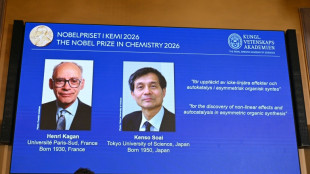 French-Japanese duo wins chemistry Nobel for solving molecular 'mystery'

 England's Nations League surge helps heal World Cup wounds

 Mayor of opposition stronghold Izmir defects to Erdogan party

Even as the United States is embarked on a bitter rivalry with China over the deployment of artificial intelligence, Chinese technology is quietly making inroads into the US market.
Despite considerable geopolitical tensions, Chinese open-source AI models are winning over a growing number of programmers and companies in the United States.
These are different from the closed generative AI models that have become household names -- ChatGPT-maker OpenAI or Google's Gemini - whose inner workings are fiercely protected.
In contrast, "open" models offered by many Chinese rivals, from Alibaba to DeepSeek, allow programmers to customize parts of the software to suit their needs.
Globally, use of Chinese-developed open models has surged from just 1.2 percent in late 2024 to nearly 30 percent in August, according to a report published this month by the developers' platform OpenRouter and US venture capital firm Andreessen Horowitz.
China's open-source models "are cheap -- in some cases free -- and they work well," Wang Wen, dean of the Chongyang Institute for Financial Studies at Renmin University of China told AFP.
One American entrepreneur, speaking on condition of anonymity, said their business saves $400,000 annually by using Alibaba's Qwen AI models instead of the proprietary models.
"If you need cutting-edge capabilities, you go back to OpenAI, Anthropic or Google, but most applications don't need that," said the entrepreneur.
US chip titan Nvidia, AI firm Perplexity and California's Stanford University are also using Qwen models in some of their work.
- DeepSeek shock -
The January launch of DeepSeek's high-performance, low-cost and open source "R1" large language model (LLM) defied the perception that the best AI tech had to be from US juggernauts like OpenAI, Anthropic or Google.
It was also a reckoning for the United States -- locked in a battle for dominance in AI tech with China -- on how far its archrival had come.
AI models from China's MiniMax and Z.ai are also popular overseas, and the country has entered the race to build AI agents -- programs that use chatbots to complete online tasks like buying tickets or adding events to a calendar.
Agent friendly -- and open-source -- models, like the latest version of the Kimi K2 model from the startup Moonshot AI, released in November, are widely considered the next frontier in the generative AI revolution.
The US government is aware of open-source's potential.
In July, the Trump administration released an "AI Action Plan" that said America needed "leading open models founded on American values".
These could become global standards, it said.
But so far US companies are taking the opposite track.
Meta, which had led the country's open-source efforts with its Llama models, is now concentrating on closed-source AI instead.
However, this summer, OpenAI -- under pressure to revive the spirit of its origin as a nonprofit -- released two "open-weight" models (slightly less malleable than "open-source").
- 'Build trust' -
Among major Western companies, only France's Mistral is sticking with open-source, but it ranks far behind DeepSeek and Qwen in usage rankings.
Western open-source offerings are "just not as interesting," said the US entrepreneur who uses Alibaba's Qwen.
The Chinese government has encouraged open-source AI technology, despite questions over its profitability.
Mark Barton, chief technology officer at OMNIUX, said he was considering using Qwen but some of his clients could be uncomfortable with the idea of interacting with Chinese-made AI, even for specific tasks.
Given the current US administration's stance on Chinese tech companies, risks remain, he told AFP.
"We wouldn't want to go all-in with one specific model provider, especially one that's maybe not aligned with Western ideas," said Barton.
"If Alibaba were to get sanctioned or usage was effectively blacklisted, we don't want to get caught in that trap."
But Paul Triolo, a partner at DGA-Albright Stonebridge Group, said there were no "salient issues" surrounding data security.
"Companies can choose to use the models and build on them...without any connection to China," he explained.
A recent Stanford study published posited that "the very nature of open-model releases enables better scrutiny" of the tech.
Gao Fei, chief technology officer at Chinese AI wellness platform BOK Health, agrees.
"The transparency and sharing nature of open source are themselves the best ways to build trust," he said.
X.Habash--SF-PST