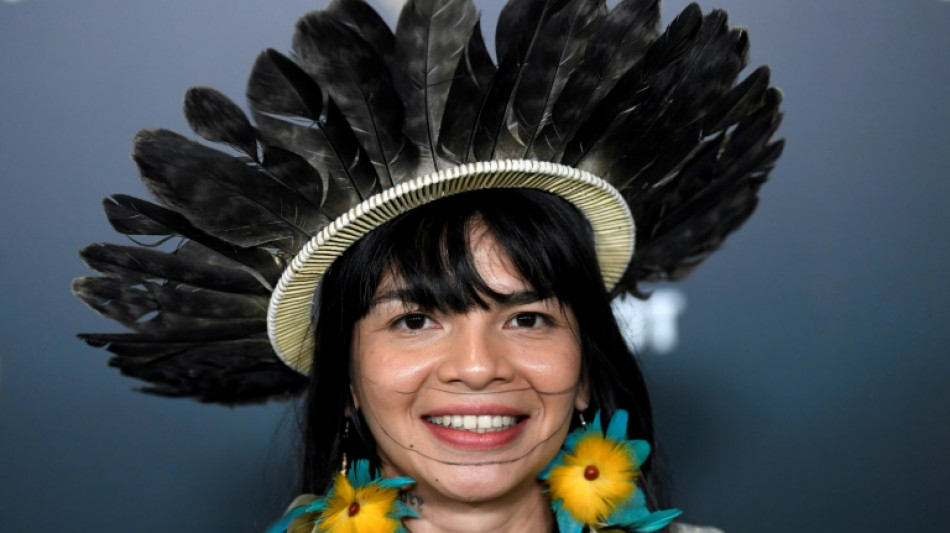
Amazon poised to host toughest climate talks in years / Photo: Daniel RAMALHO - AFP/File

 Netanyahu orders West Bank closure as attack wounds Israelis before election
 Asian stocks mixed ahead of weekend as tech recovers early losses
 How five Boeing 777s linked Madagascar's power elite to Iran
 South Korea proposes holding border talks with North
 Ukraine's young figure skaters twizzle on despite Russian threat
 Asian football endorses Infantino re-election as FIFA president
 Complete Kane hopes for 'special night' as Ballon d'Or rumours swirl

 Rooney calls United squad 'selfish babies' after Fernandes criticism

 Teddy Wilson, son of World Cup-winner David, gets Wallabies call-up

 New Zealand military chief resigns over 'inappropriate relationship'

 Man Utd's Carrick on borrowed time, free-scoring Brighton face Liverpool
 Asian stocks head into weekend on a low as tech extends losses

 'Generational rage': Young Europeans fight to be heard

 Lula, Bolsonaro to clash once more before Brazil vote
 Dressed to kill: Haircuts cap menacing look of Japan's yakuza
 Napa Valley's wineries feel Trump's tariff squeeze
 Venezuela protests demand return of Nobel winning leader Machado
 Marquez tops incident-packed opening practice for Australian MotoGP

 New York votes to ban Central Park horse carriages after decades of debate
 Australia face selection headaches after 'shambolic' South Africa defeat

 Around 150,000 rally in Belgrade as Serbia heads to pivotal poll

 Hamilton sets sights on racing in African grand prix
 Bournemouth hammer 10-man Milan, Juventus denied at the death
 Judge orders Trump to give deposition in BBC lawsuit by Dec 11
 'Fake' pollsters hit US midterms

An odor of oil hung over last year's UN climate conference in Baku, capital of fossil fuel-rich Azerbaijan.
Starting Monday, the 50,000 participants of COP30 will instead feel the heavy, humid air of the Amazon rainforest in Belem, Brazil, where they face the daunting task of keeping global climate cooperation from collapsing.
Unfazed, President Luiz Inacio Lula da Silva insisted on holding the event here despite a dire shortage of hotel rooms.
His aim: to make the Amazon itself open the eyes of negotiators, observers, businesses and journalists — in a city where locals carry umbrellas both to shield themselves from the blazing morning sun and from the tropical downpours that follow in the afternoon.
"It would be easier to hold the COP in a rich country," Lula declared in August. "We want people to see the real situation of the forests, of our rivers, of our people who live there."
The Amazon rainforest, which plays a vital role in the fight against global warming through its absorption of greenhouse gases, is itself plagued by a host of ills: deforestation, illegal mining, pollution, drug trafficking, and all manner of rights abuses against locals, especially Indigenous peoples.
While the Brazilians have been active on the diplomatic front for the past year, they're lagging behind on logistics. Many pavilions were still under construction as of Sunday.
"There is great concern about whether everything will be ready on time from a logistical standpoint," a source close to the UN told AFP. "Connections, microphones, we're even worried about having enough food," the source added.
The real uncertainty lies in what will actually be negotiated over the next two weeks: Can the world come together to respond to the latest, catastrophic projections for global warming?
How can a clash between rich nations and the developing world be avoided?
And where will the money come from to help countries hit by cyclones and droughts -- like Jamaica, devastated in October by one of the world's most powerful hurricane in nearly a century, or the Philippines, battered by two deadly typhoons in just two weeks?
And what to make of the "roadmap" on fossil fuels that Lula put on the table Thursday at the leaders' summit? The oil industry -- and the petrostates that depend on it -- have rallied since the world agreed in Dubai in 2023 to begin the gradual transition away from fossil fuels.
"How are we going to do it?" Andre Aranha Correa do Lago, the Brazilian president of COP30 said Sunday. "Is there going to be a consensus about how we are going to do it? This is one of the great mysteries in COP30."
- Sans Trump -
For 30 years, the countries that are party to the UN Framework Convention on Climate Change -- adopted here in Brazil at the 1992 Earth Summit in Rio de Janeiro -- have met annually to strengthen the global climate regime.
Those efforts culminated in the 2015 Paris Agreement, which commits the world to limiting global warming to 2 degrees Celsius above pre-industrial levels, while pursuing efforts to keep it below 1.5C.
The process continued even during US President Donald Trump's first term.
But UN chief Antonio Guterres has acknowledged in recent weeks that it is now "inevitable" the 1.5C threshold will soon be breached, urging that the overshoot be kept as brief as possible.
That means finally bringing down global greenhouse gas emissions, which come mainly from burning oil, gas and coal.
A group of small island nations is fighting to have the need for a response to this failure placed on the official agenda.
"1.5 degrees is not just a number, not just a target, but that's a lifeline," Manjeet Dhakal, an advisor to the least developed countries block of countries at COP, told AFP. "We cannot be a part of any decision where there is a discussion about (how) we can't achieve 1.5 degrees."
The United States, the world's largest economy and second-biggest emitter of greenhouse gases, is absent for the first time in the history of these meetings.
Trump, however, hasn't entirely ignored COP30. On Sunday, he took to his social network to denounce what he called the "scandal" of trees being cut down near Belem to build a new road, after seeing a segment that aired on Fox News.
fb-lg-app-ico/tmo/ia/sla
G.AbuGhazaleh--SF-PST