The AI revolution has a power problem / Photo: Jason Redmond - AFP/File

 Messi and Alcaraz love it, now padel takes step closer to Olympics

 Tolls mount in Thailand, Myanmar floods

 Why India's opposition wants top poll official out

 PU Prime Strengthens UAE Momentum with Strong Showing at Forex Expo Dubai 2026

 Eight dead in Thailand floods since mid-September

 Oil prices spike after Trump rejects Iran truce offer

 Taylor Swift sets new record at MTV VMAs
 Seoul seeks apology after Ukraine reveals transfer of North Korean POWs

 Messi on target again but Miami downed by Columbus

 In Washington's political cauldron, a fight over foie gras
 Flavio Bolsonaro: political heir in his father's shadow

 Ravens grab last-second win in Rio as Commanders stop Seahawks

 USA rallies to capture 11th consecutive Presidents Cup

 Phillies clinch, Astros wrap up division on final day of MLB season

 Commanders hand champion Seahawks their first loss

 Dupont scores twice to send Toulouse top of Top 14

 Ireland beat Israel but no handshakes due to war in Gaza

 Tense standoff over flashpoint N.Ireland parade lasts into night

 Stunned McNulty wins 'miracle' road race world title

 Re-released 'Avengers: Endgame' snaps-up N. America box office lead

 American McNulty wins shock road race world title

 Serbia's President Aleksandar Vucic announces resignation

 Tuchel urges Bellingham to play with 'rage'

 Russian strikes on Ukraine kill 8

 Bavuma, Miller hit centuries as South Africa clinch series
In the race for AI dominance, American tech giants have the money and the chips, but their ambitions have hit a new obstacle: electric power.
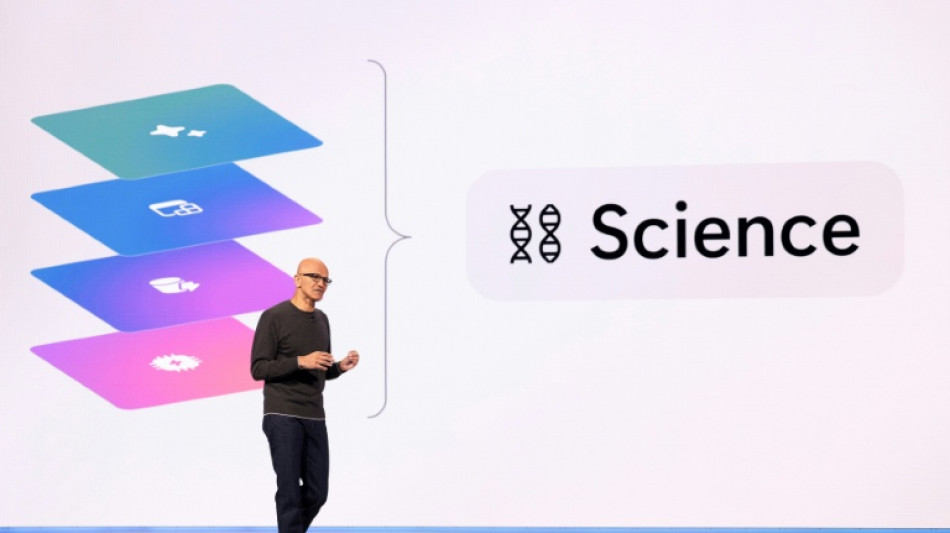
"The biggest issue we are now having is not a compute glut, but it's the power and...the ability to get the builds done fast enough close to power," Microsoft CEO Satya Nadella acknowledged on a recent podcast with OpenAI chief Sam Altman.
"So if you can't do that, you may actually have a bunch of chips sitting in inventory that I can't plug in," Nadella added.
Echoing the 1990s dotcom frenzy to build internet infrastructure, today's tech giants are spending unprecedented sums to construct the silicon backbone of the revolution in artificial intelligence.
Google, Microsoft, AWS (Amazon), and Meta (Facebook) are drawing on their massive cash reserves to spend roughly $400 billion in 2025 and even more in 2026 -- backed for now by enthusiastic investors.
All this cash has helped alleviate one initial bottleneck: acquiring the millions of chips needed for the computing power race, and the tech giants are accelerating their in-house processor production as they seek to chase global leader Nvidia.
These will go into the racks that fill the massive data centers -- which also consume enormous amounts of water for cooling.
Building the massive information warehouses takes an average of two years in the United States; bringing new high-voltage power lines into service takes five to 10 years.
- Energy wall -
The "hyperscalers," as major tech companies are called in Silicon Valley, saw the energy wall coming.
A year ago, Virginia's main utility provider, Dominion Energy, already had a data-center order book of 40 gigawatts -- equivalent to the output of 40 nuclear reactors.
The capacity it must deploy in Virginia, the world's largest cloud computing hub, has since risen to 47 gigawatts, the company announced recently.
Already blamed for inflating household electricity bills, data centers in the United Statescould account for 7 percent to 12 percent of national consumption by 2030, up from 4 percent today, according to various studies.
But some experts say the projections could be overblown.
"Both the utilities and the tech companies have an incentive to embrace the rapid growth forecast for electricity use," Jonathan Koomey, a renowned expert from UC Berkeley, warned in September.
As with the late 1990s internet bubble, "many data centers that are talked about and proposed and in some cases even announced will never get built."
- Emergency coal -
If the projected growth does materialize, it could create a 45-gigawatt shortage by 2028 -- equivalent to the consumption of 33 million American households, according to Morgan Stanley.
Several US utilities have already delayed the closure of coal plants, despite coal being the most climate-polluting energy source.
And natural gas, which powers 40 percent of data centers worldwide, according to the International Energy Agency, is experiencing renewed favor because it can be deployed quickly.
In the US state of Georgia, where data centers are multiplying, one utility has requested authorization to install 10 gigawatts of gas-powered generators.
Some providers, as well as Elon Musk's startup xAI, have rushed to purchase used turbines from abroad to build capability quickly. Even recycling aircraft turbines, an old niche solution, is gaining traction.
"The real existential threat right now is not a degree of climate change. It's the fact that we could lose the AI arms race if we don't have enough power," Interior Secretary Doug Burgum argued in October.
- Nuclear, solar, and space? -
Tech giants are quietly downplaying their climate commitments. Google, for example, promised net-zero carbon emissions by 2030 but removed that pledge from its website in June.
Instead, companies are promoting long-term projects.
Amazon is championing a nuclear revival through Small Modular Reactors (SMRs), an as-yet experimental technology that would be easier to build than conventional reactors.
Google plans to restart a reactor in Iowa in 2029. And the Trump administration announced in late October an $80 billion investment to begin construction on ten conventional reactors by 2030.
Hyperscalers are also investing heavily in solar power and battery storage, particularly in California and Texas.
The Texas grid operator plans to add approximately 100 gigawatts of capacity by 2030 from these technologies alone.
Finally, both Elon Musk, through his Starlink program, and Google have proposed putting chips in orbit in space, powered by solar energy. Google plans to conduct tests in 2027.
L.AbuAli--SF-PST