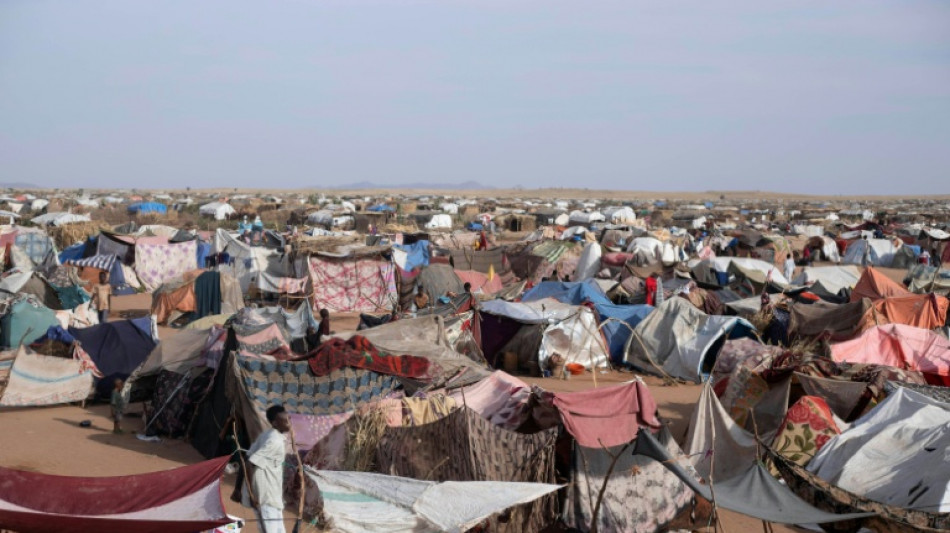
'Killed on sight': Sudanese fleeing El-Fasher recall ethnic attacks / Photo: - - AFP/File

 Netanyahu orders West Bank closure as attack wounds Israelis before election

 Asian stocks mixed ahead of weekend as tech recovers early losses
 How five Boeing 777s linked Madagascar's power elite to Iran
 South Korea proposes holding border talks with North
 Ukraine's young figure skaters twizzle on despite Russian threat

 Asian football endorses Infantino re-election as FIFA president
 Complete Kane hopes for 'special night' as Ballon d'Or rumours swirl

 Rooney calls United squad 'selfish babies' after Fernandes criticism
 Teddy Wilson, son of World Cup-winner David, gets Wallabies call-up

 New Zealand military chief resigns over 'inappropriate relationship'

 Man Utd's Carrick on borrowed time, free-scoring Brighton face Liverpool
 Asian stocks head into weekend on a low as tech extends losses

 'Generational rage': Young Europeans fight to be heard

 Lula, Bolsonaro to clash once more before Brazil vote
 Dressed to kill: Haircuts cap menacing look of Japan's yakuza
 Napa Valley's wineries feel Trump's tariff squeeze

 Venezuela protests demand return of Nobel winning leader Machado
 Marquez tops incident-packed opening practice for Australian MotoGP

 New York votes to ban Central Park horse carriages after decades of debate

 Australia face selection headaches after 'shambolic' South Africa defeat

 Around 150,000 rally in Belgrade as Serbia heads to pivotal poll

 Hamilton sets sights on racing in African grand prix
 Bournemouth hammer 10-man Milan, Juventus denied at the death

 Judge orders Trump to give deposition in BBC lawsuit by Dec 11

 'Fake' pollsters hit US midterms

As he fled the Sudanese city of El-Fasher in terror, Hassan Osman said he saw ethnic attacks by paramilitary forces, with civilians targeted for their tribe and skin colour.
The Rapid Support Forces (RSF), which have been at war with the army since April 2023, captured the last military stronghold in western Darfur on October 26.
Reports of mass killings, ethnic violence, abductions and sexual assaults have since emerged.
AFP spoke to three survivors of the battle for El-Fasher, who are now seeking shelter in the nearby town of Tawila.
Rights organisations have echoed fears that ethnic killings are taking place in areas under the paramilitaries' control.
An RSF officer rejected the accusations as false.
Osman, a university student from El-Fasher, told AFP that paramilitary fighters singled people out according to their ethnicity.
"They judge you by your tribe, your skin colour and where your family is from," he said.
"If you belong to certain tribes, they don't ask any questions, you are killed on sight."
He said the city's streets were "filled with bodies" when he escaped. "Some were slaughtered. Some were eaten by dogs."
Amna Haroun, from the Zaghawa African tribe, said she watched in horror as RSF fighters gunned down her husband and eldest son.
"They killed them right in front of my eyes, saying, 'We don't want you here'," she told AFP.
- 'Racial insults' -
The conflict in Sudan has killed tens of thousands of people, displaced nearly 12 million and triggered a hunger crisis.
Both sides have been accused of committing atrocities over the course of the war.
Darfur is home to several non-Arab ethnic groups, including the Zaghawa, Fur, Berti and Masalit, who have long been targeted by Arab militias.
The RSF traces its origins to the Janjaweed, a predominantly Arab militia accused of genocide in Darfur two decades ago.
Between 2003 and 2008, an estimated 300,000 people were killed and nearly 2.7 million were displaced in those campaigns of ethnic violence.
According to the European Union Agency for Asylum, non-Arab or African groups represent between two-thirds and three-quarters of Darfur's population.
The Zaghawa, the dominant ethnic group in El-Fasher, have been fighting alongside the army since late 2023.
The group, which initially remained neutral when the war began, aligned with the military after the RSF carried out massacres against the Masalit tribe in West Darfur capital El-Geneina, killing up to 15,000 people.
Osman said residents with darker skin, especially Zaghawa civilians, were subjected to "racial insults, humiliation, degradation and physical and psychological violence" as they fled El-Fasher.
"If your skin is light, they might let you go," he said. "It's purely ethnic."
Osman, who is from the Berti tribe, said he himself was not subjected to ethnic violence because the RSF fighters' main enmity was with the Zaghawa, who are aligned with the army.
But Hussein, from the Fur tribe, said he was detained for several days with around 200 men in Garni, a town 25 kilometres (16 miles) northwest of El-Fasher, where they were beaten and insulted.
"They hit us with sticks and called us 'slaves'," Hussein, who asked to be identified only by his first name for fear of reprisal, told AFP.
Osman also said RSF fighters demanded money from civilians -- often hundreds of dollars -- for safe passage, based on tribal identity and family origin.
"They ask where your family is from and set the amount accordingly," he said.
- 'Simply for being black' -
An RSF officer, based in El-Fasher, who asked not to be named because he was not authorised to speak to the media, denied the reported killings.
"We did not kill civilians or kill anyone because they belong to a (certain) tribe. These are just false accusations," the officer told AFP.
After the fall of El-Fasher, the paramilitary group issued a directive to its forces instructing them to "adhere strictly to the law, rules of conduct and military discipline during wartime", emphasising the need to ensure the "protection of civilians".
Since El-Fasher's takeover, the United Nations and rights monitors have reported widespread atrocities, including ethnically-driven killings and abductions.
UN experts said Friday they were "appalled by credible reports" of RSF executions of civilians in El-Fasher, calling them war crimes that "may amount to crimes against humanity".
They said the attacks mirrored earlier RSF campaigns in the nearby Zamzam camp -- overrun by paramilitaries in April -- and El-Geneina, where thousands were killed, accusing the group of targeting Fur, Masalit and Zaghawa communities "with the intent of terrorising, displacing and destroying them in whole or in part".
Sylvain Penicaud of MSF, who has been speaking to civilians fleeing El-Fasher in Tawila, told AFP that many of those fleeing said they were "targeted because of the colour of their skin".
"For me, the most terrifying part was being hunted down while they were running for their lives. Being attacked simply for being black," Penicaud said.
K.AbuTaha--SF-PST