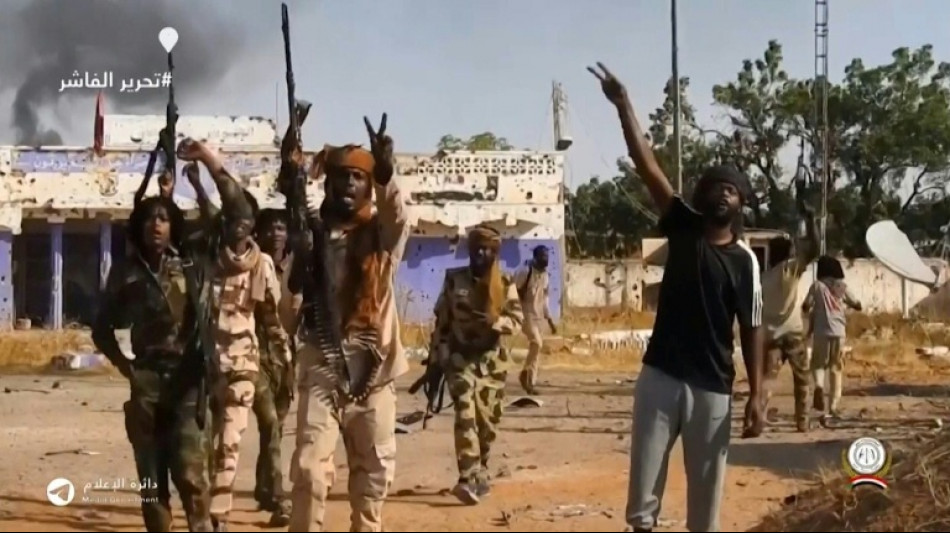
Fears of mass atrocities after Sudan's El-Fasher falls to paramilitaries / Photo: - - Rapid Support Forces (RSF)/AFP

 Saka to be carefully managed after latest injury setback, says Arteta

 Goodell says NFL's France debut 'just the beginning'

 Singapore widens haze probe to local firms linked to Indonesian fires

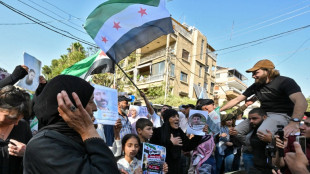 Hundreds of Syrians protest repeated Israeli incursions

 El Salvador sends troops to Haiti to find 4 missing soldiers
 Liverpool must go 'full gas' despite injury issues, says Iraola

 Oil hits $115 with stocks mixed on earnings, AI

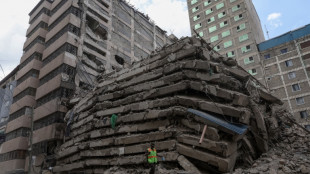 Casualties feared as multi-storey building collapses in Nairobi

 Man Utd defeat to Como 'unacceptable', says Carrick

 Hurzeler 'focused' on Brighton job despite Man Utd links
 Hammer blow for Kenya as world marathon champ Jepchirchir suspended for doping

 Latin America's right-wing swing looms large over nature summit

 European, Mideast foreign ministers hold talks in Istanbul

 World marathon champion Peres Jepchirchir suspended for doping: AIU
 Romania blames Russia for new deadly attack on ship
 Waze rejects Malaysia's data security claims after civil servant ban

 'Call of Duty' seeks to win back fans with warfare spectacle

 Volvo Cars shares plunge on losses, job cuts
 France braces for new protests as Macron seeks to restore order
 Kering shares tumble as Gucci fails to reassure investors
 West Bank attack wounds 5 as Israel PM cancels events
 Ahead of APEC summit, Trump comes knocking on Kim's door
 Emergency nurseries rescue DR Congo's Ebola orphans

 Bezzecchi tops Australian MotoGP practice as wallaby hops onto track
 Under-threat Ospreys bet on new ground and Australian 'stardust'

Fears mounted in Sudan on Tuesday, three days after paramilitaries seized the key city of El-Fasher, amid reports of mass atrocities and the killing of five Red Crescent volunteers in Kordofan.
The capture of El-Fasher, the historic heart of Darfur, has sparked fears of mass killings reminiscent of the region’s darkest days.
After an 18-month siege marked by starvation and bombardment, the city is now under the control of the Rapid Support Forces (RSF) -- descendants of the Janjaweed militias accused of genocide two decades ago.
The paramilitary group, locked in a brutal war with the army since April 2023, launched a final assault on the city in recent days, seizing the army's last positions.
In the neighbouring region of North Kordofan, the International Federation of Red Cross and Red Crescent said five Sudanese Red Crescent volunteers had been killed in Bara on Monday, and that three others were missing after the RSF took control of the town on Saturday.
Analysts say Sudan is now effectively partitioned along an east-west axis, with the RSF running a parallel government across Darfur while the army is entrenched along the Nile and Red Sea in the north, east and centre.
For many, El-Fasher's fall revives memories of the 2000s, when the Janjaweed razed villages and killed hundreds of thousands in what is believed to be one of the worst genocides of the 21st century.
But this time, the atrocities are not hidden.
The army-aligned foreign ministry said the crimes were "shamelessly documented by the perpetrators themselves".
- 'Rwanda-level' -
Since the city's fall on Sunday, RSF fighters have shared videos reportedly showing executions and abuse of civilians.
An RSF-led coalition said Tuesday it would form a committee to verify the authenticity of videos and allegations, adding that many of the videos are "fabricated" by the army.
The United Nations warned of "ethnically motivated violations and atrocities" while the African Union condemned "escalating violence" and "alleged war crimes".
Pro-democracy groups described "the worst violence and ethnic cleansing" since Sunday as the army-allied Joint Forces accused the RSF of killing over 2,000 civilians.
The UN said more than 26,000 fled El-Fasher in just two days, most on foot towards Tawila, 70 kilometres west.
"We're watching Rwanda-level mass extermination of people who are trapped inside," said Nathaniel Raymond, a US war investigator and executive director of Yale University's Humanitarian Research Lab (HRL).
In 1994 during the genocide in Rwanda, an estimated 800,000 people, mainly ethnic Tutsis, were killed in one of the 20th century's worst atrocities.
"The level, speed and totality of violence in Darfur is unlike anything I've seen," Raymond, who has been documenting war crimes across the world over the past 25 years, told AFP.
Around 177,000 civilians remain trapped in El-Fasher, according to the UN's migration agency, after the RSF built a 35-mile (56 kilometre) earthen berm sealing off food, medicine and escape routes.
Once the seat of the Darfur Sultanate, a centuries-old African kingdom that flourished long before Khartoum existed, El-Fasher's streets are now strewn with charred vehicles and bodies, smoke rising over shattered neighbourhoods.
One clip on Monday appeared to show corpses beside burnt-out cars. Another showed an RSF gunman firing into a crowd of civilians -- identified by AFP as a notorious fighter known from execution videos on his TikTok account, where he boasts of killings in newly captured areas.
- A new power map -
Pro-democracy activists also accused the RSF of executing all wounded people receiving treatment at the Saudi Hospital in El-Fasher.
Satellite analysis by Yale's HRL revealed door-to-door killings, mass graves, red patches and bodies visible on the city's berm, consistent with eyewitness accounts.
"We think those red patches are blood pools from bodies bleeding out," said Raymond, describing imagery showing "objects consistent with human bodies" and trenches filled with corpses.
To many Sudanese, these tactics are hauntingly familiar.
But Yale University's Raymond said that the RSF has grown deadlier and more militarily equipped with time.
"These people have an air force... no one can hide because they can see them from the air," he said.
Raymond also warned the current violence would not stop at El-Fasher but would spread to other non-Arab communities.
The Zaghawa, the dominant group in El-Fasher, have long seen the RSF's advance as an existential threat.
In 2023, the RSF was accused of massacres in West Darfur's capital, El-Geneina, killing up to 15,000 people from the Masalit -- another non-Arab group.
"The prospects for peace are very minimal," said Sudanese analyst Kholood Khair.
"Neither the army nor the RSF, for strategic or battlefield reasons, is willing to commit to a ceasefire or genuine peace talks," she told AFP.
The war has killed tens of thousands, displaced millions, and triggered the world's largest displacement and hunger crisis. Both sides stand accused of widespread atrocities.
A.AbuSaada--SF-PST