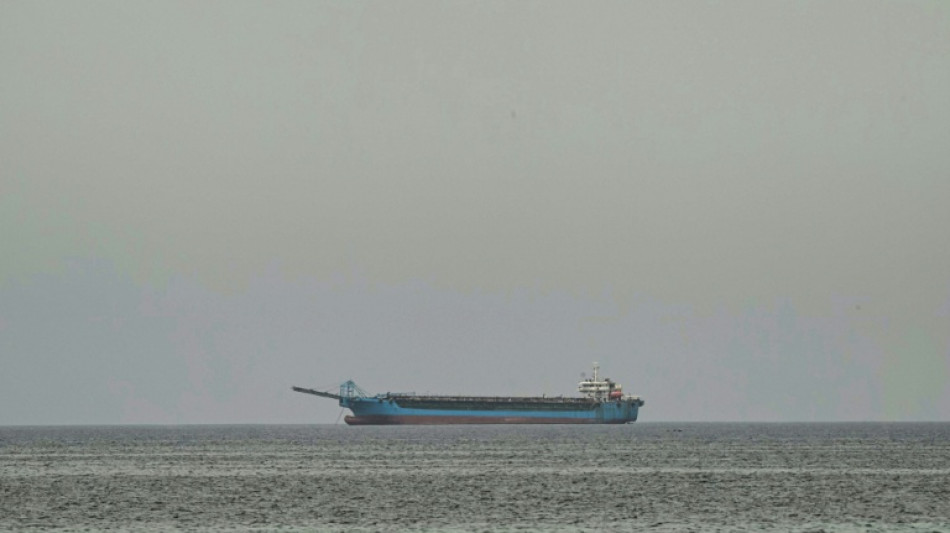
Pentagon denies clearing Hormuz Strait mines will take six months / Photo: - - AFP

 Nigeria's Tinubu confirms 32 dead after military plane crash

 'Reckless' AI firms can't control models, says whistleblower

 Switching on brain cells: the Nobel-winning science of optogenetics

 Quebec votes as separatist surge poses test for Canada PM

 Euro slides as concerns about French debt mount

 Former Trump press secretary Leavitt joins Fox News

 Djokovic advances to China Open final as Medvedev out for hitting fan with ball
 Disgraced former US House speaker dies at 84

 Euro slides as worries about French debt grow
 US withdraws all bomber aircraft from UK airbase
 Drone hits Ethiopia IDP camp as fears grow of regional war

 US-German trio wins medicine Nobel for illuminating the brain
 England captain Kane driven by desire for records says Tuchel
 N.Irish court hears challenge to disputed Orangemen parade

 Talking points from the Bahrain Grand Prix in Malaysia

 Yemen, Saudi Arabia target Houthis in new campaign as war escalates

 US-German trio wins medicine Nobel for work on optogenetics
 Swiatek, Zheng survive three-set tests in China Open third round

 Hasan says Test cricket momentum turning for Bangladesh

 Intense heat puts births in jeopardy, UN tells Fiji talks

 US arrests woman accused of spying for China on Taiwan leader's family

 Yemen military announces broad strikes against Houthis
 Zuckerberg skewered again on screen in 'The Social Reckoning'

 Fiji urges 'just' climate transition, financing at pre-COP gathering

 Thailand's Jeeno overcomes late wobble to win Lotte Championship

The Pentagon blasted as cherry picking and false on Thursday a news report saying that the department assessed it could take six months to completely clear the Strait of Hormuz of Iranian-laid mines.
The Washington Post reported on Wednesday that the Pentagon shared the six-month estimate during a classified briefing for the members of the House Armed Services Committee, citing three unidentified officials familiar with the discussion.
Iran has vowed not to reopen the Strait of Hormuz as long as the United States blockades its ports, with the blocked waterway sharply driving up oil and gas prices and disrupting the global economy.
Asked about the report, Chief Pentagon Spokesman Sean Parnell said "the media cherry picking leaked information, much of which is false, from a classified, closed briefing is dishonest journalism."
"One assessment does not mean the assessment is plausible, and a six-month closure of the Strait of Hormuz is an impossibility and completely unacceptable to the Secretary," Parnell told AFP on Thursday.
Lawmakers were told that Iran could have placed 20 or more mines in and around the strait, some floated remotely using GPS technology that makes them harder to detect, according to the Washington Post.
Iran's Revolutionary Guards have warned of a "danger zone" covering 1,400 square kilometres -– 14 times the size of Paris –- where mines may be present.
A spokesman for German transportation giant Hapag-Lloyd cautioned last week that shippers needed details on viable routes because they remain fearful of mines.
Only a few ships trickled through when the Hormuz strait briefly reopened at the start of the ceasefire this month because of concerns about attacks or mines.
The US Navy said this month its ships transited the waterway to begin removing the mines but that claim was denied by Iran's Revolutionary Guards, which threatened any military vessels attempting to cross the channel.
London hosted talks with military planners from more than 30 countries starting on Wednesday about a UK and France-led multinational mission to protect navigation in the Strait of Hormuz once hostilities end.
The "defensive" coalition is set to discuss plans to reopen the strait and conduct mine clearance operations.
It took multinational coalition forces more than two years to remove hundreds of mines and declare the northern gulf mine-free after the 1990-91 Gulf War, according to US researcher Scott Truver.
R.AbuNasser--SF-PST