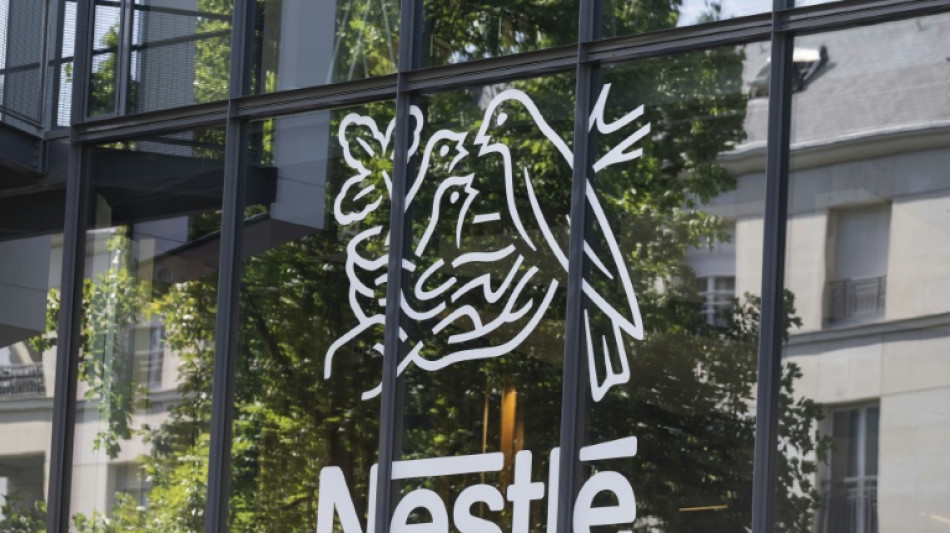
Nestle sales slump under strong franc but volumes recover / Photo: Martin LELIEVRE - AFP/File

 Nigeria's Tinubu confirms 32 dead after military plane crash

 'Reckless' AI firms can't control models, says whistleblower

 Switching on brain cells: the Nobel-winning science of optogenetics

 Quebec votes as separatist surge poses test for Canada PM

 Euro slides as concerns about French debt mount
 Former Trump press secretary Leavitt joins Fox News

 Djokovic advances to China Open final as Medvedev out for hitting fan with ball

 Disgraced former US House speaker dies at 84

 Euro slides as worries about French debt grow
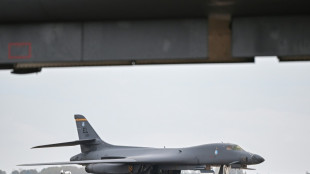 US withdraws all bomber aircraft from UK airbase
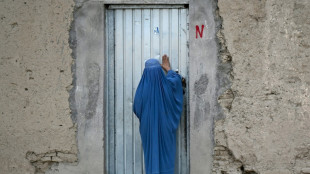
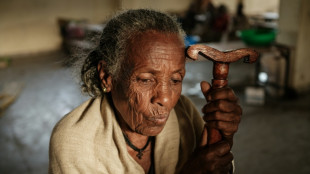 Drone hits Ethiopia IDP camp as fears grow of regional war

 US-German trio wins medicine Nobel for illuminating the brain
 England captain Kane driven by desire for records says Tuchel

 N.Irish court hears challenge to disputed Orangemen parade

 Talking points from the Bahrain Grand Prix in Malaysia

 Yemen, Saudi Arabia target Houthis in new campaign as war escalates

 US-German trio wins medicine Nobel for work on optogenetics

 Swiatek, Zheng survive three-set tests in China Open third round

 Hasan says Test cricket momentum turning for Bangladesh

 Intense heat puts births in jeopardy, UN tells Fiji talks

 US arrests woman accused of spying for China on Taiwan leader's family

 Yemen military announces broad strikes against Houthis

 Zuckerberg skewered again on screen in 'The Social Reckoning'
 Fiji urges 'just' climate transition, financing at pre-COP gathering

 Thailand's Jeeno overcomes late wobble to win Lotte Championship

Nestle, the food giant whose brands include Nespresso coffee and Perrier water, saw first-quarter sales figures slump due to the strong value of the Swiss franc and a baby formula recall, but sales volumes overall edged higher.
The maker of Purina dog food, Maggi bouillon cubes, Gerber baby food and Nesquik chocolate-flavoured drinks has struggled with flagging consumer demand in key markets in recent years.
Nestle shook up its management last year and laid off six percent of its staff.
For the first three months of the year the company reported sales of 21.3 billion Swiss francs ($24.9 billion), a drop of 5.7 percent from the period last year.
The franc has appreciated considerably as investors seek a safe haven amid global uncertainty, resulting a 9.3 percentage point drag on Nestle's sales when it converts international earnings into the Swiss currency.
Excluding currency impacts and changes in business operations, known as organic sales, revenues were up by 3.5 percent.
The results beat expectations of 2.5 percent organic sales growth to 21.2 billion Swiss francs, according to analysts surveyed by Swiss financial news agency AWP.
Nestle's management has been targeting another indicator, real internal growth (RIG), which reflects sales volumes.
This rose by 1.2 percent in the first quarter, surpassing the 0.2 percent expected by analysts.
"Our first-quarter performance demonstrates that our RIG-led growth strategy is delivering," said Nestle's new chief executive, Philipp Navratil.
The company's shares rose six percent, far outpacing the Swiss market that rose one percent overall.
"Nestle is showing early signs of re‑igniting volume growth," said analysts at Vontobel.
"This is the kind of reassurance investors were waiting for and it corroborates management's relatively upbeat tone following" 2025 annual results, they added.
"In an uncertain and complex environment, I would like to thank all our people for their dedication and our customers and consumers for their trust," Navratil added.
That trust was tested at the start of this year when it emerged that Nestle waited for days for a health-risk analysis before alerting authorities after detecting a toxin in its baby formula.
A scare over the toxin cereulide in an ingredient received from a global supplier eventually forced several manufacturers to recall potentially contaminated products in over 60 countries.
Nestle estimated that the recall and impact on consumer demand led to a 0.9 percentage point drop in organic sales.
It said product availability had returned to normal.
"We are already seeing early signs of improvement and expect to fully recover by the end of the year," the company said in a statement.
Navratil said at a press conference that the company was monitoring developments in the Middle East closely, in particular the swings in energy prices.
However, "we have so far seen very little impact in our business globally," he said.
The company said its factories in the Middle East region, which contribute around three percent to sales, continue to operate.
But it warned that the impact of the war on the cost of raw materials, production and distribution, as well as consumer behaviour, remained uncertain.
X.AbuJaber--SF-PST