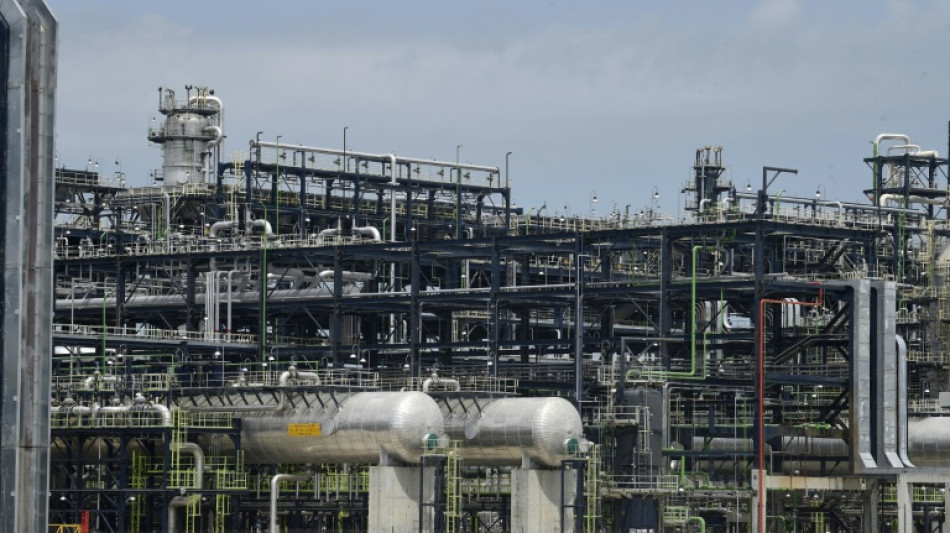
Africa faces 86 mn tonne fuel shortfall by 2040: AFC / Photo: PIUS UTOMI EKPEI - AFP

 Nigeria's Tinubu confirms 32 dead after military plane crash

 'Reckless' AI firms can't control models, says whistleblower

 Switching on brain cells: the Nobel-winning science of optogenetics
 Quebec votes as separatist surge poses test for Canada PM

 Euro slides as concerns about French debt mount

 Former Trump press secretary Leavitt joins Fox News

 Djokovic advances to China Open final as Medvedev out for hitting fan with ball

 Disgraced former US House speaker dies at 84

 Euro slides as worries about French debt grow
 US withdraws all bomber aircraft from UK airbase
 Drone hits Ethiopia IDP camp as fears grow of regional war

 US-German trio wins medicine Nobel for illuminating the brain
 England captain Kane driven by desire for records says Tuchel
 N.Irish court hears challenge to disputed Orangemen parade

 Talking points from the Bahrain Grand Prix in Malaysia

 Yemen, Saudi Arabia target Houthis in new campaign as war escalates

 US-German trio wins medicine Nobel for work on optogenetics

 Swiatek, Zheng survive three-set tests in China Open third round

 Hasan says Test cricket momentum turning for Bangladesh

 Intense heat puts births in jeopardy, UN tells Fiji talks

 US arrests woman accused of spying for China on Taiwan leader's family

 Yemen military announces broad strikes against Houthis

 Zuckerberg skewered again on screen in 'The Social Reckoning'

 Fiji urges 'just' climate transition, financing at pre-COP gathering

 Thailand's Jeeno overcomes late wobble to win Lotte Championship

The Iran war has exposed Africa's vulnerability to fuel chokepoints and is heading for a 86 million tonne fuel shortfall by 2040, the Africa Finance Corporation (AFC) said Thursday.
Africa imports over 70 percent of its refined fuel and some $230 billion worth of essential goods, including fuel, food, plastics, steel, and fertiliser each year, the AFC said in a report released in Nairobi.
Its dependence on fuel imports will continue to rise from 74 million tonnes in 2023 to 86 million tonnes in 2040, said the report by the pan-African finance institution.
That is equivalent to almost three of the giant refineries run in Nigeria by the Dangote group -- by far the biggest in Africa.
"Not only is it importing fuel, but on the eastern side of the continent, those imports are vulnerable to chokepoints -- we've all learned about the Strait of Hormuz this year, and it's not the only chokepoint," said the AFC's chief economist Rita Babihuga-Nsanze at the report's launch.
The Strait of Hormuz, which accounts for a fifth of global fuel transport, has been effectively shut down by the war in the Middle East, leaving import-dependent countries in east Africa facing critical shortages.
Kenyan President William Ruto, speaking at the AFC summit, said the war showed the need for Africa to stop relying on outsiders.
"Our ambitions will remain unrealised if we continue to depend on external capital whose primary interest is securing raw materials for their own industries," said Ruto.
"We cannot continue to export raw materials and import finished products made from them," he added.
- Infrastructure -
Kenya last year announced an infrastructure splurge, including 50 new hydroelectric dams and 10,000 megawatts of additional power generation within seven years, as well as plans to revamp roads, rail and airports.
"While historical injustices from colonialism to inequities in the global economic order are real, we must also acknowledge that other regions have faced similar challenges, but they have risen above them," Ruto told the summit.
"We are constrained only by the extent that we accept the status quo through acquiescence, complacency, and limited ambition."
Fixing Africa's energy shortfall requires new hubs and better performance from existing assets, the AFC report said.
Babihuga-Nsanze highlighted the example of Zambian dams that were not designed to cope with new drought conditions, and two gigawatts of Angolan hydropower that was not connected to the regional grid and therefore went to waste.
She also highlighted the shortages of fertiliser due to the Mideast war, since a high proportion comes from the Gulf.
Such vulnerabilities are "strange", said Babihuga-Nsanze, given that Africa has 80 percent of the world's phosphate reserves -- a key fertiliser source -- yet only produces 20 percent of the global stock.
"There's a real opportunity for Africa to step in the gap here," she said.
Q.Bulbul--SF-PST