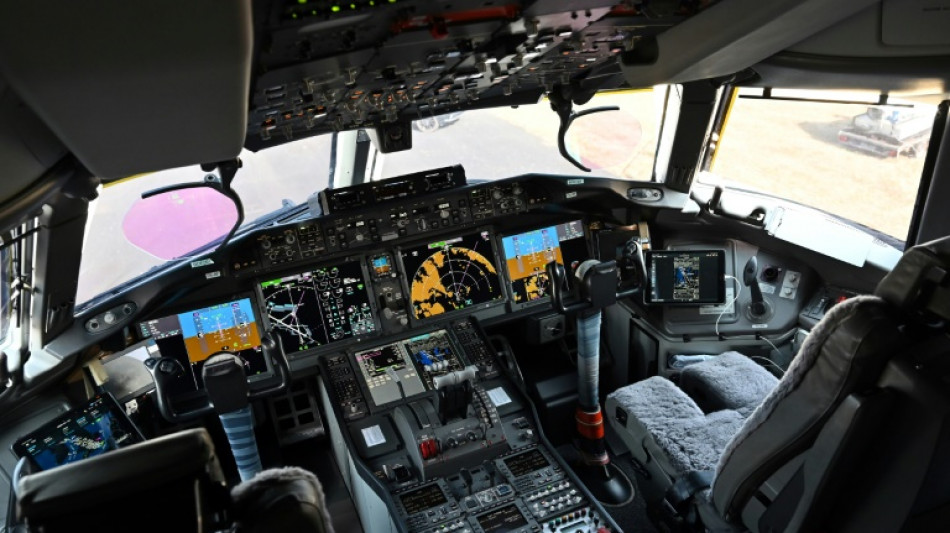
False GPS signal surge makes life hard for pilots / Photo: JUSTIN TALLIS - AFP

 LA28 Olympics torch relay to visit all 50 states

 Spain brush aside Croatia in Nations League, England down Czechs

 Trump hails 'morally binding' AI self-regulation pledge

 Yamal inspires Spain to Croatia romp on World Cup homecoming

 UN to hold fourth informal poll of secretary-general candidates

 Who are the Emiratis behind crisis-hit Manchester City?

 Singer Angelique Kidjo urges Africans to 'create together'

 Alleged Rihanna mansion shooter mentally fit for trial, says judge
 Mystery over UK airbase scare as police find petrol not explosives

 OpenAI unveils low-cost AI model, a day after shelving Astra upgrade
 Premier League confirms Man City guilty of serious financial breaches
 Brazil's Lula turns to Bad Bunny tune to criticise Trump ahead of polls

 Nigerian dancer eyes world record after seven-day marathon

 Swiss regulator concludes Julius Baer bank probe
 Brazil's patron saint pulled into latest election scrap

 Football overload leaves players near 'breaking point', warns Tebas

 Paris Eiffel Tower says chief to step down after uproar over removing women staff

 Amaze Holdings (NYSE: AMZE) Executes Binding LOI to Acquire BullionFX | Alchemy, a Decentralized Gold-Backed Financial Ecosystem for Valued at US$155 Million

 Clashes between French teens, police as school blockades intensify
 Stocks move sideways despite oil moving lower

 African leaders to gather in Egypt for business summit
 UK decides against charging foreign visitors for museums

 Dallaglio to sell England World Cup winners' medal

 Brazil come from behind to beat Australia 4-2 in friendly

 Ruthless An retains Asian Games badminton crown as Kunlavut triumphs

False GPS signals that deceive on-board plane systems and complicate the work of airline pilots are surging near conflict zones, industry employees and officials told AFP.
A ground collision alert sounds in the cockpit, for instance, even though the plane is flying at high altitude -- a phenomenon affecting several regions and apparently of military origin.
This includes the vicinity of Ukraine following the Russian invasion two years ago, the eastern Mediterranean and the air corridor running above Iraq, according to pilots and officials interviewed by AFP.
Disruptions which were previously limited to jamming preventing access to signals from geolocation satellites are now also taking a more dangerous form making it difficult to counter spoofing.
This sees a plane receive false coordinates, times and altitudes.
By comparing this data to the geographical maps in its memory banks, its systems can conclude there is imminent danger ahead, Thierry Oriol, a Boeing 777 pilot and member of the SNPL, the main French pilots' union, told AFP.
"There were some untimely alarms ordering people to pull back as far as possible on the stick and apply full power to avoid an obstacle, while the plane was in cruise... and in any case no mountain reaches so high," explained Oriol.
He also mentioned an incident "departing from Beirut where the plane thought it was at the level of the Alps, at 10,000 feet" (three kilometres/1.8 miles) above sea level.
- Risk management -
The problem, explained a manager at a European airline speaking on condition of anonymity, is that this adulterated information enters the navigation system and can cause false alerts hours afterwards as the flight nears its destination.
"At first, crews quickly see that it is a false alarm. But as it is an alarm warning of immediate danger, we ask the crews to still carry out the emergency manoeuvre, to make a return and an analysis.
"If the problem occurs a second time and the analysis has not revealed any danger, then the only way is to turn off this alarm, knowing other systems remain active to detect possible risk," the European airline manager added.
The commonly used GPS actually only covers the global navigation satellite system (GNSS) managed by the American army.
Two others exist -- the European Galileo and Russia's GLONASS.
On board airliners, GNSS are the main tools which pilots can rely on in order to determine their position, but they are not the only ones.
Without needing to return to the sextants of bygone days, these devices are equipped with inertial orientation devices capturing movement in order to deduce an object's trajectory.
But their precision deteriorates throughout the flight.
- 'Sharp rise' -
Since the start of the war in Ukraine, the European Union Aviation Safety Agency (EASA) has been warning that GNSS signal disruptions have intensified, affecting relatively remote regions beyond the conflict zone such as Finland and the Mediterranean.
In certain cases, this can lead to a modified trajectory or even a changed destination as it was impossible to carry out a landing in secure conditions, the EASA says.
The commission governing health and safety conditions for Air France pilots last month posted a warning of what it termed a "grave and imminent danger" of GPS spoofing, estimating the phenomenon was affecting as many as 3.7 flights in 1,000, according to an informed source.
In late January the EASA made it a priority to act against such disruptions in unveiling a partnership with the International Air Transport Association (IATA), the world's main airline association with more than 300 carriers, to counter spoofing and jamming.
"GNSS systems offer tremendous advantages to aviation in increasing the safety of operations in a busy shared airspace," said EASA acting executive director Luc Tytgat.
"But we have seen a sharp rise in attacks on these systems, which poses a safety risk."
Tytgat added that "in the medium term, we will need to adapt the certification requirements of the navigation and landing systems.
For the longer term, we need to ensure we are involved in the design of future satellite navigation systems."
For IATA director general Willie Walsh, "we need coordinated collection and sharing of GNSS safety data; universal procedural GNSS incident guidance from aircraft manufacturers; a commitment from States to retain traditional navigation systems as backup in cases where GNSS are spoofed or jammed."
Those systems include beacons or transmitters on the ground emitting radio signals that help planes to triangulate their position.
"Airlines will be critical partners. And whatever actions are taken, they must be the focal point of the solution as they are the front line facing the risk," said Walsh.
Z.AbuSaud--SF-PST