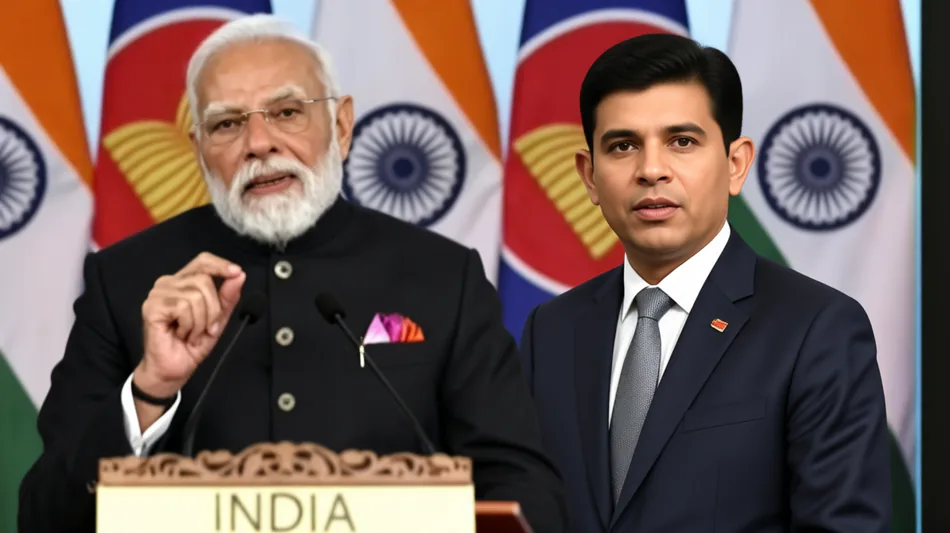
Modi’s ASEAN Agenda Prioritizes Trade Balance and Defense Ties in Manila

 استقرار أسعار الذهب مع ترقب المستثمرين لقرارات الفائدة الأمريكية
 Kuwait and Egypt Sign Eight Agreements to Expand Strategic Partnership

 تقارير إسرائيلية تكشف عن محاولات نتنياهو وزملائه للتأثير على نتائج الانتخابات عبر استهداف الفلسطينيين

 بنك القدس يتعهد بتأمين احتياجات مرضى السكري خلال أمسية توعوية في رام الله

 AI Job Losses at NAB, Qantas, Canva and Atlassian Signal Market Shift, Not Workforce Collapse

 Owner Review: 2023 Volvo XC60 Recharge Exceeds Expectations for Calgary Driver
 Indiana River Otters Make Comeback After Decades of Conservation Efforts
Prime Minister Narendra Modi has arrived in Manila for the 23rd ASEAN-India Summit and the 21st East Asia Summit, where he will prioritize balancing trade relations and deepening defense cooperation with Southeast Asian leaders. Amid a widening trade deficit and ongoing reviews of the free trade agreement, India aims to strengthen strategic ties while addressing maritime security concerns in the Indo-Pacific.
Prime Minister Narendra Modi has arrived in Manila for the 23rd ASEAN-India Summit and the 21st East Asia Summit, beginning Monday, with a diplomatic agenda centered on correcting trade imbalances, expanding defense partnerships, and addressing maritime security challenges in the Indo-Pacific.
Modi, visiting at the invitation of Philippine President Ferdinand Marcos Jr., is set to engage with regional leaders on November 17. Official sources indicate that discussions will cover freedom of navigation, disaster preparedness, the blue economy, digital transformation, and resilient supply chains. India has identified trade and investment as foundational pillars of its relationship with the Association of Southeast Asian Nations (ASEAN), aiming to reduce a significant trade deficit that has grown substantially since the implementation of the ASEAN-India Trade in Goods Agreement (AITIGA) in 2010.
According to official figures, bilateral trade between India and ASEAN reached approximately $128 billion in the fiscal year 2026. However, India’s exports stood at $38.41 billion, resulting in a trade deficit exceeding $50 billion. This marks a sharp increase from the $6-7 billion deficit recorded when AITIGA was first implemented. Delhi has been pressing for a more balanced agreement during the ongoing review of the pact, citing inadequate market access for Indian exporters in certain ASEAN countries. Conversely, ASEAN nations are also seeking greater market access, and differences between the two sides persist.
Defence cooperation is expected to feature prominently in the summit’s proceedings. India and ASEAN are looking to deepen military ties through joint exercises, naval port calls, and defense technology partnerships. The $375 million deal for BrahMos supersonic cruise missiles with the Philippines, followed by a similar agreement with Vietnam, has opened prospects for wider defense exports to the region. Jaiteerth R Joshi, chief of BrahMos Aerospace, noted last week that several other Southeast Asian countries have expressed interest in acquiring the missile system.
Maritime security remains a critical focus amid growing strategic competition with China in the Indo-Pacific. India is seeking to enhance cooperation with Southeast Asian nations on maritime surveillance, security operations, and combating illegal fishing and piracy. The second ASEAN-India Maritime Exercise was held in September and October of this year, and India hosted the seventh East Asia Summit Conference on Maritime Security Cooperation in Kochi in October.
During the 21st East Asia Summit, India is expected to reiterate its support for a free, open, and rules-based Indo-Pacific. Officials stated that New Delhi will emphasize adherence to international law, including the United Nations Convention on the Law of the Sea (UNCLOS). The summit provides a broader platform for discussing regional security and geopolitical developments.
A Quad leaders’ meeting is also anticipated in Manila on November 17. This gathering would bring together Modi, US President Donald Trump, Japanese Prime Minister Sanae Takaichi, and Australian Prime Minister Anthony Albanese. If held, it would mark the first Quad summit in two years and the first since Trump returned to the White House. Critical minerals, supply-chain resilience, and the security of commercial shipping lanes, particularly those carrying energy supplies, are expected to be key topics for the group.
The visit underscores India’s strategic pivot toward Southeast Asia as it navigates complex economic relationships and security dynamics in a region increasingly influenced by great power competition.
Y.Zaher--SF-PST