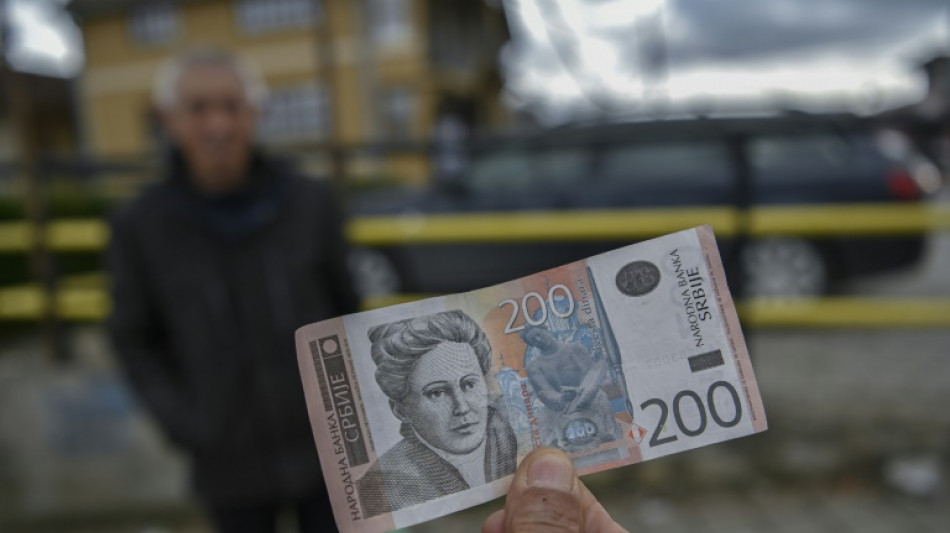
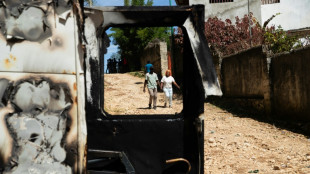
Dinar ban sparks cash crunch for Kosovo Serbs / Photo: Armend NIMANI - AFP

 LA28 Olympics torch relay to visit all 50 states
 Spain brush aside Croatia in Nations League, England down Czechs
 Trump hails 'morally binding' AI self-regulation pledge
 Yamal inspires Spain to Croatia romp on World Cup homecoming

 UN to hold fourth informal poll of secretary-general candidates
 Who are the Emiratis behind crisis-hit Manchester City?
 Singer Angelique Kidjo urges Africans to 'create together'

 Alleged Rihanna mansion shooter mentally fit for trial, says judge
 Mystery over UK airbase scare as police find petrol not explosives
 OpenAI unveils low-cost AI model, a day after shelving Astra upgrade
 Premier League confirms Man City guilty of serious financial breaches
 Brazil's Lula turns to Bad Bunny tune to criticise Trump ahead of polls
 Nigerian dancer eyes world record after seven-day marathon
 Swiss regulator concludes Julius Baer bank probe
 Brazil's patron saint pulled into latest election scrap

 Football overload leaves players near 'breaking point', warns Tebas
 Paris Eiffel Tower says chief to step down after uproar over removing women staff
 Amaze Holdings (NYSE: AMZE) Executes Binding LOI to Acquire BullionFX | Alchemy, a Decentralized Gold-Backed Financial Ecosystem for Valued at US$155 Million
 Clashes between French teens, police as school blockades intensify
 Stocks move sideways despite oil moving lower
 African leaders to gather in Egypt for business summit
 UK decides against charging foreign visitors for museums

 Dallaglio to sell England World Cup winners' medal

 Brazil come from behind to beat Australia 4-2 in friendly
 Ruthless An retains Asian Games badminton crown as Kunlavut triumphs

Serb communities in parts of Kosovo are struggling to get their hands on dinars, jeopardising the salaries, pensions and social security payments that thousands there get from Belgrade.
Frustrations are spiking more than a month after a controversial new rule made the euro the only legal currency in Kosovo, effectively outlawing the use of the Serbian dinar.
The move sparked anger in Belgrade, which does not recognise Kosovo's independence and continues to finance a parallel health, education and social security system for Serbs there.
But the Kosovo government has repeatedly blocked currency shipments at the border, hoping to choke off the supply of cash that authorities claim is the lifeblood for organised crime groups across the north where most Serbs live.
Kosovo's roughly 100,000 Serbs have clung tight to the dinar since a brutal late-1990s war between Serbia and ethnic Albanian insurgents saw Serbian troops and government personnel withdraw from the breakaway province that declared independence in 2008.
Those living near the northern border with Serbia have greater connections to Serbian government institutions and still have access to a trickle of dinars.
But it is much harder for enclaves further from the frontier already more integrated into the Kosovo system.
Cash had run out for Serb communities south of the northern city of Mitrovica by Thursday, according to Serbian state broadcaster RTS.
AFP was not able to independently verify the claim.
- 'Already difficult' -
In Gracanica -- home to a 14th-century Orthodox church seen as a spiritual and political stronghold for generations of Serbs -- the dinar regulation has been hitting the surrounding community hard.
Long lines have been forming at Serbia's Postal Savings Bank -- the only place where Serbs could receive pension payments and salaries for work in Serbian institutions in the area.
With its cash reserves dwindling, the bank has imposed a 10,000-dinar (85-euro) withdrawal limit.
"The pension is late, but the bills are not. I don't know how we will make it," said Snezana Vujovic, a 43-year-old nurse.
"The economic situation is already difficult, and without the money from Serbia it is even more harsh," Momir Jeftic, a 68-year-old pensioner told AFP as he stood next to an empty cash machine.
"Now whoever wants money must go to Serbia," Jeftic added, saying he would likely have to dip into emergency food supplies saved for a rainy day.
The spiralling financial crisis has forced many Kosovo Serbs to spend hours on the road travelling back and forth to the nearby border towns of Kursumlija, Vranje and Bujanovac in Serbia for money.
The cash crunch has provided a rare boon for taxi drivers, according to local media reports, with drivers charging passengers up to 10 euros per person.
"All this is aimed at harming citizens. Such decisions are freakish," Dragan Colic, 68, told AFP.
"The greater the inflow of money, the richer Kosovo is."
- Shutting down parallel state -
Despite criticism of the ban by several Western governments, including the US, Kosovo authorities have doubled down on the measure.
Officials have introduced a three-month transitional period to help the Serb community adapt.
Branimir Stojanovic, a Kosovo Serb civil society leader based in Gracanica, said the measure would likely bridle the parallel state that allowed Serbs to bypass Kosovo institutions.
"The financial aid from Serbia is literally fuel for the one engine that works here," said Stojanovic.
"When you cut off what supplies that mechanism, you have actually made a move to shut down that entire system."
Ferdi Ahmeti, a Roma grocer in Gracanica, is caught in the middle of the tug of war.
His takings fell by half from the first day of the crisis. "I cannot buy goods wholesale from Albanians in Pristina for euros and sell to Serbs in Gracanica for dinars like before," he said.
"I hope that a solution will be found soon. For me, it's the same -- dinar or euro."
H.Darwish--SF-PST