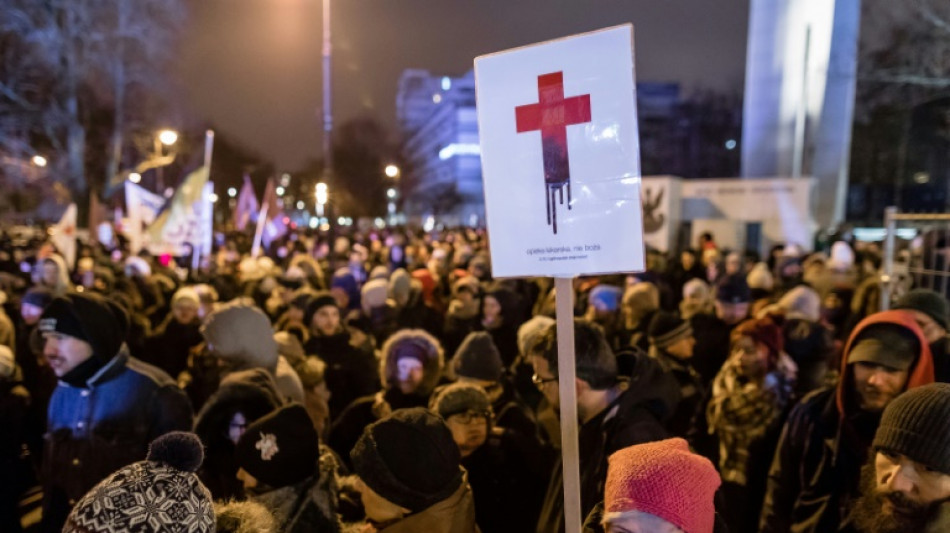
Polish women 'betrayed' by slow pace of abortion reforms / Photo: Wojtek RADWANSKI - AFP

 NBA close to picking new $12-13bn Vegas team owners: report
 LA28 Olympics torch relay to visit all 50 states
 Spain brush aside Croatia in Nations League, England down Czechs

 Trump hails 'morally binding' AI self-regulation pledge

 Yamal inspires Spain to Croatia romp on World Cup homecoming

 UN to hold fourth informal poll of secretary-general candidates
 Who are the Emiratis behind crisis-hit Manchester City?

 Singer Angelique Kidjo urges Africans to 'create together'

 Alleged Rihanna mansion shooter mentally fit for trial, says judge

 Mystery over UK airbase scare as police find petrol not explosives

 OpenAI unveils low-cost AI model, a day after shelving Astra upgrade
 Premier League confirms Man City guilty of serious financial breaches

 Brazil's Lula turns to Bad Bunny tune to criticise Trump ahead of polls

 Nigerian dancer eyes world record after seven-day marathon

 Swiss regulator concludes Julius Baer bank probe

 Brazil's patron saint pulled into latest election scrap

 Football overload leaves players near 'breaking point', warns Tebas
 Paris Eiffel Tower says chief to step down after uproar over removing women staff

 Amaze Holdings (NYSE: AMZE) Executes Binding LOI to Acquire BullionFX | Alchemy, a Decentralized Gold-Backed Financial Ecosystem for Valued at US$155 Million
 Clashes between French teens, police as school blockades intensify

 Stocks move sideways despite oil moving lower

 African leaders to gather in Egypt for business summit

 UK decides against charging foreign visitors for museums

 Dallaglio to sell England World Cup winners' medal

 Brazil come from behind to beat Australia 4-2 in friendly

An unprecedented mobilisation among women brought a liberal alliance to power in Poland, raising hopes that one of Europe's strictest abortion laws would be scrapped. But now they feel betrayed.
A record 74 percent of eligible women voted in the October elections and the mobilisation of young female voters helped pro-Western parties oust the conservative Law and Justice (PiS) government.
Women are now voicing anger and frustration, saying the government is dragging its feet on changing the laws on womens' reproductive rights.
Abortion in the majority-Catholic country has been outlawed since 1993 and is only legal if the pregnancy results from sexual assault or incest, or threatens the life or health of the mother.
The PiS's eight-year rule saw access to abortion, in-vitro fertilisation and emergency contraception tightened.
Four bills to liberalise the laws have now been stalled in parliament, as MPs wait for a green light from the lower house speaker to start debate.
But the speaker, Szymon Holownia, from the Third Way centre-right junior coalition party, decided this week to further delay the debate to April.
Holownia, who presents himself as a progressive Catholic, said he did want debate on the bills while campaigning was on for local elections due in April.
"We feel betrayed," Marta Lempart, leader of the Women's Strike movement, told AFP.
Out of the four bills stuck in parliament, two were submitted by the Left, another coalition partner. One of them allows abortion until the 12th week and the other decriminalises abortion assistance.
The Civic Coalition of Prime Minister Donald Tusk submitted a separate bill to legalise abortion.
- 'Can't shelve human rights' -
Lempart, who had earlier coordinated nationwide mass protests against the restrictive laws, said she would keep on fighting until they are reversed.
"It was women in Poland who decided the outcome of the elections, and now we deserve that work on legalising abortion begins," Lempart said.
Lempart called for protests at the office of the Third Way.
Lawmakers from fellow coalition parties, the Civic Coalition and the Left, also slammed the delay which caused the first major rift within the ruling coalition.
"You can't just shelve human rights," Family Minister Agnieszka Dziemianowicz-Bak said, adding that women are "tired of waiting" for the laws to change.
"We have organised ourselves and now we simply demand what we were promised," Natalia Broniarczyk, from Abortion Without Borders group, told AFP.
"Doctors were simply not taught how to perform abortions," Broniarczyk said, adding that there is "not a single word" on how to carry out the procedure in Polish medical textbooks.
In 2022, according to the latest available data, only 161 legal abortions were carried out in the EU member of 38 million people.
But Abortion Without Borders say each year they help thousands of Polish women seeking to terminate a pregnancy.
The stalled measure comes as France enshrined the right to abortion in the constitution, Broniarczyk pointed out.
"French women used to come to Poland to have abortions back in the 1970s, when this was still possible here," Broniarczyk said.
"And now we're in a completely different, frustrating position."
B.Khalifa--SF-PST